



Over the past several years, indoor air quality (IAQ) has been a much debated and publicised topic, especially as it concerns public health. The EPA (USA Environmental Protection Agency) estimates that we spend approximately 90% of our time indoors, and further studies indicate that indoor air in some commercial settings is up to five times more polluted than outdoor air.
Airborne particulates come in a variety of forms ranging from animal dander, plant pollen and airborne bacteria, to fibreglass, asbestos and combustion particles. Motionless, human beings alone shed up to 500 000 particles per minute. When active, this level can reach up to 45 000 000 particles per minute.
Humidity and temperature play a significant role in the generation rate of these pollutants. To properly identify and troubleshoot IAQ problems, the technician needs a tool that not only reads particle concentrations, but also provides insight into the environment that causes pollutants to grow.
Why particle counts matter
Different locations have varying levels of acceptable particulate concentrations, driven primarily by health and comfort concerns (ie, homes, offices, paint booths) or contamination (ie, hospitals, food and beverage plants, cleanrooms). Excessive levels can result in medical conditions such as sick building syndrome, lower productivity, contaminated product, or all of the above.
Maintaining acceptable air quality levels may not only lower the costs associated with downtime, but also reduce or remove costs associated with expensive fixes in the future. The first step in establishing an IAQ maintenance program is to determine if a problem currently exists.
IAQ investigation
An IAQ investigation is the first step in an ongoing maintenance program or in responding to complaints potentially associated with air quality. In either case, the methodology is similar:
1. Conduct a survey of credible staff at the facility. Who has filed complaints, and what are the symptoms? Are those who complained centrally located, or dispersed throughout the facility? The purpose is to gauge the level of toxicity as evidenced by allergic reactions or irritation.
2. Research the building's history. When was the building built and/or remodelled? Have there been any instances of excessive damage and how were the repairs carried out? What are the maintenance practices within the facility? For example, roof or plumbing leaks may have been repaired, but the underlying water damage may not have been addressed.
3. Perform a physical inspection. Technicians need to be aware of their test environments by considering harmful particulate sources. Within a given location, areas containing exhaust vents, furnaces, cleaning supplies, as well as areas with fresh paint and/or carpeting must be accounted for, especially if present within a complaint area. Are there any odours or visible sources (ie, mould)?
4. Take air quality measurements. When conducting a complete IAQ investigation, temperature, humidity, CO and CO2 readings should also be taken to identify problems related to inadequate and/or contaminated ventilation, potentially creating a particulate problem. For example, temperature and humidity readings play a key role in identifying mould and bacteria. A location with high relative humidity and higher concentrations of particles 3,0 μm or larger may indicate the presence of mould spores, which should be remedied once identified.
The most efficient procedure for assessing indoor air quality is to obtain several outdoor air readings as baselines, noting where the readings are taken in relation to the facility. At least one of the readings should be from near the building's fresh air intake vent. Note, however, the location of the intake vent to ensure baseline readings are not skewed by pollutant sources, for example, locations near a loading dock. An indoor air particulate 'target' is then calculated by modifying the baseline readings by the efficiency of indoor filtering.
Particles tend to diffuse very quickly into the surrounding air, making source identification a challenging task. One method is to take multiple indoor readings, starting with the complaint area first, then moving outwards. As data is collected, take note of any unusual increases in particulate quantity and size. Using the Fluke 983's integrated temperature and humidity sensors, gauge the readings against the accepted parameters (NEN-ISO 7730) for temperature and relative humidity. Compare the particle readings against the outdoor baseline to get a feel for the relative severity of the particulate concentration, and identify hotspots and pathways that may lead to the particulate source. Continue to follow the path of higher concentrations until the source is identified. Once the source is identified, the area is reassessed to ensure the corrective action addresses the problem.
Multiple tools are often used to carry out such an investigation; however, the Fluke 983 includes both temperature and humidity sensors in a device with a six-channel particle display. Armed with this tool, the technician can conduct a basic IAQ investigation and take appropriate steps to treat the problem.
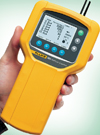
The new Fluke 983 Particle Counter is an option for HVAC and IAQ professionals. From filter testing to IAQ investigations, the Fluke 983 is the portable solution for determining airborne particle concentrations. Use the Fluke 983 to immediately respond to occupant complaints, or as part of a comprehensive preventive maintenance program.
The Fluke 983 simultaneously measures and displays six channels of particle size distribution, temperature and humidity. This compact, lightweight, self-contained tool allows for one-hand operation. As the 983 does not require level holding, it can make accurate measurements in any position. The eight-hour rechargeable battery, together with a large 5000 sample record, allows for complete air quality surveys in one go. The 983 is an ideal tool for determining size distribution of airborne particles or tracking down a particle source.
Comtest is the sole authorised distributor of Fluke Industrial and Electrical, FPM and HART Scientific test tools in southern Africa. Fluke is a world leader in the manufacture, distribution and service of electrical and industrial test tools solutions.
For more information contact Val Verwer, Comtest Distribution, +27 (0) 11 254 2200, [email protected]
| Tel: | +27 10 595 1824 |
| Email: | [email protected] |
| www: | www.comtest.co.za |
| Articles: | More information and articles about Comtest |






© Technews Publishing (Pty) Ltd | All Rights Reserved
 printer friendly version