



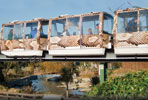
The Zoofari monorail is a popular visitor attraction at one of the UK’s most well known zoos. On busy days it carries in excess of 2000 passengers, but in legal terms at least, it is not a pleasure ride. Because it has four automated unmanned trains and two stations, it is officially classified as a transportation system and is subject to the tough operational and safety requirements laid down by the Office of the Rail Regulator. Safety and control equipment from Omron is proving equal to the challenge of meeting these requirements dependably and cost effectively.
The challenge
Originally put into service in 1991, the monorail had for most of its life given excellent service, but it was becoming dated and difficult to maintain. In addition, there was an ever increasing need to upgrade the safety systems to a more modern design.
To determine the best way to remedy these problems and provide the monorail with an assured future the zoo management team commissioned a detailed report that recommended the existing safety and control systems be replaced. This would allow the latest equipment to be used throughout, giving compliance with today’s increasingly strict safety requirements.
Project implementation
The contract for the control and safety systems was won by a local system integrator that had put forward an offer based on Omron safety and control equipment including EtherNet/IP technology – wireless, wired and fibre-optic-based – to link the various system components.
The integrator commented: “We chose Omron for several reasons. One was that much of the original equipment was from Omron and it had given excellent service in this demanding application for more than 17 years. No mean feat when you consider that the system operates 365 days a year.”
The scale of the new safety and control installation is large. Each of the four trains has two independent PLCs that, among other functions, monitor and control the variable speed drives that provide the motive power. Each train also has a Handy NSH handheld HMI terminal with a colour touch screen that provides dead-man and emergency stop functions. This terminal is used for driver operation and control during maintenance and it also provides access to the extensive on-board diagnostic systems.
The trains are made up of four carriages with remote I/O modules connected to the on-board PLC and safety network controllers provided in each carriage. When the system is running, the trains PLCs and safety controllers communicate with a master PLC in the central control room via an EtherNet/IP wireless connection that uses Omron smart roaming technology. This provides multiple access points and handles multiple clients, as well as supporting rapid switching as the trains move in and out of range of the individual access points.
The master PLC, in turn, communicates with a scada in the control room at Station One. The scada installation incorporates a large widescreen display that provides the monorail supervisor with comprehensive real-time information about the precise locations and performance of the trains and about the status of the safety systems.
In order to meet the highest possible standards for safety, the installation also makes extensive use of Omron safety network controllers – seven NE1A safety controllers are used. These are fitted to each train where one of the functions is to provide interlocking of the carriage doors on the basis of motion and position to ensure that operation coincides with the opening of the trackside passenger gates at each station.
The safety network controllers conform to Category 4 in line with EN954-1, and SIL3 in line with IEC61508. In this application, however, they are used to meet EN954-1 Category 3 requirements on the platforms, where they work in conjunction with the proximity safety laser scanners on each station platform to detect the presence of passengers who may be near to closing exit doors.
Additional safety network controllers are used in a fixed installation that covers each station, and to provide safe interlocking of two track switch points in the maintenance areas. These controllers are linked by a fibre-optic Ethernet/IP network that uses ring topology with dual redundancy. To transfer data between safety network controllers, an Omron Safe Devicenet-to-Ethernet controller is employed to ensure high transmission integrity over nearly a kilometre.
One of the key requirements for the new installation was that it should employ the most effective measures possible to ensure that a collision between trains cannot happen. To achieve this, three independent systems were deployed and the overall system has been evaluated and approved by the Office of the Rail Regulator.
After refurbishment, the Zoofari monorail was officially re-opened by millionaire rail enthusiast Pete Waterman. It is proving as popular as ever with visitors to the zoo and, thanks at least in part to its new safety and control systems, it is envisaged to provide many years of safe and reliable service.
For more information contact Terry McIntosh, Omron Electronics, 086 066 7661, [email protected], www.industrial.omron.co.za
| Tel: | +27 11 579 2600 |
| Email: | [email protected] |
| www: | www.industrial.omron.co.za |
| Articles: | More information and articles about Omron Electronics |






© Technews Publishing (Pty) Ltd | All Rights Reserved
 printer friendly version