




Emerson Process Management’s four-electrode conductivity sensors are helping German brewer Schneider Weisse to optimise the CIP process at its brewery in Bavaria. Replacing ageing sensors with the accurate Rosemount Analytical 410VP has enabled the brewer to optimise its process by reducing the total caustic detergent, water and energy used, as well as saving previously wasted finished product. In addition, Schneider Weisse is now able to bring production back online quicker, enabling a potential increase in overall production.
“We continually strive to improve our production processes in order to maximise output and efficiency,” said Norbert Appoltshauser, automation manager, Schneider Weisse. “We do this by taking advantage of the latest innovative technologies. For instance, we identified an opportunity to measure the interface between the CIP rinse water and end product more accurately and have been delighted with the results. At Schneider Weisse we are continuously reviewing opportunities for process optimisation in order to remain competitive.”
CIP applications in the food and beverage industry present a number of challenges for conductivity sensors, devices must be easy to clean and able to withstand rapid changes in temperature. Conductivity sensors used for this type of measurement are often encased in plastic and in general do not respond well to rapid temperature changes. They also protrude into the pipe creating an intrusion, which can disrupt flow in smaller lines. These factors all add up to reduce the dependability of the conductivity measurement. As brewers have to ensure the effectiveness of the CIP process, while minimising product losses, the ability to optimise the process by introducing a more accurate instrument for the measurement of conductivity is attractive.
Working in co-operation with GEA Brewery Systems, three existing electrode conductivity sensors installed within pipes supplying the fermentation and storage tanks were replaced with Emerson’s Rosemount Analytical 410VP sensors. The existing sensors were ageing and unreliable, causing false switching during the different phases of the CIP process. Replacement parts were also not available.
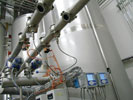
The sensors determine electrolytic conductivity which allows monitoring of the concentration of the clean-in-place (CIP) solution, and the interface between rinse water and end product. The CIP system is used to clean the process piping 12 times a day with each process including three water flushes of three minutes duration. The CIP process uses a caustic solution to wash through and ensure product integrity. The wash cycle includes a pre-flushing stage, followed by a caustic solution, an intermediate flushing, an acid solution, and then a final flush prior to restarting of production.
During an initial four week trial period, Schneider Weisse identified that the Rosemount 410VP sensor was operating effectively. The accuracy of the conductivity and temperature measurements are critical to optimising the process. Using the Rosemount sensor to identify the exact point at which the different phases start and stop, and when the interface between the CIP rinse water is replaced by in-specification beer, it has been possible to reduce the duration of each flush from three minutes to one minute. This has reduced the total flush time by 72 minutes a day.
As well as delivering clear environmental benefits, using less wash water saves Schneider Weisse around €8000 a year. Approximately 3000 kW/h of electrical energy is also saved. With the faster detection of the different phases, Schneider Weisse sees the potential for further optimisation and eventually to increase overall beer production.
Anton Ladenburger, sales manager, GEA brewery systems says, “The Rosemount device offers improved levels of accuracy and reliability over traditional technology. Also, the Varivent connection allows the sensor to sit flat within the pipes, avoiding potential crevices and it can be easily fitted to the bottom of the pipe which ensures it is always wet.”
The 410VP sensor’s four-electrode design provides accurate linearity and responds well to rapid temperature changes. The sensor has a flat sensing face consisting of four circular electrodes arranged in a row. The analyser injects an alternating current through the outer electrodes and measures the voltage across the inner electrodes. The conductance of the electrolyte solution between the voltage electrodes is readily calculated from the measured current and voltage. Because the voltage measuring circuit draws almost no current, errors caused by series capacitance and cable resistance, which are significant in two-electrode measurements at high conductivity, are virtually eliminated.
The sensors are located in different areas of the plant where there is a mixture of 230 VAC and 24 VDC supply. This resulted in Schneider Weisse having to use two different sensors in the past. By offering the capability to work using either 230 VAC or 24 VDC, the Rosemount 410VP could be applied in both areas of the plant, reducing inventory and training requirements.
“We are extremely confident of the new measurement system,” explained Appoltshauser. “The improved accuracy of the conductivity measurements has enabled us to identify the exact point when the interface has passed through the process, allowing us to return to full production in a shorter time span. False switching has been eliminated and the different CIP phases are detected within just two seconds – this is very fast.”
Existing connections within the pipes enabled the rapid installation of the factory calibrated 410VP sensors. Rosemount Analytical Model 1056 intelligent analysers incorporating a simple to use menu navigation screen ensured that the sensors were easily set up.
“The 1056 analysers are simple to work with and because the sensors are pre-calibrated the functional commissioning was straightforward, intuitive and self explanatory. We are delighted with the new system, it is very different from anything we have been used to,” concluded Appoltshauser.
For more information contact Luculle Stols, Alpret Control Specialists, +27 (0)11 249 6700, [email protected], www.alpret.co.za
| Tel: | +27 11 249 6700 |
| Email: | [email protected] |
| www: | www.acs-autocon.com |
| Articles: | More information and articles about Automation Control Solutions |






© Technews Publishing (Pty) Ltd | All Rights Reserved
 printer friendly version