



Andrew Ashton interviews Conrad Muller of Beckhoff Automation.
Technews: Can one really classify the Beckhoff system as a distributed control system? Many people would categorise this system as a programmable automation controller rather than a DCS.
Conrad Muller: Beckhoff's control systems incorporate features aimed at distributed control, decentralised pre-processing and I/O sharing. There is also support for redundancy and configurable failsafe conditions.
Using our TwinCAT software tool users can program all networked devices via the primary control network. Networking and data exchange between devices are also configured within the same software. Users can access all programs and data on all controllers from anywhere on the network. The remote programmability and diagnostics even extends to devices on Profibus sub-networks connected to the primary Ethernet network. Full backup capabilities are supported over the network to facilitate storing essential files from all controllers to a network server. When a controller is replaced, the restore process ensures that all systems are configured identically to the previous controller. The new controller starts up automatically and all programs run.
The combination of these capabilities justifies our categorising the system as a DCS.
Technews: How does the system differ from the current offerings of traditional DCS suppliers?
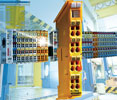
Conrad Muller: Beckhoff has an extensive range of I/O terminals for distributed applications. From the standard analog and digital signals, to power measurement, loadcell cards, thermo-elements, PWM signals and more. A recent innovation is the TwinSAFE terminal range which integrates safety switching within distributed I/O rather than through external safety devices.
Technews: In many DCS architectures the application logic is partitioned to run on multiple controllers to allow a graceful degradation of system operation when things go wrong. How does Beckhoff address this?
Conrad Muller: Our systems can operate in redundant mode, load share mode, I/O share mode and fallback mode. Very large applications, for which the computing power of even a 3 GHz system is insufficient, can distribute the control tasks between a number of PC controllers and exchange large amounts of data quasi-synchronously with the cycles (even at sub-millisecond speeds), using the realtime capable network variables. This effectively means that distributed control can take place on several levels, but still remain synchronised as if it was one single controller.
Local systems can be configured to automatically take over control from one another should a master controller be taken out of operation.
Technews: When you have closed loop PID control, where is the loop solution logic executed?
Conrad Muller: Loop solution logic is solved at the lowest level controllers in the system, closest to the I/O points. This ensures fast reaction times for precise control. However, loop parameters may be shared with higher level controllers to allow for self-tuning and compensation algorithms to be implemented from the top down.
Technews: In the upper tiers of your system topology you rely on PCs running Microsoft desktop operating systems. How do you achieve realtime deterministic control with this combination of hardware and operating systems?
Conrad Muller: With a background of more than 20 years of experience with PC software solutions, Beckhoff has developed a proven and independent realtime extension for Windows NT and has harmonised it with Microsoft as a system partner. This means that there is an exact time basis which executes programs with maximum priority, and independently of other processor tasks.
Technews: Your core communication technology is Ethernet-based. Traditionalists have shied away from Ethernet because of concerns about its non-deterministic characteristics. Can users safely rely on this technology for safety-critical applications?
Conrad Muller: Yes, the EtherCAT (Ethernet for control automation technology) solution from Beckhoff is built to IEC specification (IEC/PAS 62407) and features high precision device synchronisation, a cable redundancy option, and a functional safety protocol (SIL3). EtherCAT sets new standards where conventional fieldbus systems reach their limits with regards to speed, deterministic character and robustness.
The use of network variables also allows all controllers to decide which information they wish to share with other controllers on cyclic or event driven triggers. This works on a publication and subscription philosophy.
Technews: The system has a range of HMI devices for local visualisation of process device states. How do you implement higher level process and loop (controller template) visualisation?
Conrad Muller: Beckhoff controllers have many local visualisation options, however, these are purely HMI and are not intended to compete with scada systems. For higher level overviews we utilise scada solutions from manufacturers such as Adroit, Citect and Wonderware.
| Tel: | +27 11 795 2898 |
| Email: | [email protected] |
| www: | www.beckhoff.com |
| Articles: | More information and articles about Beckhoff Automation |






© Technews Publishing (Pty) Ltd | All Rights Reserved
 printer friendly version