



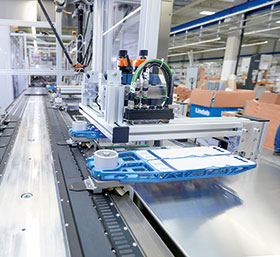
Koch Pac-Systeme of Pfalzgrafenweiler, Germany, is a specialist in customer-specific blister packaging machines and systems. With extensive line design experience, the company’s engineers are able to implement each customer’s requirements in a flexible and effective manner. The packaging experts have again proven their expertise with a complex new packaging line for toothbrushes. At its centre, the eXtended Transport System (XTS) from Beckhoff replaces expensive mechanical systems with software functionalities that make the line more compact and more flexible for faster product changeovers.
Koch achieves a seamless, fully integrated and efficiently executed packaging process with customised equipment ranging from blister machines to product infeed and blister grouping modules to end-of-line packers. Customers receive solutions that meet their specific requirements and are perfectly matched to the size and shape of the respective products. A line for packaging toothbrushes that is fully controlled via Beckhoff TwinCAT automation software and processes up to 320 toothbrushes or 240 blisters per minute is an especially innovative example of the expertise demonstrated by the Koch Packaging Lines.
Project manager Gert Müller explains the functional scope and complexity of the line with a total length of 28 m: “In a first step, the line will be operated with two different formats for which the customer uses two different foil thicknesses. What makes the line so attractive is its superior flexibility, because an automatic foil width adjustment feature allows the customer to use different foil sizes to produce additional blister sizes in the future. After the blisters have been formed, the toothbrushes are supplied via a high-speed pick-and-place (HSPP) system that uses a camera to control their position. Next, another HSPP places the cardboard backing and uses ultrasonic spot sealing to keep it in place for the actual sealing process. A laser system applies a code to the back of the card that is verified downstream via a camera system. After the blisters have been separated in a punch station, they are transferred via a two-axis portal to the central labelling and grouping unit before another HSPP system groups and transfers them to a cartoning machine. The packaged blister packs are then transferred to the customer’s downstream packaging steps.”
XTS makes labelling and grouping unit more efficient
The labelling and grouping unit is a prime example of Koch’s expertise in developing highly innovative solutions. Müller explains: “We installed an XTS circuit that is 11 m long and equipped with 24 movers with special carriers for single and twin blisters, so when the product changes, only the carriers have to be switched. Since this is a very quick and easy process, setup changeover times are reduced considerably.”
Wolfgang Braun, global account manager at Koch, adds: “The end customer wants to produce different formats with our packaging line, and therefore very fast and flexible format changeovers are required.”
Jürgen Welker, director of automation and technology at Koch, lists two more factors that convinced the company to use XTS technology: “The high throughput rate and the ability to adapt to varying labelling speeds at the labelling station are great benefits of XTS. In addition, the system can be very easily adapted to the various blister formats, since XTS enables flexibility for a wide range of products to be packaged. It is also highly reliable, which is critical, because the end customer requires 24/7 operation with 95 percent system availability.” He also mentions machine design benefits: “Without the compact XTS, the labelling and grouping unit – and therefore the entire line – would have been 2 m longer and much more complex due to the additional mechanical components that would have been required. It also would have been much less accessible for the operators when format changes need to be executed.”
Braun considers the high level of flexibility and the ability to convert the line very quickly to be key benefits from the end customer’s perspective: “The original plan called for a conventional solution based on a so-called bucket chain. While it was designed to be width adjustable, it quickly encountered limitations because of the constantly expanding product spectrum. One – much more expensive – solution would have been to add a second bucket chain or even a split line with two separate packaging machines. As a highly flexible and software-based transport system, XTS turned out to be a better and more cost-effective solution.”
XTS ensures high flexibility with software functionality
Müller explains the flexible motion sequences within the labelling and grouping unit: “Depending on the format, the two-axis system transfers eight or twelve blister packs to four or six movers. These movers then travel to the labelling station. Another HSPP system places the blister packs in multiple layers into the cartoning machine’s product chain in accordance with the outer packaging type. The system stands still for loading and unloading while the labelling process runs continuously. With XTS, all these different movements can be programmed very easily.”
The software functionality of XTS also supports the quick product changeover requirement, because each blister format has its own recipe, including the precise processing positions that can be easily selected with a mouse click. In addition, the machine module has two labelling devices. Depending on the format, the software tells the XTS to which of these it needs to travel.
Powerful PC and EtherCAT-based control technology
A single control cabinet PC from Beckhoff is all that is needed to control the 24 XTS movers dynamically and with perfect precision. The C6930 PC is powerful enough to also control two HSPP systems, handling the systems as additional TwinCAT NC tasks. Both HSPP systems are equipped with servo drive technology from Beckhoff. Welker concludes: “TwinCAT provides all necessary functionalities. For example, we use the complete TwinCAT XTS Extension with functions like collision avoidance and cam plate. The fact that each mover is mapped as a separate servo axis in TwinCAT is hugely advantageous for us. That way, we can monitor and adjust each mover separately, which is convenient and also safe due to integrated higher-level functions like collision avoidance. And to top it all off, there is EtherCAT’s exceptional performance. The controller makes full use of EtherCAT’s extreme speed to manage the communication with the many servo drives in the system.”
For more information contact Kenneth McPherson, Beckhoff Automation, +27 (0)11 795 2898, kennethm@beckhoff.com, www.beckhoff.co.za
| Tel: | +27 11 795 2898 |
| Email: | info@beckhoff.co.za |
| www: | www.beckhoff.com |
| Articles: | More information and articles about Beckhoff Automation |






© Technews Publishing (Pty) Ltd | All Rights Reserved
 printer friendly version