



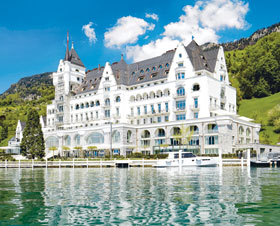
Housed in a 110-year-old building complex, situated directly on the shore of Lake Lucerne in Switzerland, the Park Hotel Vitznau combines an historic setting with the equipment and range of services offered by a modern 5-star luxury hotel. The advanced building automation from Beckhoff, with over 100 embedded PCs networked by BACnet, is largely responsible for the ability to configure the complex building operation with maximum comfort for the hotel and event guests.
Following three and a half years of extensive renovation work, during which the technical building infrastructure was also brought up to the latest standards, the hotel opened its doors again in March 2013. The complexity of the property (which is subdivided into four ‘houses’) and the building automation, is shown by the wide range of services alone: 47 suites in six different topical galleries, which include the music, theatre and finance galleries, are supplemented among other things by two restaurants, six wine cellars and a large spa area, as well as numerous event rooms. Even a doctor’s practice is integrated into the facility.
Versatile functions of room and building automation
PC-based control from Beckhoff is the basis for all functions in the secondary area of the technical building infrastructure implemented by the Swiss system integrator, Panthek. Connected to the primary systems for heating and ventilation as well as to the higher-level building management system, 108 CX5010 embedded PCs with Intel Atom processors operating as BACnet/IP servers and clients provide the necessary data communication and control for the automation tasks, which include, but are not limited to the individual suites, the two hotel restaurants and the spa/medical area as well as in the floor distributors and the two weather stations.
Within the scope of room automation, the lighting, blinds, air conditioning and suite controllers can be adapted individually. In addition, there is the switching on and off of under-floor and mirror heating, especially in the bathrooms. Primarily, four lighting effects – i.e. the lighting scenarios dark, medium ‘bright and off – can be selected in the rooms. Additional special and colour effects are used, for example, in the bar or in the relaxation room of the spa area. The lighting is controlled using the DALI standard via the KL6811 bus terminal which is connected to the PC-based control system.
Higher-level reactions are possible via the hotel reservation system. Thus, 24 hours before the guest arrives, the room is raised from the energy-free mode to the comfort mode, for example, a pleasant temperature is set and the valves for the water supply are opened. The booking system, which is linked to the control technology via the TwinCAT Database Server and TwinCAT FIAS Server running on a C6920 Control cabinet industrial PC, also enables the pooling of several suites. For this, connecting doors are automatically unlocked and telephone, doorbell and master switch are forwarded accordingly.
Similarly, the information from the two weather stations is evaluated centrally. The information is used, among other things, to retract the sun awnings in case of strong wind gusts and to close the windows in case of rain. Nevertheless, sufficient leeway remains for individuality: even if the horizontal awnings are retracted for safety reasons, the additional vertical blinds can still be operated via the room automation. The automatic shading of the individual fa&231;ade sides is an additional function of the weather stations equipped with Embedded PCs.
Openness and flexibility thanks to modular I/O system
Over 100 embedded PCs and around 90 BK9100 Ethernet TCP/IP Bus Couplers acquire approximately 10 000 I/O data points in the Park Hotel Vitznau. A total of more than 1600 bus terminals are connected to them. These include numerous:
• KL1408 or KL2408 8-channel digital input and output terminals (24 V DC).
• KL2761 1-channel universal dimmer terminals (230 V AC, 600 VA).
• KL3208 8-channel HD analogue input terminals for resistance sensors.
• KL3464 or KL4408 8-channel analogue input and output terminals.
• KL6041 serial RS-485 interfaces for Modbus room sensors.
• KL6301 EIB/KNX bus terminals for control elements.
• KL6811 DALI/DSI master and power supply terminals.
All of this information comes together in the respective floor distributors and is processed there by the embedded PCs. Thus, a CX5010 controls all functions in one corridor, such as the pasteurisation function for thermal water disinfection, as well as the distribution of the hot water supplied by a heat pump, which provides air conditioning for the rooms via the ceiling, the base and an additional fan convector.
The openness and flexibility of PC-based control is also shown by the simple integration of several subsystems into the BACnet-networked control technology: for example, it was possible to integrate all control buttons simply using KNX. The room sensors specified by the hotel for temperature and humidity, as well as for the adjustment of the ventilation, are connected via Modbus RTU. Conversely, the audio/video systems employed communicate with their environment via Modbus TCP/IP. It was possible to implement all of this on the software side as well without a great deal of expense using the TwinCAT automation suite and the appropriate supplements. The same applies to the hotel reservation system, which is an integral component of the holistic building automation via TwinCAT FIAS server and TwinCAT database server.
Simple control of a complex system with TwinCAT BACnet/IP
The embedded PCs with TwinCAT BACnet/IP fulfil all requirements of the BACnet standard ISO 16484-5:2010 and thus offer a scalable control platform for system and vendor-spanning automation of buildings. Numerous additional functions have been implemented that extend beyond the requirements for BACnet building controllers. With the integration of the BACnet protocol in the TwinCAT system manager it is possible to configure the I/O bus terminals and the BACnet devices with a single tool. The auto mapping function additionally reduces programming efforts and shortens the development time.
Extensive additional functions supplement the required interoperability function blocks of the Beckhoff BACnet Building Control (BBC) devices. Timer switch schedules and trend objects among other things can thus be created and configured even later on by the dynamic generation of BACnet objects. Distributed clocks can be synchronised with the aid of the supported client and master functions. BBMD (BACnet Broadcast Management Device) services have been integrated into TwinCAT BACnet/IP for use in widely distributed networks. The integration of spatially remote and third-party devices is particularly convenient within the framework of the client functionality.
It was possible to implement this functionality with great efficiency, particularly since the building management system and the primary system from Sauter also use the BACnet standard for their communication. According to Andreas Hutter, project manager from Panthek, the connection of the automation technology was simple and the connectivity via BACnet/IP was much clearer and self-descriptive than a conventional Modbus TCP/IP coupling. The fact that each individual CX5010 is already inherently BACnet capable also simplifies matters.
Comfortable BACnet solution with auto-mapping
The simplification of the project implementation is due in no small part to the auto-mapping function: in a BACnet environment data are always represented via objects and their properties. This applies equally to memory states (variables) and to hardware input/outputs and PLC variables. In the end this means that all hardware terminals in the I/O system as well as all PLC states of the PLC runtime, which should be visible in BACnet, must be mapped by means of BACnet objects. With TwinCAT BACnet/IP this is done conveniently by the automatic mapping, which considerably reduces the work required for linking the BACnet objects. Hutter explains: “We wrote reusable programs for this complex project. Thus, the approximately 60 suites are all controlled by the same program and we therefore benefit a great deal from the fact that BACnet can be configured directly in the respective program and not just centrally in the TwinCAT System Manager. In the System Manager only the individual device is created; everything else takes place via the individual control program.”
Daniel Rothenberger, building automation sales manager at Beckhoff Switzerland, mentions a further consideration: “It is particularly important that TwinCAT BACnet/IP facilitates the engineering with numerous functions and templates, since BACnet requires a somewhat changed philosophy or perception. Whereas real variables are used in traditional controller programming, there are additional properties in a BACnet object with its ‘Present Value’, such as min/max values. The system integrator first has to get used to this and TwinCAT BACnet/IP offers optimum support here.”
For more information contact Kenneth McPherson, Beckhoff Automation, +27 (0)11 795 2898, [email protected], www.beckhoff.co.za
| Tel: | +27 11 795 2898 |
| Email: | [email protected] |
| www: | www.beckhoff.com |
| Articles: | More information and articles about Beckhoff Automation |






© Technews Publishing (Pty) Ltd | All Rights Reserved
 printer friendly version