




Hydraulic fracturing, fracking, is the process of creating fractures in underground rock formations to allow natural gas and oil to flow more freely into wellbores. It is a proven mechanical technique that has been employed in the oil and gas industry since 1947 and in recent years advanced technology has led to a rapid rise in its use for the production of natural gas from dense shale rock.
The mechanics of fracking
Shale formations have fine grains with few interconnected pores, resulting in low porosity and permeability. In order for natural gas or oil to be produced economically, individual molecules trapped in pores smaller than the width of a hair must find their way to the well. Hydraulic fracturing creates a network of small fractures in the formation rock, allowing molecules a long distance away to migrate to the fracture and travel quickly to the well.
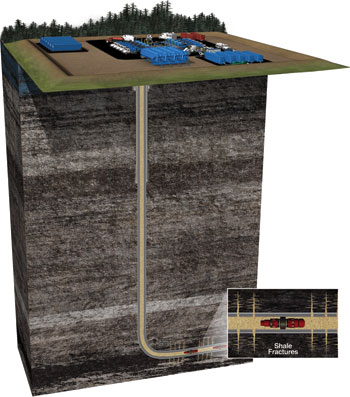
The production casing of a newly drilled well is lined with steel and cement capable of withstanding high pressures. A tool called a perforating gun is lowered through this and punches small holes in the well casing, cement and rock. Water under high pressure is then pumped down the well and through the perforations at a rate which must be fast enough to maintain the pressure needed to propagate the fractures. (This is known as the propagation pressure.) This initial volume of fluid is termed the pad and typically comprises 20% of the total fluid volume. The actual fracturing generally takes place over several kilometres and below groundwater levels.
Proppant keeps the fracture open
As the fractures continue to propagate, sand is added to the fluid to wedge the fractures open. This is known as the proppant. When pumping is stopped and the excess pressure is removed, the fracture attempts to close. The proppant keeps the fracture open, allowing fluids to flow more readily. The fracturing fluid is typically 99% water and sand, with the remainder made up of chemical additives which help reduce friction and prevent bacterial growth and scale from blocking the flow of gas or oil.
The well is fractured in stages and plugged between each stage to maintain the highest water pressure possible and get maximum fracturing in the rock. After all the stages in the well are fractured the plugs are drilled out, the water pressure is reduced and fluids are carried up the wellbore for disposal or treatment and re-use. The sand is left to prop open the fractures and allow gas and oil to flow up through the well to begin production. The result is a highly sophisticated process that optimises the network of fractures and keeps them safely contained within the deep shale formation.
Fracture treatments can usually be completed within a day and are normally only performed once during the life of a well. Once a well is drilled and fractured it is ready for production. Everything is dismantled except for the well-head and connecting gas lines running to the distribution network. A natural gas well can produce for up to four decades and is monitored continuously to ensure well integrity.
Equipment
The process of hydraulic fracturing is very equipment intensive but only for a short period of time. When hydraulic fracturing is completed at one site, equipment is moved to the next, so it needs to be mobile. Various surface facilities and mobile equipment including fracture fluid storage tanks, sand storage units, chemical trucks, blending equipment and pumping equipment, surround the wellhead. A combination unit which has the fracturing equipment fitted on a truck can be used for multiple stage fracturing, where one fracturing crew performs several fractures in a single day. Compared to conventional fracturing setups, the combo unit provides significant savings through increased efficiency of equipment utilisation and related services. The unit leaves a small environmental footprint and no fluid waste.
The hydraulic fracturing process is monitored from a single truck called the data monitoring van. This tracks and records the rate and pressure at which the fracturing fluid is pumped down the wellbore, the rates of the necessary additives present in the fracturing fluid and proppant concentration.
Pressure transmitters are obviously a critical part of the system. The fracturing pressure must be greater than the stress that geological forces apply to the reservoir rock, the tectonic stress, but within the pressure rating of the well and fracturing equipment. Fracturing equipment operates over a range of pressures and injection rates, and can reach up to 100 MPa and 265 litres per second. The equipment utilises the latest in electronics and motor and pump technology to ensure that it is reliable and effective in placing fractures as designed.
A wide variety of pumps are used in the fracturing stage. Progressive cavity pumps are used to mix solid proppant with water. Metering pumps, especially diaphragm or piston types, are used for adding chemicals to the hydraulic fluid. Fracking pumps are large engineered reciprocating pumps, typically powerful triplex, or quintiplex pumps, that can move hydraulic fluid at very high pressures. Because of the high pressure requirements, many pumps are connected through a manifold with gear and vane pumps used for lubrication and fuel transfer.
Pumps used in these operations experience harsh conditions, and failure of any one component may disrupt the drilling, completion and production process. As a result, the key consideration for pumps used in shale gas applications is reliability.
| Tel: | +27 11 543 5800 |
| Email: | [email protected] |
| www: | www.technews.co.za |
| Articles: | More information and articles about Technews Publishing (SA Instrumentation & Control) |






© Technews Publishing (Pty) Ltd | All Rights Reserved
 printer friendly version