


Electrical Power & Protection


Increased safety in mine charging stations

November 2017 Electrical Power & Protection

Increasingly, mines are using battery-powered electric vehicles underground as they help eliminate the problem of air pollution from diesel exhaust emissions. However, there is also an inherent risk in having large multi-battery charging bays underground. The charging process generates hydrogen, which escapes from the banks of batteries on charge to form a potentially explosive mix. This could result in a potentially catastrophic hydrogen gas explosion – constituting a very real health and safety risk in the process.

In addition, in a ‘fiery’ mine such as a colliery for example, hydrogen combustion may potentially trigger a more serious secondary coal dust explosion.

RTS Africa Engineering, based in Tshwane, specialises in innovative technologies that provide solutions to industrial challenges. Among other things, the company has been involved in supplying hydrogen production and analysis equipment for many years.

“Importantly, we also offer hydrogen detection instruments, the Hy-Alerta 500 and the Hy-Alerta 600B/610B from our international California-based principal, H2Scan, for use in many industrial applications, including the mining sector,” explains managing director Ian Fraser. “For example, these products serve as a valuable safety aid in hydrogen gas detection within battery charging stations in underground mines.”

Hydrogen detection and monitoring

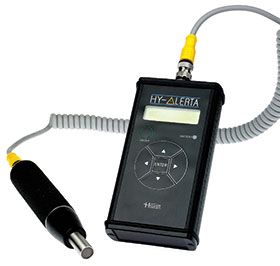
The Hy-Alerta 500 instrument is a versatile handheld detection device, able to detect a wide range of hydrogen gas concentrations without the need for any peripheral equipment. The hydrogen sensor probe has a unique visual LED array that will effectively help navigate to the source of a hydrogen leak where hydrogen gas is produced, used, transported or stored.

“With two sensing elements on the same semiconductor die, the Hy-Alerta 500 can detect hydrogen leaks as low as 15 ppm and will not saturate or be destroyed when detecting high concentrations of hydrogen up to 100%,” says Fraser.

The Hy-Alerta 600B/610B fixed area hydrogen monitors are better suited for area monitoring; and will provide hydrogen-specific leak detection and measurement for hydrogen concentrations as low as 4000 ppm. They can, furthermore, be scaled to any concentration up to 5% hydrogen by volume, a range representing 10% to 125% of hydrogen’s low flammability limit.

“This instrument can be connected to a flashing light or an alarm siren and, if need be, can communicate with a mine’s existing control system,” elaborates Fraser.

Both models have been designed for either ceiling or wall mount; and have RS-422 capability that extends the interface from the sensor to the controller to over a hundred metres.

“In addition, H2Scan’s hydrogen-specific sensor technology has no cross-sensitivity to other combustible gases, thus eliminating false alarms and increasing system reliability,” adds Fraser.

He points out that the company’s hydrogen analysers and leak detectors are based on patented, solid-state core hydrogen sensor technology exclusively licensed from the US Department of Energy, and are supported by 15 years of research and development, and field verification work. In terms of occupational health and safety certification, H2Scan’s instruments conform to the highest international standards.

For the past ten years, RTS Africa has been the agent – locally and pan-Africa – for H2Scan. Many Hy-Alerta instruments are currently being used to detect hydrogen leaks around power station generators.

“Ultimately, with the improved measurement capability provided by these solutions, industries such as mining and the petrochemical industry will be able to operate with the added peace of mind that the risk of hydrogen combustion has been eliminated,” concludes Fraser.

For more information contact RTS Africa Engineering, +27 (0)12 433 6335, www.rtsafrica.co.za


Share this article:
Share via emailShare via LinkedInPrint this page

Further reading:

SF6-free MV switchgear for Western Cape Fruit Processors
Schneider Electric South Africa Electrical Power & Protection
Schneider Electric and Technoserve Medium Voltage have installed the award-winning RM AirSeT SF6-free pure air MV switchgear at the Western Cape Fruit Processors facility in the Elgin Valley, Grabouw.

Read more...
Why expert O&M will secure South Africa’s energy future
Electrical Power & Protection
South Africa’s clean energy sector is entering a new phase. Attention has moved from installing new capacity to how consistently these assets perform. This shift places operations and maintenance at the centre of long-term energy reliability and financial returns.

Read more...
Why it pays to outsource boiler operations
Electrical Power & Protection
Associated Energy Services has improved energy efficiency by 35% at a large FMCG manufacturer’s site and followed up with a 21% improvement at a second.

Read more...
Cable entry plate for reliable protection under extreme conditions
Electrical Power & Protection
With the new KEL-DPU-OD cable entry plate, icotek presents an innovative solution for applications that are permanently exposed to strong UV radiation, weathering and temperature fluctuations.

Read more...
Future-ready electrical infrastructure for evolving mine needs
Electrical Power & Protection
The ability to design and scale electrical infrastructure for mines’ changing needs has become a critical competitive advantage for Trafo Power Solutions, allowing customers to avoid costly re-engineering as their mines evolve.

Read more...
Scalable, high-capacity double-stack busway system
Electrical Power & Protection
Vertiv has expanded its PowerBar Track busway family with the introduction of a compact, high-capacity double-stack design that enables higher power density while optimising valuable white space.

Read more...
How batteries can help SA avoid a grid crisis
WEG Africa Electrical Power & Protection
Last year, Spain and Portugal lost up to 60% of their electrical power in mere seconds. It’s crucial that SA avoids a similar grid crisis, and battery energy storage systems are vital for that transition.

Read more...
Real-time modelling for a resilient, bi-directional energy future
Schneider Electric South Africa Electrical Power & Protection
South Africa’s electrical grid is a classic example of a traditional power system, designed for one-way energy flow. This is where real-time grid modelling becomes critical.

Read more...
Why grid flexibility and reliability are more important than you think
Schneider Electric South Africa Electrical Power & Protection
In South Africa the grid was never designed to accommodate large-scale rooftop solar adoption, widespread distributed generation, or the rapid growth of electric vehicles and charging infrastructure. As the electricity landscape and grid evolve, flexibility and reliability should become part of this equation.

Read more...
Electric mobility can bring predictability to international energy disruptions
Electrical Power & Protection
South Africa is vulnerable to international market shifts. Today we are more dependent on energy than we were in the 1970s, and the events unfolding in the Middle East are a catalyst for greater energy independence.

Read more...


While every effort has been made to ensure the accuracy of the information contained herein, the publisher and its agents cannot be held responsible for any errors contained, or any loss incurred as a result. Articles published do not necessarily reflect the views of the publishers. The editor reserves the right to alter or cut copy. Articles submitted are deemed to have been cleared for publication. Advertisements and company contact details are published as provided by the advertiser. Technews Publishing (Pty) Ltd cannot be held responsible for the accuracy or veracity of supplied material.


© Technews Publishing (Pty) Ltd | All Rights Reserved

