



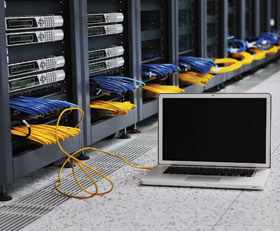
It is well documented that problems have occurred with hard disk drives when discharging gaseous fire extinguishing systems. Documented evidence exists for this problem, which can be attributed to all gas types.
Siemens has done extensive testing on gas systems and the hard drive issue, as have several other manufacturers and suppliers of fire protection equipment and hard disk ‘quality’ seems to be the root cause of the problem.
If one considers the length of time that gas fire extinguishing systems have been available and installed in data centres, you have to ask the question, why has the noise issue only surfaced in the last couple of years? What has actually changed?
Documented test results show that halocarbon agents such as Halon 1301 produce a higher sound level than inert gas blends. Inert gas blends took over from Halon 1301 some 20 years ago and design standards for these systems have remained basically unchanged for the last 10 years or so.
IT system technology, however, is changing on an almost daily basis and hard disk drives are no exception. There is a continued drive (pardon the pun) to increase data storage density and decrease data access times, while simultaneously reducing hardware costs. Many disk drives are now designed and produced in China with little or no vibration testing.
The collated international test data makes the following recommendations:
• Use enterprise-quality disks or solid-state disks where possible.
• Enclose hard disks in noise-proofed enclosures and keep the doors closed.
• Replicate critical data to offsite disk storage.
• Position siren and gas nozzle locations so that they do not radiate directly on the disk drives.
• Muzzle the sirens during fire-extinguisher tests.
• Increase the number and decrease the spacing of suppression nozzles to decrease their sound levels.
• Avoid very short discharge times (less than 60 seconds).
Overview of the problem
The noise level is proportional to the mass flow rate of the gas flowing through the discharge orifice. International consensus, backed up by testing, has shown that by increasing the number of nozzles or making discharge times longer, sound levels can be reduced.
When inert gasses were first introduced there was a concern that the discharge noise would be too high. Special sound reducing nozzles, incorporating a baffle, were introduced to combat the perceived problem. However, when testing was done, the discharge noise was 10 dB lower than a comparable Halon 1301 system and so the baffle nozzles were never commercialised.
There are several solutions that we have for reducing the noise level from the gas discharge. However, the gas discharge is not the root cause of the problem and one should be aware that disk faults have been caused just by the noise from the fire warning sirens or bells. A test conducted by an IT specialist and published on You-Tube shows disk errors occurring just by shouting at the disk drives!
The Alien Systems & Technologies solution
We recommend a two tier approach to mitigating the hard disk drive problem caused by sound:
1. IT specific:
• Use enterprise-quality disks or solid-state disks where possible.
• Enclose hard disks in noise-proofed enclosures, and keep the doors closed.
2. Fire system specific:
• Consider extending the discharge time to 2 minutes.
• Increase the number of discharge nozzles.
• Ensure nozzles do not point at server cabinets containing disk drives.
• Baffle the discharge nozzles.
Considering the fire specific points above, these are very easy to achieve with a Pyroshield system and an elegant solution is proposed as follows:
• The discharge time can be extended to 2 minutes by fitting a new orifice block. The effect of this is to reduce the mass flow rate to each nozzle by 50%.
• Increasing the number of discharge nozzles can be done with very minimal pipe layout changes. Doubling up on the number of nozzles would reduce the mass flow rate to each nozzle by 50%.
• A nozzle baffle is relatively easily implemented on the system. The baffle is simply fitted over the existing nozzles. Baffle holes will direct the discharge away from ceiling tiles and away from server cabinets.
However, IT specialists should understand that we are treating the symptom and not the cause, and the IT specific measures should also be implemented. As mechanical disk drives continue to become more and more sensitive due to performance and cost driven objectives, noise and vibration sensitivity will become more of an issue.
For more information contact Samantha Wright, Alien Systems & Technologies, +27 (0)11 949 1157, sam@astafrica.com, www.astafrica.com
| Tel: | +27 11 949 1157 |
| Email: | sales@astafrica.com |
| www: | www.astafrica.com |
| Articles: | More information and articles about Alien Systems & Technologies |






© Technews Publishing (Pty) Ltd | All Rights Reserved
 printer friendly version