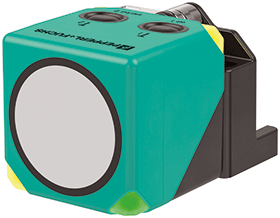
Pepperl+Fuchs is breaking new ground in ultrasonic sensor technology for CAN-based applications in mobile machines. For the first time, machine builders can now use E1-approved ultrasonic sensors with an integrated CAN interface in their mobile machines. This makes the costly and time-consuming integration of additional CAN interfaces a thing of the past.
The latest addition to the proven Pepperl+Fuchs L2 product family enables convenient configuration of all sensor functions via CAN on a PLC, via a PC (with a DTM) or via a USB-CAN converter. Precise interference target suppression and adjustable sound beam width allow optimal adaptation to the application. Protruding machine parts that could cause interference can simply be suppressed, while the sound beam can be adjusted without loss of measuring range. Due to the autonomous synchronisation, several ultrasonic sensors can be operated in close proximity to each other without any problems.
Once successfully parameterised, the new L2 CAN sensors demonstrate the full strength of the Pepperl+Fuchs industrial ultrasonic technology. Distances are reliably measured regardless of material, surface structure and colour, even under the most difficult environmental conditions. IP68 protection, high EMC resistance, and an extended temperature range from -40 to 85°C are testimony to the robustness of the sensors. To simplify the wiring of the devices on mobile machines, connections such as AMP and DEUTSCH are available in addition to variants with the round connectors commonly used in industrial automation.
Conductivity sensing as a cornerstone of South Africa’s water smart industry ifm - South Africa
Editor's Choice Sensors & Transducers
South Africa’s engineers operate at the intersection of resource constraint and industrial ambition. Few parameters illustrate this balancing act as clearly as water quality. Whether in municipal treatment works, food and beverage plants or mining operations, the ability to measure water quality accurately and continuously has become non-negotiable.
Read more...Futureproofing pharma, one pixel at a time Omron Electronics
Sensors & Transducers
In pharmaceutical manufacturing, there’s no room for error. Omron’s FH-AI and FHV7-AI vision systems introduce AI-powered inspection that adapts to real-world variability, something conventional rule-based vision systems cannot easily achieve.
Read more...Distance sensor for confined spaces ifm - South Africa
Sensors & Transducers
The O6D100 from ifm has been designed as a powerful all-rounder for typical applications in object detection, distance measurement and positioning.
Read more...Long-range laser distance measuring sensor Vepac Electronics
Sensors & Transducers
The MS-100A is a long-range laser distance measuring sensor with a range of 150 to 1000 mm. This sensor excels in applications requiring extended measurement capabilities, such as quality control and logistics.
Read more...Listening for damage to wind turbines
Sensors & Transducers
The Fraunhofer Institute for Integrated Circuits, working in concert with the Fraunhofer Institute for Wind Energy Systems, has developed a solution that can be used to identify cracks and breakage inside wind turbine blades remotely at an early stage.
Read more...Verification using Heartbeat Technology is a breeze Endress+Hauser South Africa
Sensors & Transducers
Heartbeat Technology reflects Endress+Hauser’s long-term commitment to enhancing measurement reliability and efficiency across a growing product portfolio.
Read more...Enhancing efficiency and reliability in the energy sector VEGA Controls SA
Sensors & Transducers
VEGA offers practical, reliable solutions through specialised measuring instruments and deep industry know-how, all tailored to help energy companies keep costs under control while meeting strict regulatory standards.
Read more...Condition monitoring for hydroelectric plants ifm - South Africa
Sensors & Transducers
The energy company Compagnia Valdostana delle Acque generates electricity in the region’s 32 hydroelectric power plants with a total capacity of over 900 MW. Vibration sensors from ifm monitor the maintenance requirements of the turbines and power generators at all times.
Read more...Precision sensing for water treatment ifm - South Africa
Sensors & Transducers
ifm electronic has introduced two next-generation sensors designed for South Africa’s bulk and wastewater sector, engineered to withstand harsh environments and deliver long-term reliability.
Read more...The next generation of inductive scanning encoder solutions ATI Systems
Editor's Choice Sensors & Transducers
With the launch of the ECI 1122 and EQI 1134 rotary encoders, positioning specialist, HEIDENHAIN has introduced a new benchmark in inductive scanning technology that raises the bar for motion control and precision automation.
While every effort has been made to ensure the accuracy of the information contained herein, the publisher and its agents cannot be held responsible for any errors contained, or any loss incurred as a result. Articles published do not necessarily reflect the views of the publishers. The editor reserves the right to alter or cut copy. Articles submitted are deemed to have been cleared for publication. Advertisements and company contact details are published as provided by the advertiser. Technews Publishing (Pty) Ltd cannot be held responsible for the accuracy or veracity of supplied material.










 printer friendly version