



If a competition between the most idyllic holiday destinations was held, the area around picturesque lake Wolfgangsee in Salzkammergut (near Salzburg, Austria) would likely win the top prize. And this is so not only because of the breathtaking views and excellent quality of the lake water, but also because of the municipality’s well-thought-out and very efficient wastewater disposal system.
Responsible for this is the Reinhalteverband (Pollution Control Association) Wolfgangsee-Ischl, which disposes of the effluent from the municipality of Bad Ischl and the Wolfgangsee municipalities of St Gilgen, Strobl and St Wolfgang. The special challenge in operating the facility are the many tourists, who cause extreme fluctuations in the flow of wastewater.
To express this with a concrete number: the average annual load on the system is about 43 000 population equivalent (PE) units. But around the lake there are many campsites, hotels and holiday homes whose effluent also ends up in the association’s treatment plant in Bad Ischl, mainly in the summer. “That’s why the load increases suddenly during the main holiday season, when the wastewater from about 80 000 PEs has to be collected and treated,” says Stefan Keil of Reinhalteverband Wolfgangsee-Ischl, describing the seasonal differences.
Already service-proven, but always being brought up to date
The sewage clarification plant in Bad Ischl has hardly changed structurally since it was first commissioned in 1988, but its mechanical and electrical equipment has been continuously optimised since then. The wastewater treatment plant has operated energy-autonomously for many years already. To achieve this feat, the digester gases are converted into electricity with the help of a combined heat and power plant. Thanks to the plant’s own efficient energy production, it now generates more electrical energy than it consumes. What is more, the plant provides space for 330 m2 of solar panels, which generate approximately 50 000 kWh of solar power that is sold as ‘green’ electricity.
The wastewater treatment system comprises a single-stage activated sludge unit with three processing lines, in addition to three primary sedimentation basins (400 m3 each), three recirculating aeration basins with bubble tube aeration (1700 m3 each) and three secondary clarifiers (1900 m3 each). “We don’t just have to take care of the sewage treatment plant itself, but also nearly a hundred pumping stations around the lake and the lake pressure pipes,” explains Keil. It is important to know that most of the wastewater from the member communities around Wolfgangsee is pumped through the lake via the lake pressure pipes.
Reliability is what counts
Whether sewage treatment plant, pumping station or lake pressure pipe – throughout all of the association’s facilities, one processing step meshes perfectly with the next. Each individual facility and component is fine-tuned to the downstream processes so that the overall system works optimally. To control the various process stages automatically, precise measurement data is required.
But accuracy is not everything, as Keil emphasises: “For us, it’s important that the sensors function reliably for a very long time and that, if they do fail, they can be replaced quickly.” Smooth operation is only possible with robust, long-lasting sensors that can withstand the adverse conditions in a wastewater pumping station.
Long-term collaboration
The first pressure transmitters from VEGA for measuring levels in sludge tanks were installed 33 years ago. At that time, they were more or less included within the scope of the tender. Many ultrasonic sensors from different manufacturers were also in use, and these generally worked very well. “But time and again there were malfunctions due to foam formation in the measuring vessel and condensation on the sensor,” says Keil, drawing on his own experiences.
For that reason, about 15 years ago the company began replacing numerous sensors based on pressure and ultrasonic technology with radar sensors. “Today we use VEGA sensors for many level and pressure monitoring applications”, adds Keil. The development of the compact radar level sensor VEGAPULS C two years ago made non-contact measurement of levels extremely attractive in terms of cost. “Since then we’ve equipped numerous level measuring points with it. Given the low price, there’s no need to even think about analog measurement anymore,” Keil enthuses.
Radar beats ultrasonic
The compact VEGAPULS series measures with a frequency of 80 GHz, which enables very good signal focusing. This makes it easier to separate measurement signals from interference signals − the measuring process itself thus becomes much easier and more precise than other measuring methods.
The beating heart of the new sensor series is a radar chip newly developed by VEGA and specially optimised for the requirements of level measurement. Thanks to the miniaturised design, very compact sensors are now possible. Moreover, they are so inexpensive that they can replace previously-used ultrasonic sensors in almost all applications. The sensors of VEGAPULS series C 11, C 21 and C 22 have a fixed cable connection and are designed in protection class IP66/IP68.
“The compact design is very practical. Ultrasonic instruments often require large controllers and settings via relays,” says Keil. Besides being unaffected by temperature fluctuations, vacuum or high pressures, radar sensors are, most importantly, non-sensitive to foam on the water surface and dirt build-up. These are all factors that can often cause other types of measuring devices, such as ultrasonic level transmitters, to malfunction. This predestines radar sensors for the wastewater sector.

Small sensor, big task
“In the past, we often measured the levels with hydrostatic pressure transmitters, but these often had to be serviced directly in the wastewater pumping stations,” recalls Keil. Today, VEGAPULS C 21 is used to control the pumps, some of which are as tall as a man.
“The job of the small sensor is enormously important at this measuring point – the instrument has to function perfectly. The sensor triggers the pumping process when the wastewater reaches a set level,” explains Keil. For that reason, many of the approximately 100 pumping stations are now equipped with the Ex-protected VEGAPULS C 21 units.
“Finding a suitable installation location is not always easy, especially in the narrow pumping stations where there is often a lot of other installed equipment. The narrow measuring beam and the software-based option of suppressing interference signals is very helpful here,” adds Keil, who heads the Pollution Control Association. “In the pumping stations we use the encapsulated, Ex-protected version of the instrument and connect it directly to the PLC. This saves space in the control cabinet, where there’s usually no room to spare.”
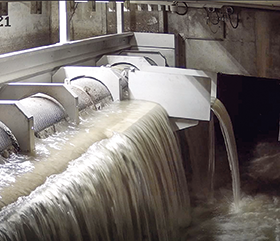
Due to the high accuracy of the radar probes, they were also installed on some of the spillways. In a stormwater discharge structure, there is a screening system for the retention of solid materials. VEGAPULS C 21 measures the height of the water overflow there. The calculated discharge volume in the measuring channel is extrapolated to the entire 8 metre length of the structure.
Another application of VEGAPULS C 21/22 is the detection of the water levels in the drainage channels of the three secondary clarifiers. Level comparison and control flaps in the inlets make it possible to charge the secondary clarifiers evenly.
The association also relies on VEGA for measurement in the depths of the lake. Most of the wastewater from the member communities around Wolfgangsee is pumped through the lake in polyethylene pressure pipes. These pipes are located at a depth of up to 120 m and have a total length of 21 km. Numerous VEGABAR 82 pressure transmitters monitor pressure in the lake’s pressure pipes, for example by giving an early warning of pipe blockage.
Outlook
Keil’s conclusion regarding VEGA sensors is positive in every respect: “Our own experience has shown thus far that plastic-encapsulated radar sensors can be used with no problem in wastewater applications. In Ex areas, the new encapsulated sensors have been very advantageous because they eliminate the need to use additional components, such as separators.” In most cases here, the measured value is transmitted directly to a freely programmable controller.
“Besides that,” he adds, “the sensors are comparatively inexpensive and adjusting them via the VEGA Tools app is really simple. Many of the measuring points in wastewater systems are extremely difficult to access. The connection via Bluetooth for setting up the instruments or calibrating them is therefore extremely practical.” This makes everyday life easier in the harsh environments of the industry. For that reason, Keil is certain that the latest sensors ordered will certainly not be the last.
| Tel: | +27 11 795 3249 |
| Email: | [email protected] |
| www: | www.vega.com/en/home_za |
| Articles: | More information and articles about VEGA Controls SA |






© Technews Publishing (Pty) Ltd | All Rights Reserved
 printer friendly version