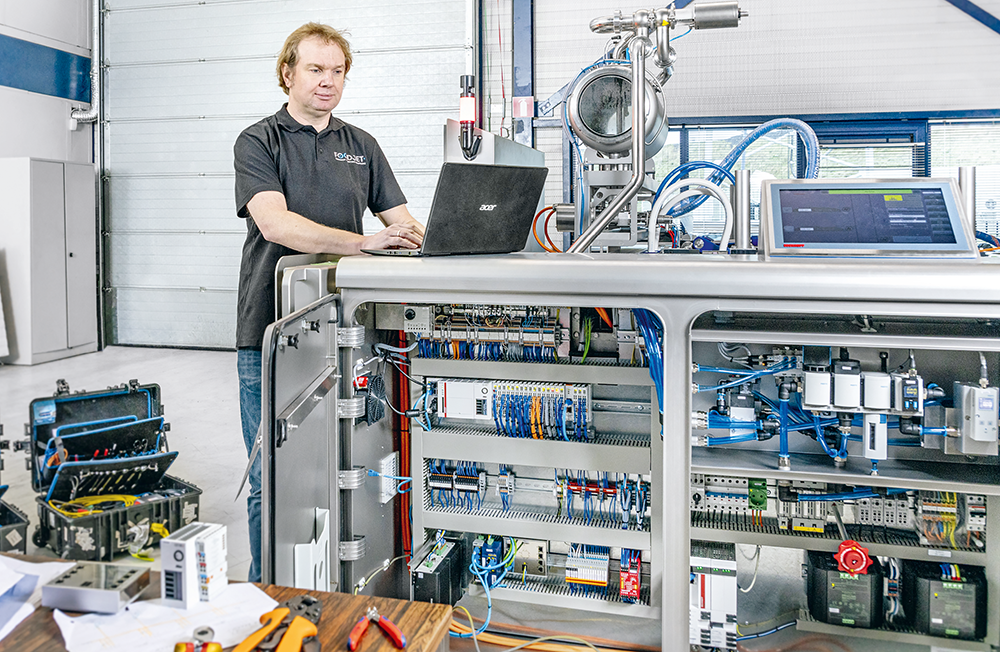
When you’re working with a continuous product flow, how do you apply tomato sauce to a pizza base or garlic paste to a pita? And how do you ice cookies with Christmas or Easter decorations in a flash? Dutch company Foodjet, based in Nijmegen, has developed the ideal solution to challenges such as these in the form of various systems for dispensing foodstuffs, one of which is the Moveable Depositor Large (MDL).
“The advantage of our MDL dosing unit is that the print pattern can be flexibly adapted to suit the dimensions and shape of each product,” explains Dirk Schindler, head of sales and marketing at Foodjet. The traditionally round pizza base, for example, is giving way to more abstract shapes as more and more suppliers lean toward hand-stretched dough. In fact, there are plenty of foodstuffs that are generally not round in shape, but these products should still always remain free of sauce around the edges. “This means that we have to precisely scan each dough base on the assembly line, so that our print head knows exactly where to deposit the sauce,” he clarifies. After all, it is vital to ensure that the throughput of the machine is not affected.
No more unpopular manual work on the assembly line
“The MDL also allows us to address a pain point for our customers,” Schindler emphasises. Despite the level of automation already involved, in many cases there are still employees standing along the assembly line, spreading the sauce around the dough bases with a spoon: “Not only is this stressful, but it is also imprecise and involves fluctuations in weight.” Foodjet can easily quantify this cost pool for interested buyers if needed.
When applying decorations, ROI (return on investment) calculations are more difficult to make: How much would decoration actually contribute to sales? Is this really a way to gain market share? “Probably, yes,” is the answer Schindler keeps hearing.

Foodjet has noticed that the market is picking up on this topic, not least because the first food manufacturers have already made the switch and no one wants to be left behind – nor should they be. With this in mind, it is now virtually essential for companies to be capable of decorating their own products flexibly in the form of seasonal toppings, for example, whether that’s stars at Christmas, bunnies at Easter, or hearts for Valentine’s Day. Using PC-based control from Beckhoff, Foodjet has been able to overcome this type of technical challenge.
To keep up with the high speed of a pizza production line, for example, the Foodjet machines have to determine dosing patterns at lightning speed. With a typical distance of 85 cm between the camera system and dispensing heads, this leaves only half a second to make the necessary calculations. “The pizza has to be captured by the camera within a single frame,” explains control system engineer, Ed de Leur. Only when the pizza base is completely scanned can you create a pattern, calculate the individual dots for the print head and synchronise everything with the moving conveyor belt.
Individual control of 48 print heads with µs accuracy
The second challenge is the need for a high level of repeatability. “We work with servo pumps to be able to push the required amount of sauce through the nozzles at exactly the right moment,” says De Leur. The precise control of these nozzles – within the millilitre range – has a crucial impact on the shape of the droplets, and therefore on how neatly the sauce is deposited. “With the Beckhoff control system integrated in the MDL, we can handle this with an accuracy of 20 µs,” he reports.
What’s more, the special arrangement of the print heads also has to be taken into account: up to 48 print heads are positioned in several offset rows and are angled towards the direction of travel of the conveyor belt. This serves to benefit the resolution since it reduces the effective distance between the nozzles; however, the front nozzles have to start working much earlier than the ones in the rear rows. What this means is that each nozzle has to be controlled separately, while still ensuring that each dispenses the same amount of sauce.
Software functionality replaces mechanics
“We often see that producers come up with all kinds of tricks to arrange dough bases in neat rows on the conveyor belt,” reveals Schindler. When using an MDL, this effort is completely eliminated since the shape and orientation of the dough no longer play a role. When creating the recipe with the Foodjet Food Designer software, only the distance between the sauce and the edge of a base has to be parametrised. After that, the system knows enough to accurately layer each product. As de Leur explains, “It’s a major win for customers that they no longer have to teach the machine patterns.”
If required, even pizzas and baguettes can run randomly, one after the other on the belt, and they will still be topped correctly. Furthermore, during the scanning process, the MDL already recognises bases that are not in line with the specifications and can sort these out before topping them. “That control is firmly anchored within our processes,” says Schindler.

Since the MDL systems have to calculate a wide variety of patterns on the fly, one thing was clear to De Leur: “The control technology had to come from Beckhoff. I’m pretty familiar with all the competitors, but since our application is so special, there are not many other control vendors you can really go to with it. The computing power that Beckhoff provides, and the fact that you can program directly on the Windows core, are features that other PLC manufacturers simply don’t offer – or you can’t afford it.” Nikolas Eimer, working on business development at Beckhoff Netherlands, adds: “Not every customer uses the computing power of our embedded PCs quite so extensively. Foodjet’s process is one of the fastest high-end applications.”
Foodjet uses a CX2040 embedded PC with Intel Core i7 quad-core CPU. The hardware guarantees that the calculations are completed within 150 µs, and a result is available via EtherCAT for the most important task, which is the actual printing. Filling the buffers in the print heads can take a little longer, while for the motion tasks that control the servo pumps, de Leur estimates 500 µs.
And finally, there are the regular machine tasks such as the HMI, safety functions and pressure measurements, for which a 50 ms cycle time is sufficient. De Leur is very satisfied with the freedom of choice offered by the Beckhoff platform: “There is a wide range of I/Os, not only the standard terminals for valves or pumps, but also very specific variants.”
For the HMI, Foodjet decided to develop the visualisation in C# and run it in a Windows environment. The advantage of PC-based control is that this application can also run on the same control computer, despite the demanding real-time requirements of the print heads. This is because the HMI simply runs on a different CPU core. “As a software developer, having the freedom to run different applications on the same hardware platform is another real strength of PC-based control,” says De Leur.
The automation specialist also praises the collaboration with Beckhoff: “I’m a typical software engineer who likes to just get going and try to solve things.” Lead times are short and problems often occur late in the process. This is why it is so important for De Leur to get the answers and support he needs quickly. “The cooperation with Beckhoff also works very well in this respect.”
Foodjet currently still uses a separate PC for the vision system; however, its stated aim is to also integrate image processing into the Beckhoff platform, since synchronising the timing between the two systems can be quite complicated. “The Beckhoff technology is ready for that integration,” explains De Leur, “we just haven’t had the time to implement it.”
From full-surface painting to intricate drawing
“The next logical step would be to also use MDL technology for food decoration. Then you’re talking about different speeds, resolutions and quantities of output,” says Schindler. Foodjet has already developed machines for this market but has resolved to convert them to PC-based control. The aim is to move towards a single universal control platform for all applications and industries.
Foodjet is also working on the process of combining different sauces via two MDL systems placed in sequence. The first MDL prints the tomato sauce, while the second unit adds ricotta, béchamel sauce or olive oil. “This already works well,” says Schindler, “but there is always room for improvement.” The consistency of the pizza can be improved if less tomato sauce is applied to the areas where cheese is subsequently placed, for example. Or the toppings could be split half and half, with regular tomato sauce on one side and a spicier version on the other. Variations like these are both conceivable and feasible with the aid of Foodjet Designer Studio software and PC-based control.
| Tel: | +27 11 795 2898 |
| Email: | info@beckhoff.co.za |
| www: | www.beckhoff.com |
| Articles: | More information and articles about Beckhoff Automation |






© Technews Publishing (Pty) Ltd | All Rights Reserved
 printer friendly version