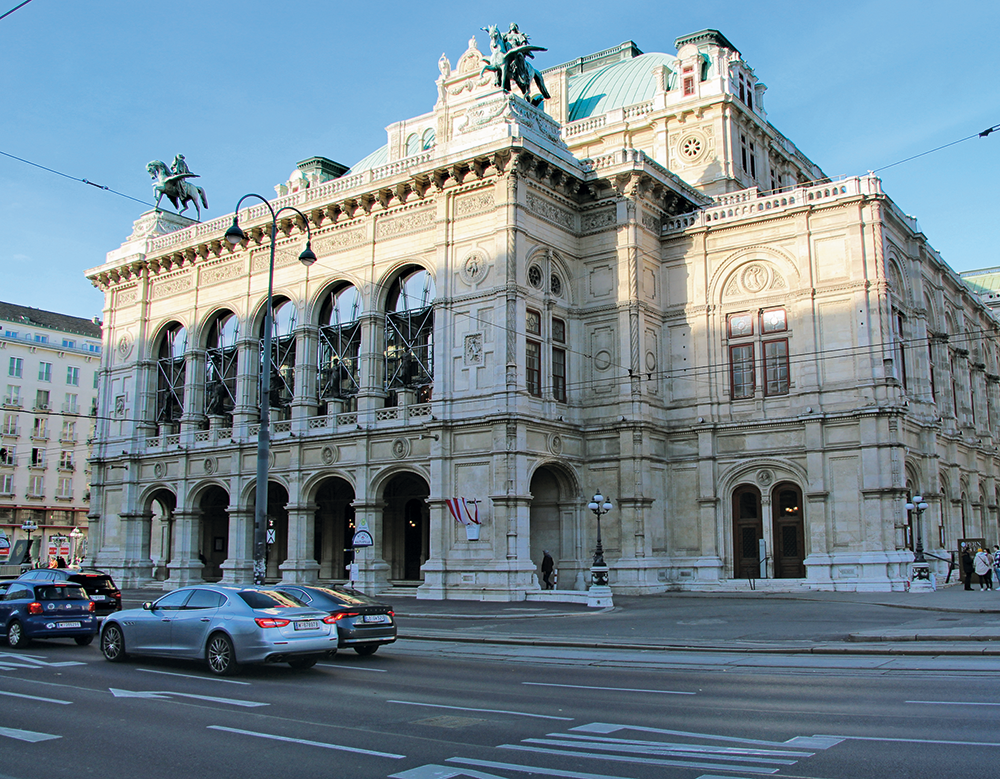
The renowned Vienna State Opera in Austria is considered one of the world’s leading opera houses. There are around 300 performances with more than 60 different operas and ballets each season. This schedule is an enormous challenge for both the employees who work in shifts and for the stage technology, which must function smoothly.
To give visitors the best possible listening experience, the sound system has been upgraded using state-of-the-art audio technology and an entirely refurbished audio control system. The system was brought to life by Viennese company Salzgeber, a specialist in planning and implementing high-tech audio and video systems, working closely with Beckhoff Austria.
The system requirements for the sound technology were extensive: in addition to perfect acoustics, it needed to provide optimised diagnostics options plus energy metering with the ability to visualise the system, especially the amplifiers. “The sound system that had been in continuous use at the Vienna State Opera for over 20 years could no longer keep up with the sound standards set by modern systems. Our situation involves typical audio signals such as opera vocals, acoustic instruments, a choir, an organ and incidental music,” explains Athanasios Rovakis, who is in charge of sound and video systems at the venue.
The choice of speakers was primarily determined by artistic requirements, such as organically embedding vocal and instrumental soloists or a choir, depending on the production. The speakers also needed to produce a certain sense of direction and distance for the sounds, and a certain sound ‘character’. “Today’s systems, with their modellable coverage, can be used and tuned very differently than they were just a few years ago. This is particularly important in situations involving a lot of room acoustics, as is the case in this theatre,” says Rovakis.
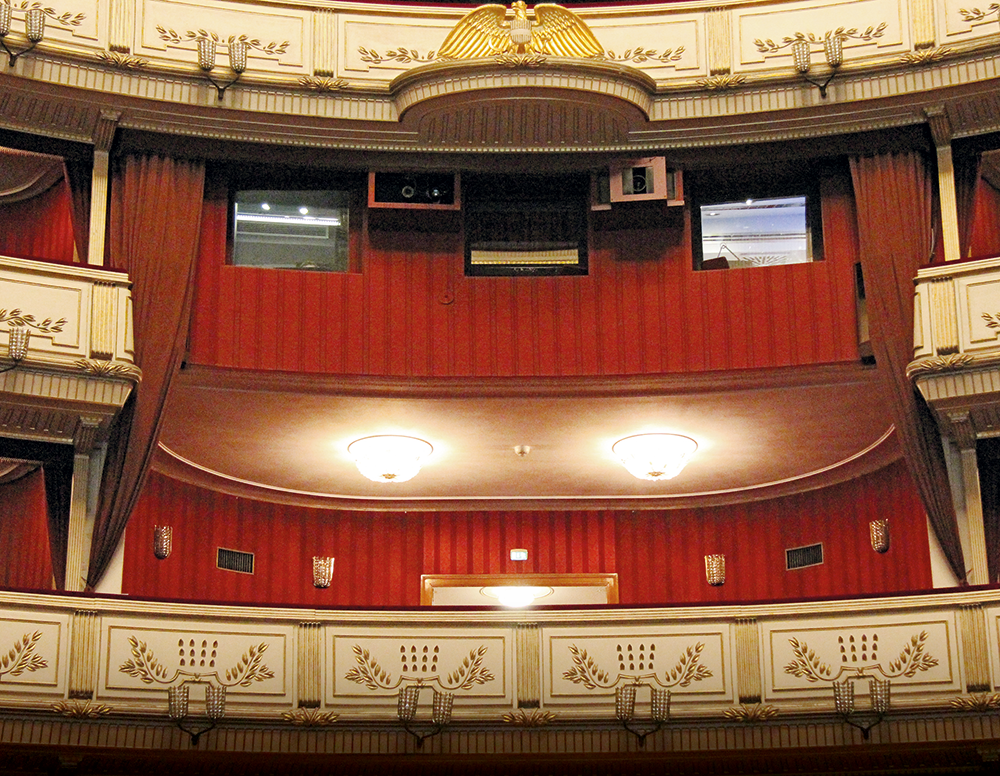
“Due to its unique architecture, the Vienna State Opera house has very lively acoustics and there are sometimes long distances and different types of directivity to deal with. The auditory impression in the orchestra stalls is different from the one in the gallery, for example. Collectively, voices can be heard better further back in the ‘Stehparterre’, a standing section of the hall, while the upper tiers receive a more balanced sound. The auditorium can accommodate almost 2700 visitors, most of whom sit in the upper two tiers, so of course we have to take that into account when it comes to the sound system,” the head audio engineer explains.
After several years of careful planning, the rebuild of the entire audio system was completed in November 2020. Tino Pfeifer, senior project engineer at Salzgeber, was involved from the very beginning. He planned and developed the monitored power supply, the amplifier monitoring and the connection between the amplifiers and additional signals.
“I decided to go with an L-Acoustics speaker system – specifically, the ARCS W/F series sounded particularly good for the applications in this space. All the other integration steps then had to be based on the selected system, or be compatible with it,” reports Rovakis. The sound master wanted a diagnostic option based on collected and analysed audio and power amplifier data. Rovakis continues: “This is a function that we had previously found to be very time-consuming to implement in analog form, and which we definitely wanted to see brought up to date.
“With the variety of audio channels we have to manage here, it’s important that we can clearly see if a signal is actually getting to where it was intended for. We also have remote control abilities – for example, muting via physical pushbuttons, which are also integrated into the automation of the audio mixing console.” Other requirements were energy monitoring and fault diagnostics for the audio devices, as well as visualisation of the audio system.
The next step was to find a solution that combines these functions with the selected audio system. This is where Beckhoff came into play as a control equipment supplier. Since the audio devices from L-Acoustics communicate with the control system via an
Energy metering for the audio system
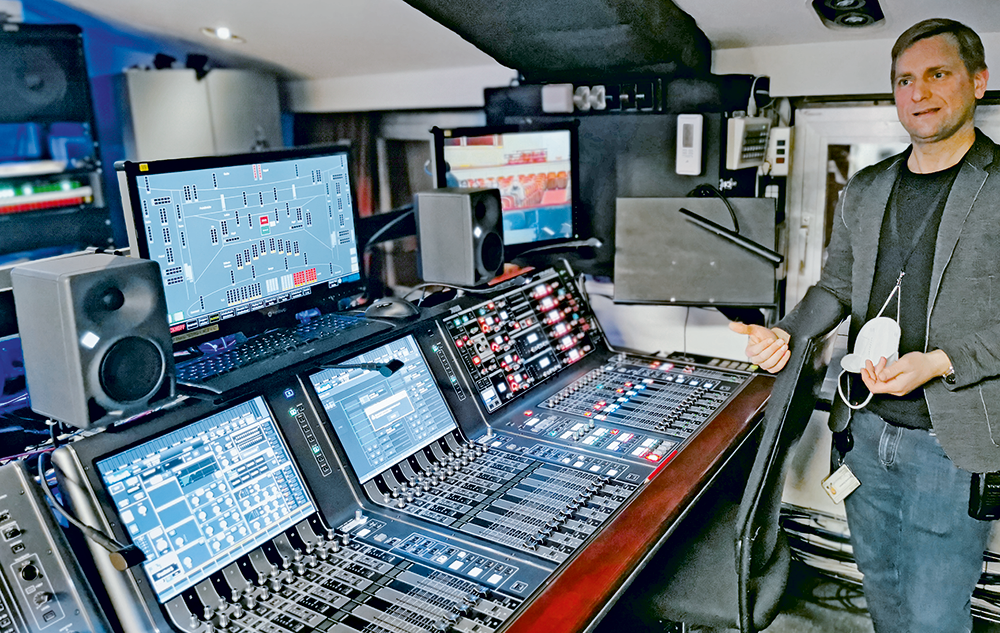
Since the 1950s, the Vienna State Opera’s sound technology has been repeatedly added to and, in some cases, replaced. “This means that layer after layer was laid on top of each other, and that gave us a rather confusing system of cables and individual components to deal with in the sound control room,” explains Rovakis. “With the help of Tino Pfeifer from Salzgeber, we completely redesigned the sound control room in a highly modular way, which hopefully means that we won’t have to make any more fundamental changes to it in the next 25 years.”
The power distribution in the control room, the point from which all the audio and video equipment is controlled, now consists of only three cable types for incoming circuits, outgoing circuits and the network. “The Beckhoff C6015 ultra-compact industrial PC with an EK1100 EtherCAT coupler and matching bus terminals is used for power distribution; it switches the power supply on and off as needed, and performs diagnostics on the protective switches,” says Tino Pfeifer.
Instead of hard-wired devices, Salzgeber designed a flexible system consisting of eighteen 19-inch rack elements. Using the individual racks, all consumers and each outlet can now be assigned to groups, switched and have their energy status read. This configuration was created with the aim of flexibly switching interrelated functional units together independent of their location. The modular bus design even allows entire racks to be separated and moved out of the room for servicing.
“With such a vast number of performances and rehearsals to deal with, each with different technical requirements, this really helps us keep track of everything,” says Rovakis. “We have duplicates of every critical component in case something breaks. We analyse the three phases of the mains supply, which are equipped with their own residual-current device or circuit breaker. We can dynamically switch devices via six remotely controlled and monitored ports, which are in the form of socket arrays.”
All of the racks are based on the same structure, which includes a BK9100 Ethernet bus coupler with two KL3403 3-phase power measurement terminals, six current transformers, two KM2614 4-channel relay terminals with 16 A wired-to-break contacts, and a KL1809 for monitoring the ground fault circuit interrupter switches. In total, more than 100 switching channels are available with a wide range of monitoring options.
The power measurement terminal accurately displays the status of each load. Envelope curve analysis is used to monitor the current consumption of each outgoing circuit, with the resulting data stored for reference. The racks can be operated via two central keypads, as well as on the PC. “But we can also operate all the functions downstairs from the auditorium – all we need is a network connection,” adds Rovakis.
Visualisation displays the status of all power amplifiers
The visualisation software was implemented on the basis of the TwinCAT HMI server (TF2000) which runs on a C6515 control-cabinet industrial PC. The HMI used for displaying the status of all audio devices is made up of approximately 1000 PLC variables on one HMI page, with the variables updated every 50 ms. It includes various windows that show power distribution, status monitoring and audio signals.
“The development of the visualisation or field of view was one of the most important aspects as far as we were concerned, and one of the main reasons for choosing to work with Beckhoff,” states Rovakis. “Now we can use the monitor to track where things are happening. When you play an audio signal in a scenario where the speakers are far away, you receive a diffuse noise whose origin you can’t exactly determine when working at the mixer. This is where the 3D arrangement of speaker VU meters in the HMI comes in handy.”
The audio outputs can be muted individually or all together via physical buttons in the control room, via the audio consoles and via the HMI. The current operating status of the amplifiers is also illuminated in the control room. A pleasant indirect light is created via LED strips. Blue indicates that speakers are muted. Red and dimmed ambient lighting in the fully automated control room is an ‘on-air’ signal, which heightens the concentration of the operators.
“One major reason for choosing the Beckhoff control system was its openness and the long-term availability of the components. The bus terminals enable us to cover every function and we have even added value by implementing functions that we had not even considered before,” Rovakis concludes.
| Tel: | +27 11 795 2898 |
| Email: | info@beckhoff.co.za |
| www: | www.beckhoff.com |
| Articles: | More information and articles about Beckhoff Automation |






© Technews Publishing (Pty) Ltd | All Rights Reserved
 printer friendly version