



The agricultural sector was a successful market for SEW-EURODRIVE last year, most notably in the poultry industry. According to regional sales manager, Willem Strydom, the company has products and solutions tailored for cattle and poultry feed processors, abattoirs and manufacturers of pesticides and fertilisers.
“On the feed side, we have implemented several successful new plants in partnership with feed-mill OEMs in Pretoria and Johannesburg,” he said. Feed mills, he explained, are fairly similar in shape and size, with a few minor differences between poultry and beef. The process starts with milling and mixing. Screw conveyors driven by SEW geared motors feed measured quantities of ingredients into a hammer or roller mill which crushes the dry ingredients – corn, wheat and other grains, along with some medication.
“The ingredients are then mixed using small paddle mixers driven by our geared motors or, for batch applications mixing 2 tons or more, using entry-level industrial gearboxes (IGs) of about 55 kW, which can cope with the relatively high torque requirements. At the final stage of manufacture, a binder such as molasses is added to the mix before the feed is extruded into pellets. Because of the low speed and high torque requirements, our IGs are typically used here too, to drive the extruder,” noted Strydom.
Describing the control required, he added that on a single-paddle mixer this is fairly easy, since only the speed and torque have to be controlled. This is done using SEW-EURODRIVE’s single variable speed drives (VSD). “The biggest mixer drive we have supplied was for a dual-drive mixer with two paddles. We supplied two 75 kW SEW IE3 motors connected to two industrial gearboxes weighing 750 kg each. Size-wise, this is similar to the mixer drives used for aeration in the wastewater treatment industry,” Strydom explained.
With respect to control for dual-paddle mixers, however, the synchronisation of the rotation also has to be precisely controlled to prevent contact between the two paddles. These turn in opposite directions and each paddle is controlled by its own VSD, while an upper-level PLC keeps the two paddles synchronised for optimised mixing. In terms of speed, plants tend to have two or three different product mixes which each require a different mixing speed and torque for thorough blending. By using VSDs, the blending requirements can be pre-programmed to make product switchovers easier. “Demand is still growing in this area and we are currently involved with a project requiring 13 geared motors and two industrial gear units for a poultry feed mill in the North West province,” added Strydom.
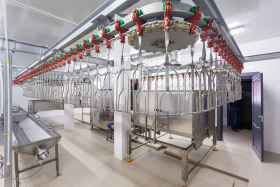
A second area of success for SEW-EURODRIVE’s agricultural offering has been on the abattoir side of the poultry industry. “In a poultry abattoir, the chickens are suspended on an overhead conveyor system called an air line. Slaughtered chickens are fully processed while continuously moving through all the processing stages on this line, including plucking, washing and chilling.
“Recently, there was a project where the chain conveyor used was a staggering 2,2 kilometres in length. To drive this conveyor, 36 gearmotors were needed, and they were divided into sections in order to manage the load and chain tension variations,” he said.
To prevent these long chain conveyors from snapping, 6 or 7 hydraulic or pneumatic tensioners are used to take up slack or to reduce the tension, which varies considerably due to loading and unloading variations and temperature differences between, for example, the chiller and the unloading sections, and the loading and washing sections.
“To drive the chain conveyor and to control its tension and speed, we use an SEW geared motor with our MOVidrive frequency inverter. The master VSD picks up the position from the proximity sensors on the tensioners. It then calculates the motor speeds required in each sector and adjusts them to restore the tensioner to its neutral position,” Strydom explained. Following initial success in overcoming the chain snapping problems, SEW-EURODRIVE designed five more of these systems during 2021.
From a design perspective, SEW-EURODRIVE’s Maxolution department is on hand to assist in the design of any agricultural processing lines and the selection of the most efficient and effective drive solutions and control strategies for these applications. The company’s Maxolution designs for abattoirs are particularly successful because they involve all of the mechanical, electronic, programming and onsite systems integration work.
Across the agricultural sector, Strydom says that energy efficiency has become increasingly important, which is leading farmers and service providers to look more closely at sophisticated, modern drive solutions. “As a precursor to investing in expensive-to-run backup systems, the sector is on a big energy efficiency drive so as to minimise consumption and reduce energy costs and backup power investment needs,” Strydom concluded.
| Tel: | +27 11 248 7000 |
| Email: | [email protected] |
| www: | www.sew-eurodrive.co.za |
| Articles: | More information and articles about SEW-EURODRIVE |






© Technews Publishing (Pty) Ltd | All Rights Reserved
 printer friendly version