



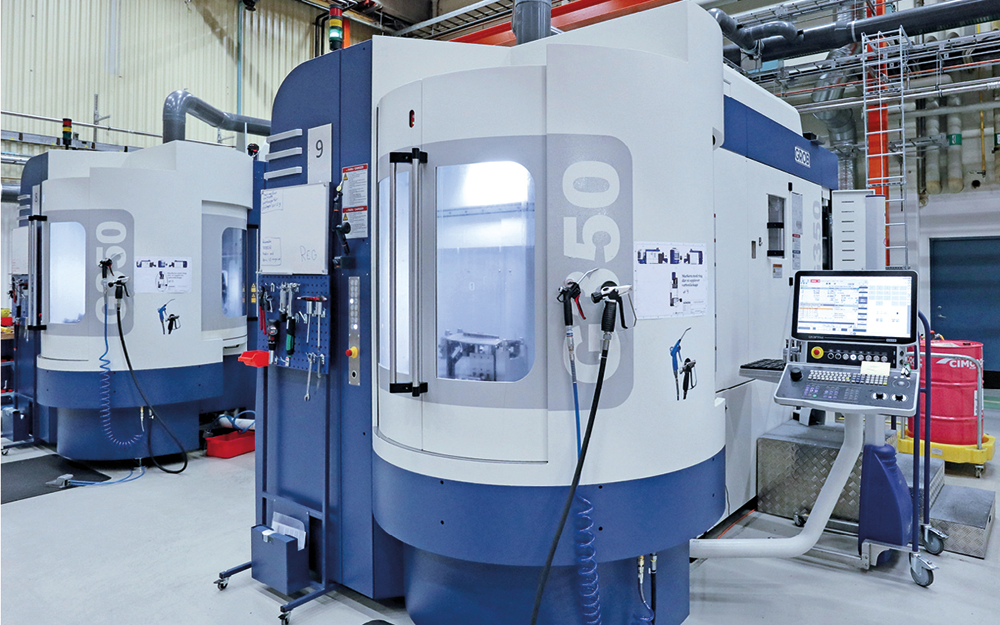
The Swedish company GKN Aerospace produces high-precision parts for aircraft engines and other aerospace applications. To ensure maximum transparency and the highest product quality, the machine tools used in production are all monitored by sensors from ifm electronic. Mikael Alm, IIoT engineer at GKN, explains: “We monitor our machines with the help of sensors, so that everything works perfectly and nothing unexpected happens. For about three years, we have been using vibration sensors from ifm to monitor the spindles in our machine tools.”
Ensuring fault- and trouble-free machining of the workpiece is of the utmost priority. This is the only way to guarantee high product quality. Due to the high machining speed and process forces, quickly reacting diagnostic systems are required that immediately detect damage occurring on the tool and that stop the process immediately, thus preventing damage to the machine and the workpiece. Permanent vibration diagnosis has proven to be the optimum procedure.
Minimum unbalances reveal problems
The centrepiece of this system is a highly sensitive and extremely reliable vibration sensor from ifm electronic, which is mounted directly onto the spindle housing. The vibration sensor of type VSA is a small micromechanical acceleration sensor that continuously detects vibration on non-rotating machine surfaces.
The VSA is so sensitive that it detects even the slightest damage on a milling head. Changes in the cutting forces that may, for example, be caused by a blunt drill or too much swarf are detected and reported to a diagnostic unit. At GKN, the evaluation unit processes signals from up to four vibration sensors can trigger a warning or machine stop in the case of a fault.
Limit values for vibration and collision detection can be stored in the machine controller for each tool, and for every step in the process. To determine them in advance, a program cycle is carried out in teach mode. Individual vibration data and adjustable tolerance values are stored in the controller for each tool. If those values are exceeded during machining, this is interpreted as an error and provides a warning message or stops the machining depending on the amplitude of the vibration.
Another protective function is spindle condition monitoring. Wear on the bearings of the complex spindle mechanics is detected and signalled based on unusual vibration characteristics, providing users with additional safety.
Further sensors
The evaluation system has two analog inputs, where additional sensors for monitoring can be integrated. GKN uses many PN7 pressure sensors to control the pressure in the cooling pipe. Since a pressure drop could stop the cooling process and damage the tool and workpiece, sensors signal if the operating pressure drops too low.
GKN connects all sensors to the central controller via the AS-i bus system. A two-wire flat cable transmits signals from up to 127 sensors with the help of AS-i I/O modules to the AS-i master. Bus wiring significantly reduces the cabling costs and provides higher flexibility of installation.
Evaluation
GKN uses Smartobserver to monitor and analyse the machine condition. This software was especially developed by ifm for condition monitoring of installations. All measured sensor values meet here. Next to illustrating all process values and their limits, the software creates trend analyses to help to optimise the production process.
Alm elaborates: “It is important for us to understand what happens during the production process. Our products are very expensive, and we have to be able to make improvements when the processes are not entirely optimum. We use the data from Smartobserver in our own analysis tool, thus making precise assessments and acting accordingly. The extensive alarm management of the ifm software enables condition-based maintenance of the machines.”
Conclusion
With the help of sensors and Smartobserver, machine tools can be monitored reliably. Faults are detected in time and the maintenance operation is calculable and condition-based. This not only saves on costs, but also ensures maximum availability and the highest product quality.
| Tel: | +27 12 450 0400 |
| Email: | info.za@ifm.com |
| www: | www.ifm.com/za |
| Articles: | More information and articles about ifm - South Africa |






© Technews Publishing (Pty) Ltd | All Rights Reserved
 printer friendly version