



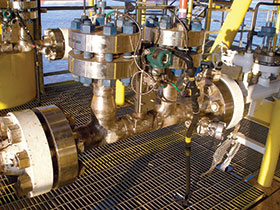
Oil producers looking past today’s difficult world markets understand development of new sources will bring a growing list of challenges. An ever-increasing amount of oil and natural gas is being produced by techniques once considered unconventional: tar sand extraction, fracking, and deep water offshore drilling. As the costs of these extraction methods have gone down, the range of economically recoverable deposits has increased. When crude oil markets return to more normal levels, these difficult fields, including deep water offshore oil and gas, will become increasingly important.
For South Africa in particular, long-term development efforts will certainly involve exploitation of offshore fields with special challenges. For example, the Outeniqua Basin off its southern coast shows great promise, but the waters are deep with difficult currents. Some parts of the field have depths as great as 1800 metres, and initial test efforts have shown it will not be easy to drill in these areas.
Of course, what is now considered a challenge would have been unimaginable a decade or two ago. Drilling safely and reliably in depths greater than 1000 metres is now becoming routine. Some of the most extreme examples of deep offshore drilling are the fields off the coast of Brazil in the Santos Basin. The Lula field is already producing even though the reservoirs are below 2000 metres of water and 5000 metres of salt, sand and rock. Estimates of recoverable oil from these deposits are around 7,5 billion barrels, but until recently this kind of oil deposit would have been considered impossible to exploit.
Dealing with unique challenges
Several challenges arise in the deployment, successful operation and maintenance of deep-water production assets:
• High costs of subsea and topside installations, particularly instrumentation and wiring, call for precision engineering and coordination of field work as controls and communications become ever more critical.
• More equipment and manpower means more weight on topside platforms, amplifying operational challenges and risk. The amount of equipment moving to the sea floor is growing, but this makes accessibility far more complicated.
• Safety depends on proper maintenance including device status and performance, valve signatures, periodic testing and so on. These tasks are costly, but failures are far worse.
• Maintaining offshore assets while allowing for optimum profitability, minimal risk, system reusability and end-of-life decommissioning requires management of huge amounts of information over the lifetime of the assets.
• The high daily production value from a major offshore asset makes the cost of a shutdown or subsea repair mind boggling in terms of operating costs and lost production, and environmental consequences can be significant. To put the figures in perspective, the combined costs associated with a single trip at a sea-floor wellhead causing a shutdown, period of lost production, repair and environmental impact may exceed the cost of the entire control and functional safety project. This places huge responsibilities on the shoulders of offshore operations to have all process, automation and safety systems performing flawlessly.
Minimising risks
As the amount of equipment moving to the seafloor increases, producers have to minimise the risks given the cost and complexity of performing even simple maintenance operations at the depths involved. Common goals include:
• Reduce engineering risks in terms of cost and operational errors across the whole project.
• Shorten the turnaround time to design, engineer, deploy and commission the entire project, subsea and topside.
• Reduce the human safety and environmental risks associated with operations.
• Create engineering designs for ease of reuse to simplify replicating wells and other production assets.
• Integrate disparate subsea and topside systems into one operational and engineering interface with one consolidated system for data management.
• Capture and organise automated information from all devices, systems and activities to improve operational efficiency, system reliability, operational safety, environmental risk and profitability.
Applying automation technology
Automation suppliers competing within this demanding space must offer products and solutions covering the entire project lifecycle. This includes many individual elements:
• Design, engineering and commissioning solutions for standardisation, project schedule reduction and risk management.
• Reliable core platforms for control and safety.
• Full integration of the subsea MCS (master control station) with the TPU (topside processing unit) for control, engineering, asset maintenance and information access functions.
• Field hardware and process simulation to support project phase validation, testing and commissioning.
When considering systems from various suppliers, it can be difficult to determine exactly how all these elements can be drawn together, particularly given the variety of possible combinations of configurations, equipment choices and manufacturers. Each situation is different, but often the ability to integrate all the disparate parts into one operational whole proves to be the most critical element in supplier selection.
Operational integration and lifecycle
Making everything work together as one unit is the key to effective and safe day-to-day operation. Subsea and topside control interfaces must integrate seamlessly, using advanced operator-centric design and coordinated operation with the core control platform. Creating consistent HMIs is critical for safety and shutdown systems so operators don’t have to mentally sort through various possibilities when facing an abnormal situation.
For example, the operation to close a valve or shut off a pump has to be the same from one end of the system to the other. This calls for consistent application of high-performance graphic standards throughout. Designs based on ISA 106 serve as a basis for standardising operating procedures and best practices, leading to predictable and profitable activity. Alarm and abnormal event management spanning topside, subsea and onshore systems should be based on ISA 18.2 and EEMUA191 guidelines, with automatic KPI derivation and reporting.
Safety function monitoring of ESD (emergency shutdown) systems during normal and testing operations should be determined based on LOPA (layers of protection analysis) and HAZOP (hazardous operation) analysis and safety requirements.
All automation assets, especially those deployed on the seafloor must be monitored using an appropriate asset management platform. This includes field devices such as valves and transmitters, and also controllers and software. Maintaining production depends on resilient sensors and other equipment able to resist substantial pressure, which means most traditional process equipment is simply unsuitable. Likewise, hardened communication media such as subsea fibre optic cable are needed, along with satellite communication and highly deterministic protocols to handle environmental obstacles related to subsea integration and production.
Key architectural elements
Control systems for offshore applications have many similarities to conventional land-based counterparts, however there are additional elements needed to support more complex installations.
The subsea MCS has to interface directly with the TPU on the platform. Given the complexity of these multiple operational areas, there can be more than one control system, and multiple vendors and communication protocols may be involved. The MCS has to be able to speak to all these protocols natively so control can be fast and efficient to:
• Execute valve commands and interlocks, automatic shutdown, choke control, etc.
• Receive and monitor subsea instrument process and diagnostic data.
• Monitor the subsea control module.
• Provide HMI functions for control, alarm handling and trending.
Design patterns for hardware and software control applications should support standardisation and reusability. Standard field-deployed I/O and controller skids with tested, validated control layers can become building blocks for very reliable and scalable production.
Modular smart I/O can mitigate risks related to project delays and costs resulting from late project changes and additions. The ability to use some form of smart or configurable I/O can reduce or eliminate re-engineering due to marshalling and controller loading issues.
Given the inevitability of having to integrate multiple-vendor and third-party systems, the MCS needs both basic and sophisticated integration capabilities:
• Maintain HMI and alarm philosophy consistency for topside and subsea.
• Remote system access.
• Modular design to allow additional well configuration (subsea piece, topside piece, control and safety, I/O designation, third-party subsystem functions, etc.) via drag and drop.
• Generic application programming and testing.
• Design modifications and additions can be done once and applied to all.
• High-fidelity process simulation validation of equipment and control applications.
When all these elements are working together properly, the result can be a major saving by reducing the time and cost to design, implement and test. Once the system is built and commissioned, troubleshooting is far more straightforward with simpler change management. Reliable systems can be replicated as new wells are added.
The future of subsea automation
Automation technologies are not standing still. Advances are expanding opportunities going forward:
• Self-engineering, self-documenting systems.
• Broader information standards and protocols able to span production, control room and business layers.
• Greater focus on sustainability and reusability of deployed assets.
Regardless of what changes these advances bring, some elements will remain immutable: reliability and safety will not change as key design and operating parameters. Yokogawa is collaborating with its partners to bring the future of subsea operations a little closer to the present day reality of topside systems.
For more information contact Christie Cronje, Yokogawa South Africa, +27 (0)11 831 6300, [email protected], www.yokogawa.com/za
| Tel: | +27 11 831 6300 |
| Email: | [email protected] |
| www: | www.yokogawa.com/za |
| Articles: | More information and articles about Yokogawa South Africa |






© Technews Publishing (Pty) Ltd | All Rights Reserved
 printer friendly version