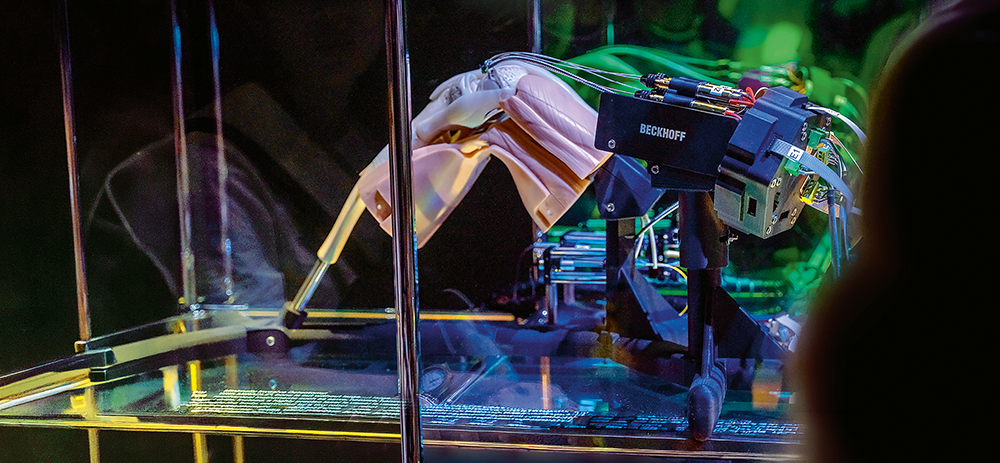
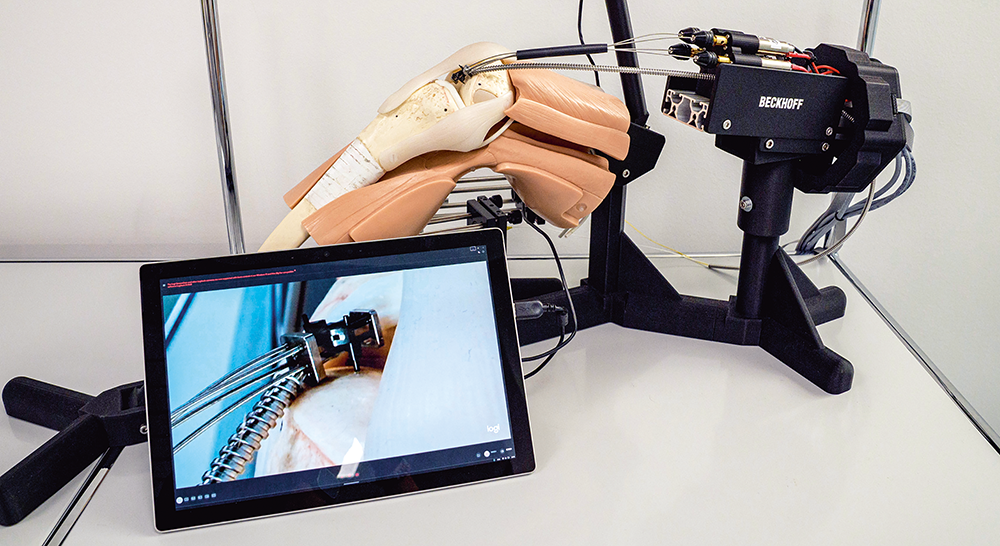
MIRACLE II is the second phase of the MIRACLE project funded by the Werner Siemens Foundation. MIRACLE stands for Minimally Invasive Robot Assisted Computer-guided LaserosteotomE, a modular laser robot for minimally invasive bone removal that is planned and supervised in virtual reality. The robotic elements of this system were developed by professor Georg Rauter and his team at the University of Basel, based on Beckhoff control technology, and specifically, TwinCAT 3 Target for Simulink.
MIRACLE II is based at the Department of Biomedical Engineering (DBE) in the Faculty of Medicine at the University of Basel. “Researchers from the fields of computer science, engineering, robotics, laser physics, surgery and other disciplines are coming together here to bring bone surgery into the space age,” says Rauter, head of the BIROMED Lab (Bio-Inspired RObots for MEDicine Laboratory) at DBE. The corresponding miniature robot will perform functional incisions with unprecedented precision for customised bio-ink implants produced directly at the treatment site.
PC-based control as the technological foundation
As part of his research, roboticist Rauter has been working with PC-based control technology from Beckhoff since 2008. He describes the starting point as follows: “At the time, we needed a communication solution for several hundred components distributed over a large area. In addition, the majority of the measurement technology cards were PCI bus-based or PCI Express bus-based. To avoid the increasing difficulties associated with the number of interfaces and signal cable lengths, our search for a bus-based system led us to EtherCAT as a compatible solution, and consequently, also to Beckhoff as a suitable provider of the associated control technology.”
As a doctoral student, Rauter’s work in this field started with the development of a rowing simulator at ETH Zürich based on a cable-driven robot. The concept was built around the synchronised control of two cable-driven parallel robots, each with five drivetrains. The aim of the rowing simulator was to use an intelligent algorithm to teach people to move autonomously by providing personalised multimodal feedback on the execution of movements.
Rauter explains: “The intention was to research movement learning in sophisticated movements in healthy individuals. Safety was a central element of the simulator because rowing can generate significant forces when the oar is submerged, for example, which the simulator must be able to reproduce. The safety functionality was initially implemented with a separate safety controller. With TwinCAT 3, we are now using the system-integrated TwinSAFE safety technology, which also enables seamless integration into the human-machine interface, for example.
An additional advantage of TwinCAT 3 is that we were able to retain the familiar workflow. This allows us to continue using a graphical programming surface as well as programming with MATLAB and Simulink.
I am a big fan of the workflow with TwinCAT 3 Target for Simulink, which delivers a C++ project that can be integrated directly into TwinCAT, and the appropriate machine code following compilation.” In addition, the TwinCAT workflow also benefits students on the master’s programme and new employees. “We run a block course on this every year, twice in Basel and now once in Innsbruck due to its great popularity. We also host workshops at our congresses. In principle, these courses are also open to industry participants who are specifically interested in the implementation of MATLAB and Simulink® in TwinCAT 3.”
Implementation in surgical robotics
As part of the MIRACLE II project, Rauter has applied his robotics know-how and experience of PC-based control to surgical robotics. The project focuses on classic orthopaedic applications in which an endoscope is used to insert a laser into the body via a small opening in a minimally invasive operation to precisely manipulate the bone or change its geometry and, therefore, stability. The research already carried out is now being expanded to include regenerative cartilage medicine.
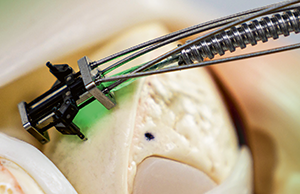
Rauter explains more: “Parallel robotics combined with lasers is our core focus in Basel and is also unique in its miniaturised dimensions. Currently, surgical robotics uses large devices anchored to the floor with correspondingly large kinematic chains that are complex to stabilise for sufficient precision. Our miniature robot, on the other hand, is supported locally on the tissue and also inserts the laser there, which itself has no interaction forces. This means that the system can be positioned very accurately without having to compensate for interfering forces. The required torque is applied from the outside via flexible spindles. Overall, this design results in a very small footprint with a cross-section of
High-performance technology required
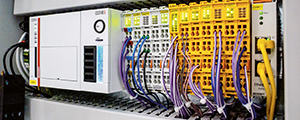
The parallel drivetrains require powerful control technology for synchronisation, as is available with TwinCAT, the CX2043 Embedded PC, and the EtherCAT and TwinSAFE terminals from Beckhoff. This technology allows the planar system to reliably utilise its three planar degrees of freedom: forward and backward movement, lateral movement, and rotation. A total of four EtherCAT- and FSoE-capable small servo motors are used for this purpose, including redundancy, which move the robot to the desired position via flexible spiral spindles.
Rauter describes the special feature of the control system as follows: “Due to the redundant drive, rather than solving a linear system of equations, the control system solves a real-time optimisation problem in order to achieve the best possible result, not only iteratively, but also multiple times every millisecond.”
According to Rauter, the high functionality of TwinCAT is used to a wide extent: “A good example is TwinCAT HMI, where I particularly like the data exchange across different logics, from C++ through PLC or hardware, and beyond to safety. In addition, our kinematics can be conveniently integrated into TwinCAT, and it is easy to communicate with third-party components, like machine learning-based vision components, via ADS. TwinCAT and EtherCAT offer this openness and flexibility not least due to their widespread use. That is why components with the right interfaces are available for all requirements.”
The benefits of close cooperation
According to Rauter, the research undertaken at the University of Basel also benefits from close cooperation with Beckhoff Switzerland. Rapid response times when specific inquiries are submitted and the ability to test hardware on a short-term basis are important aspects in this regard. He explains that they were able to test the application potential of the XPlanar intelligent transport system over the course of a year, for example. In addition, the department’s own development proposals regarding control technology are openly listened to and reviewed.
“Ten years ago, secure and reliable communication and automation technology from Beckhoff, which we originally used on the rowing simulator at ETH, made a technology transfer possible. This was in the form of
The FLOAT, the world’s first cable-based robot for free, weight-supported 3D gait rehabilitation on the ground, developed in collaboration with Reha-Stim Medtec AG, Schlieren, Switzerland, and the Centre for Paraplegia at the University of Zurich in Balgrist. We are now looking forward to taking this step toward commercialisation in surgical robotics as soon as possible, thanks to robust automation technology,” concludes Rauter.
| Tel: | +27 11 795 2898 |
| Email: | info@beckhoff.co.za |
| www: | www.beckhoff.com |
| Articles: | More information and articles about Beckhoff Automation |






© Technews Publishing (Pty) Ltd | All Rights Reserved
 printer friendly version