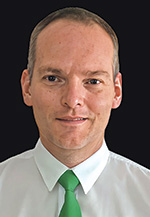
By Kobus Vermeulen, direct sales executive, Process Automation at Schneider Electric.
Today, many plant control systems are stable while the hardware infrastructure around them is toppling. Ageing servers, unsupported operating systems and increasing maintenance complexity are quietly introducing risk into otherwise stable distributed control system/ DCS environments.
For operators, this creates a familiar cycle: refresh hardware to stay supported, manage downtime during upgrades and do so again every few years. Fortunately, there is a more pragmatic way forward by virtualising the control system environment, decoupling the DCS from the constraints of physical hardware, and allowing it to operate in a virtualised world.
Kobus Vermeulen, direct sales executive, Process Automation at Schneider Electric.
Ageing infrastructure’s hidden risk
Many plants today are running DCS on legacy server platforms tied to outdated operating systems and hardware. While these systems may still function, the risks are compounding, leading to hardware failure as sourcing replacements becomes increasingly difficult. At the same time, unsupported operating systems fall behind on critical security updates, exposing control environments to evolving cyber threats.
These environments tend to be operationally fragile. A single server failure, whether hosting a human-machine interface/HMI, historian or application layer, can result in a loss of view, leaving operators without visibility into live processes.
Decoupling control
Instead of tying each DCS function to a specific physical server, engineering workstations, HMIs, historians and application servers are hosted as virtual machines/VMs. Each VM encapsulates the full runtime environment including operating system, control software and configurations, making it portable and hardware-agnostic. The underlying server infrastructure then becomes interchangeable.
This means hardware refreshes no longer require system rebuilds or downtime. If a server approaches end of life or shows signs of failure, workloads can simply be moved to another host, often without interrupting operations. Live migration enables running systems to be moved between servers without interruption, allowing maintenance or hardware replacement to take place without impacting operators. It also allows plants to move from hardware-driven lifecycle management to software-driven planning, with upgrades to control software or operating systems scheduled based on operational priorities, rather than dictated by failing infrastructure.
Building a low-risk, high-return roadmap
One of the most common concerns among plant owners is the perceived cost and disruption of moving to a virtualised environment. In reality, the transition can be structured to minimise both. A phased approach typically begins with assessment and planning, followed by deploying the virtualisation platform in parallel with the existing system. Initial migrations focus on low-risk components, allowing teams to validate performance and stability without impacting production.Only then, once confidence is established, will operator-facing systems be transitioned.
By decoupling the DCS from ageing infrastructure, plants can reduce risk, improve availability and regain control over their lifecycle strategy. Virtualising control systems enables organisations to modernise without disruption, freeing the DCS from the hardware obsolescence trap and offering a smarter way to sustain performance for years to come.
Designing the modern AI cooling stack Schneider Electric South Africa
Industrial Computer Hardware
: As average rack densities in data centres climb from 16 to 27 kW in a single year, Schneider Electric’s Canninah Dladla outlines the six liquid cooling architectures available to operators, seven design factors, and three operational practices that determine energy and water efficiency.
Read more...Network-capable remote relay system with flexible channel assignment Phoenix Contact
PLCs, DCSs & Controllers
Phoenix Contact has launched a modular PLC-Interface Ethernet Gateway remote relay system with up to 56 configurable I/O channels, multi-protocol support including Profinet Class C and S2 redundancy, and compatibility with established controller software for straightforward network integration.
Read more...Software-defined automation is overcoming hardware interoperability limits Schneider Electric South Africa
SCADA/HMI
Schneider Electric’s Kobus Vermeulen and Sydney Higgo explain how open communication standards and software-defined architectures are enabling industrial operators to integrate legacy equipment, new control systems, and cloud platforms without disrupting operations.
Read more...Calcamite partners with Schneider Electric and 4Sight for smart water management Schneider Electric South Africa
Editor's Choice
Schneider Electric, AVEVA and 4Sight OT Automation are helping South African wastewater specialist, Calcamite, digitalise its modular treatment plants through a scalable edge-to-cloud automation platform, with the award-winning Gourikwa pilot now scaling to hundreds of remote sites.
Read more...AI in industry is an early warning system, not a guarantee Schneider Electric South Africa
IT in Manufacturing
Schneider Electric’s Paul Steyn argues that AI in industrial maintenance is only as good as the infrastructure and people behind it, and explains the three layers a facility needs before predictive maintenance can deliver on its promise.
Read more...Schneider Electric concludes Innovation Summit Middle East and Africa Schneider Electric South Africa
News
Schneider Electric's Innovation Summit Middle East and Africa, held in Abu Dhabi with more than 2500 attendees, explored the convergence of energy, AI and industrial software, launched an Industrial AI study and announced the NEST Accelerator Programme for energy and industrial tech startups.
Read more...Seven checks before replacing an obsolete industrial control component
PLCs, DCSs & Controllers
An obsolete control component rarely fails in isolation. Before ordering an exact spare, manufacturer successor or engineered alternative, maintenance and procurement teams should work through seven checks to define the problem properly and avoid a costly mismatch.
Read more...The grid needs to become more intelligent Schneider Electric South Africa
Electrical Power & Protection
South Africa’s power grid is becoming bidirectional and far more dynamic as distributed energy resources proliferate. Schneider Electric’s Nishandra Bajinath explains why digitalisation, DERMS and aggregation are essential to keep this increasingly complex grid stable and efficient.
Read more...Schneider Electric concludes Innovation Summit Middle East and Africa Schneider Electric South Africa
News
Schneider Electric’s Innovation Summit Middle East and Africa, held in Abu Dhabi with more than 2500 attendees, explored the convergence of energy, AI and industrial software, launched an Industrial AI study and announced the NEST Accelerator Programme.
Read more...The next generation of engineers is building living labs of innovation Schneider Electric South Africa
IT in Manufacturing
Graduate engineers at Schneider Electric East Africa designed, integrated and commissioned the smart building systems in the company’s new Nairobi head office, demonstrating how practical, real-world project experience accelerates engineering capability and confidence.
While every effort has been made to ensure the accuracy of the information contained herein, the publisher and its agents cannot be held responsible for any errors contained, or any loss incurred as a result. Articles published do not necessarily reflect the views of the publishers. The editor reserves the right to alter or cut copy. Articles submitted are deemed to have been cleared for publication. Advertisements and company contact details are published as provided by the advertiser. Technews Publishing (Pty) Ltd cannot be held responsible for the accuracy or veracity of supplied material.










 printer friendly version