



The National Instruments CompactRIO Programmable Automation Controller (PAC) is a low-cost reconfigurable control and acquisition system designed for applications that require high performance and reliability. The system combines an open embedded architecture with small size (~180 x 88 mm), ruggedness, and hot-swappable industrial I/O modules.
Reconfigurable I/O (RIO) technology gives users the ability to define their own custom measurement hardware circuitry using reconfigurable FPGA chips and LabVIEW graphical development tools. The RIO core includes an FPGA chip and surrounding circuitry that enables LabVIEW to perform hardware synthesis.
Rapidly design custom hardware
NI RIO technology helps the user design data acquisition, communication, and control hardware with the same ease of use and flexibility of NI LabVIEW graphical programming. Using RIO technology, the user can rapidly create custom hardware circuitry with high-performance I/O and unprecedented flexibility in system timing control.
RIO technology, found throughout the NI platform, includes NI PCI and PXI R Series DAQ devices, the compact vision system, and CompactRIO. The R Series DAQ devices should be used for custom data acquisition or realtime I/O applications. Users can develop custom FPGA logic on the compact vision system to add triggering, pulse-width modulation signals, or custom communications protocols to machine vision applications. The CompactRIO family offers maximum flexibility in embedded measurement and control applications - and provides the benefit of modular FPGA-timed I/O with built-in signal conditioning and direct signal connectivity.
Customisable circuitry advantage
RIO technology is ideal for building optimised and flexible electric circuitry for I/O communication and control applications without actually building custom circuitry. Using LabVIEW dataflow programming, the user can synthesise on-board logic of the FPGA to implement many of the communication protocols that may be needed. Additionally, the user can use the built-in LabVIEW functions for signal processing and discrete linear and non-linear control to build digital control systems for rates up to 20 MHz and analog control systems for rates up to 150 kHz.
Wide variety of signals
Using off-the-shelf RIO hardware and the LabVIEW FPGA module, users can define their own hardware without in-depth knowledge of hardware design tools or hardware description languages. Whether the users need analog, digital, or counter I/O or more complex I/O for communication protocols or control signals, they can develop LabVIEW code to connect directly to their signals using RIO technology. When the signal requirements change, users can modify, recompile, and download the LabVIEW code to the FPGA to change the I/O number, mix, or type. This flexibility can save valuable time and money as the same hardware and software may be re-used.
Reconfigurable embedded system
The CompactRIO embedded system, Figure 1(a), contains the NI Reconfigurable (RIO) technology and a realtime controller. The FPGA chip is embedded within the CompactRIO chassis and is connected to the I/O modules in a star topology, providing direct access to each module for precise control and flexibility in timing, triggering, and synchronisation.

The I/O modules contain built-in signal conditioning, isolation, and an I/O connector to provide direct connections to their sensors and actuators. Data passes from the FPGA chip within the embedded chassis backplane to the realtime controller via an internal PCI bus. The NI CompactRIO realtime controller has a powerful floating-point processor and hosts embedded LabVIEW realtime applications for closed-loop control, acquisition, signal processing, datalogging, and communication.
Reconfigurable embedded chassis
The embedded chassis are the heart of the CompactRIO system because they contain the reconfigurable I/O (RIO) FPGA core. The RIO core has an individual connection to each I/O module and is programmed using easy to use elemental I/O functions to read or write signal information from each module.
Because there is no shared communication bus between the RIO FPGA core and the I/O modules, input/output operations on each module can be precisely synchronised with 25 ns resolution. The RIO core can perform local integer-based signal processing and decision-making and directly pass signals from one module to another.
The RIO core is also connected to the CompactRIO realtime controller through a local PCI bus interface. The realtime controller can retrieve data from any control or indicator on the front-panel of the RIO FPGA application through an easy-to-use FPGA Read/Write function. The RIO FPGA can also generate interrupt requests (IRQs) to synchronise the realtime software execution with the RIO FPGA. Typically, the realtime controller is used to convert the integer based I/O data to scaled floating-point numbers. In addition, the realtime controller typically performs single-point control, waveform analysis, datalogging, and Ethernet/serial communication.
The National Instruments cRIO-9101, Figure 1(b), is a 4-slot, 1 M gate reconfigurable embedded chassis, giving the user high processing power and the ability to design custom hardware using NI LabVIEW. This chassis provides low-level hardware access to any CompactRIO I/O module so users can create innumerable timing, triggering, and synchronisation schemes. Panel mounting holes are built in to all CompactRIO chassis. For DIN-rail mounting options, the user can purchase a CompactRIO DIN-rail mounting kit separately.
The cRIO-9102, Figure 1(c) is an 8-slot version of the cRIO-9101.
3 M gate chassis versions
The National Instruments cRIO-9103 and cRIO-9104 are 4 and 8-slot, 3 M gate reconfigurable embedded chassis giving the user the same functionality as the 1 M gate versions, but with ultimate processing power.
Realtime embedded controllers
National Instruments' CompactRIO realtime embedded controllers, Figure 2(a), offer powerful standalone embedded execution for deterministic LabVIEW realtime applications. These controllers are of rugged design, offering high reliability with low power consumption, and dual 11 to 30 V d.c. supply inputs that deliver isolated power to the CompactRIO chassis/modules and a -40 to 70°C temperature range. A 200 MHz industrial processor balances low power consumption with powerful realtime floating-point signal processing and analysis capabilities for deterministic control loops exceeding 1 kHz.
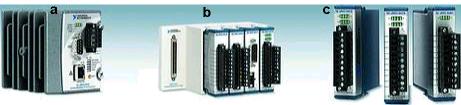
The cRIO-9002 is an embedded realtime controller that features an industrial 200 MHz Pentium-class processor for deterministic and reliable realtime applications. There is 32 MB of DRAM memory and 64 MB of non-volatile Compact Flash storage for file storage, a 10/100 Mbps Ethernet port for programmatic communication over the network and built-in Web (HTTP) and file (FTP) servers. Using the remote-panel Web server, the user can automatically publish the front-panel graphical user interface of their LabVIEW realtime application for multiclient remote monitoring or control.
Expansion system
The R series expansion system includes the cRIO-9151, Figure 2(b), CompactRIO R Series expansion chassis connected directly to a PXI or PCI R Series device such as the PXI-7831R, PXI-7811R, or PCI-7831R. In this configuration, the FPGA resides on the R Series device and the CompactRIO I/O modules provides industrial I/O, isolation, and signal conditioning. The Windows host CPU or realtime controller provides high-performance processing for analog control, analysis, or hardware-in-the-loop (HIL) simulations. The R Series RIO device and CompactRIO chassis provide high-speed signal-conditioned input, output, communication, and control capabilities and offer what is considered unprecedented flexibility and optimisation.
With the PXI-7831R or PCI-7831R, the user can connect up to two expansion chassis for a maximum of eight I/O modules per R Series device. With the PXI-7811R, the user can connect up to four expansion chassis for a maximum of 16 I/O modules per R Series device.
Embedded System Hardware Evaluation Kit
The National Instruments CompactRIO Embedded System Evaluation Kit contains all the hardware needed to build a complete customised, high-performance, embedded system. Contained in this kit are a cRIO-9004 realtime embedded controller with 512 MB flash storage and 64 MB DRAM, a cRIO-9103 4-slot 3 M gate reconfigurable chassis, a cRIO-9215 analog input module, a cRIO-9263 analog output module, a cRIO-9411 digital input module with a cRIO-9935 15-pin connector kit with strain relief, a cRIO-9474 digital output module, a cRIO-9932 strain relief and high-voltage connector kit for 10-position screw terminals, a cRIO-9912 DIN-rail mounting kit for a 4-slot CompactRIO chassis, and a power supply.
Development software
The software development kit includes all of the tools users would need for building an embedded, customised CompactRIO system - the LabVIEW FPGA Module for synthesising custom hardware in the user-configurable reconfigurable I/O FPGA core and the LabVIEW Real-Time Module for building deterministic, standalone realtime applications. The kit also includes a comprehensive set of LabVIEW add-on tools for control algorithm development, realtime development analysis, Microsoft Office report generation, Internet connectivity, database communication, and advanced signal processing.
I/O modules
National Instruments' CompactRIO provides direct hardware access to the input/output circuitry of each I/O module, Figure 2(c), using LabVIEW FPGA elemental I/O functions. Each I/O module contains built-in signal conditioning and screw terminal, BNC, or D-Sub connectors. A variety of I/O types is available, including ±80 mV thermocouple inputs, ±10 V simultaneous-sampling analog inputs/outputs, 24 V industrial digital I/O with up to 1 A current drive, differential/TTL digital inputs with 5 V regulated supply output for encoders, and 250 V rms universal digital inputs.
Because the modules contain built-in signal conditioning for extended voltage ranges or industrial signal types, users can usually make wiring connections directly from the CompactRIO module to their sensors/actuators. In most cases, the CompactRIO modules provide isolation from channel-to-earth ground.
NI CompactRIO modules connect directly to reconfigurable I/O (RIO) FPGA devices to create high-performance embedded systems that deliver the optimisation and flexibility of a custom electrical circuit completely dedicated to the input/output application. The RIO FPGA hardware provides essentially unlimited options for timing, triggering, synchronisation, and sensor-level signal processing and decision-making.
For more information contact Michael Hutton, National Instruments SA, 011 805 8197.






© Technews Publishing (Pty) Ltd | All Rights Reserved
 printer friendly version