



In South African manufacturing, the final stages of production – picking, placing, packing and palletising – are no longer routine tasks. Rising product variety, fluctuating volumes and increasingly exacting quality standards mean that manufacturers need more than manual labour or conventional automation. For many, vision-guided robotics is becoming the solution to smarter, more flexible end-of-line processes.
The challenges at the end-of-line
For companies in fast-moving consumer goods (FMCG), food and beverage and logistics, the end-of-line can quickly become a bottleneck. Historically, tasks such as case packing, stacking and palletising relied on manual labour. However, with growing stock keeping units (SKUs), mixed-case orders and seasonal peaks, these traditional methods struggle to keep up.
High-volume bakeries or food-packaging lines that switch products frequently cannot afford delays, product damage or errors associated with manual handling. The need for speed, precision and adaptability has never been more pressing.
Vision-guided robots
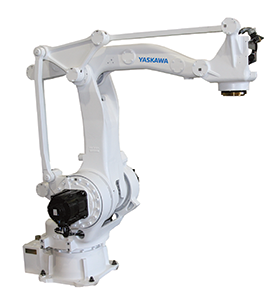
Vision-guided robots combine advanced manipulators with machine vision systems and intelligent software. Yaskawa’s pick-and-place robots, when paired with MotoSight and MotoPick software, allow production lines to track products dynamically, pick them in real time, and adapt to changes on the fly.
Rather than simply following pre-programmed paths, these systems detect incoming products, classify them, allocate tasks among robots and adjust automatically – even on moving conveyors. On the palletising side, Yaskawa’s Motoman robots use vision-enabled stacking strategies, intelligent grippers and advanced software such as Pallet Solver to optimise throughput while reducing errors.
Handling mixed SKUs and packaging types
Production lines today often deal with a wide variety of box sizes, bag types and packaging formats. Fixed-pattern palletising cannot keep up. Vision-guided robotics enables robots to identify shapes and weights, adjusting stacking and picking strategies in real time. This flexibility is critical for manufacturers responding to customer demand, seasonal changes or varied SKUs without lengthy downtime.
Rapid changeovers and flexibility
With integrated vision systems and intelligent software, Yaskawa solutions allow for fast changeovers with minimal reprogramming. Engineers can quickly switch the line to a new product, reducing downtime and improving overall agility.
Reducing product damage and improving output
Manual handling comes with risks such as errors, fatigue, and damaged products. Vision-guided systems pick accurately and consistently at high speeds, lowering reject rates and increasing output.
Labour efficiency and safety
Automating repetitive or physically demanding tasks frees human workers to focus on higher-value activities. Robots can operate 24/7 without fatigue, while reducing the risk of injuries associated with manual palletising.
Strong return on investment
When configured correctly, vision-guided pick-and-place and palletising solutions deliver measurable cost benefits, including lower handling costs, reduced waste and more efficient labour deployment. Over time, these gains typically outweigh the initial investment, especially in high-volume or labour-intensive operations.
Building local capability
Technology alone is not enough. Successful deployment requires trained integrators, engineers and operators who understand vision systems, gripper design and stacking optimisation. Collaborating with local experts and investing in training helps create a strong ecosystem that supports long-term innovation and sustainable adoption.
Looking ahead
Adoption of vision-guided robotics in South Africa is set to grow for several reasons:
• Automation beyond automotive: While robotics was once closely associated with automotive manufacturing, industries such as FMCG, food and beverage, and logistics are increasingly embracing automation.
• Industry 4.0 and digitalisation: Data-driven production relies on vision-guided robots to improve process control, traceability and performance analytics.
• Sustainability: Flexible automation reduces product waste, lowers damage and optimises transport efficiency, supporting more sustainable manufacturing practices.
For South African manufacturers navigating growth, volatility and digital transformation, vision-guided robotics offers a clear pathway to smarter machines, greater productivity and a stronger competitive edge.
For more information contact Yaskawa Southern Africa,
| Tel: | +27 11 608 3182 |
| Email: | |
| www: | www.yaskawa.za.com |
| Articles: | More information and articles about Yaskawa Southern Africa |






© Technews Publishing (Pty) Ltd | All Rights Reserved
 printer friendly version