Lubrication application a key component for wire rope longevity
I&C February 2026
Motion Control & Drives
As part of its extensive work to help develop benchmarking standards for wire rope lubrication in South Africa, lubrication specialists, Lubrication Engineers (LE) South Africa, has found the Viper wire rope lubricator to be a key element for effective lubrication application and rope maintenance.
Designed and manufactured in Australia over 15 years ago, the Viper was initially developed for port ropes, but LE South Africa saw its immense potential for different types of wire rope applications and has led the introduction of the Viper into the local market. “It really shines in in the mining sector, particularly for six-stranded triangular mine winder ropes,” says Ronald Byrnes, LE’s business development manager.
Byrnes has helped to drive the formalisation of LE’s Xtend team – a group of lubrication technicians who are highly skilled in assessing, applying and monitoring lubrication systems for wire ropes. Part of the Xtend team’s focus has been establishing benchmarking standards for wire rope lubrication in South Africa. “The Viper has been a key part of this process, and we see a major difference in the impact of lubricants when the Viper is used for application,” says Byrnes.
Another major win for maintenance teams is the time saving that the Viper offers. When machines using wire ropes come to a standstill in order for lubricants to be applied, a plant loses valuable time. “Where it would take several people several hours of scrubbing a rope to clean it, which can leave a machine like a winder rim or a shaft closed for more than a day, with Viper products, teams can clean and lubricate in a single pass within an hour,” explains Byrnes. “It takes us very little time to set up and it can run continuously; even changing pails of lubricants is done in real time.”
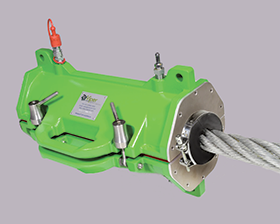
The Viper consists of two collars that are hinged. It is fitted internally with seals made from a polymer composite with ridges inside. It is a compressed air driven system that pushes the lubricant into the rope using approximately five bar of pressure. “The ridges inside it massage the lubricant into the rope, particularly the outer strands and the valleys between the outer strands of the rope, so that one gets a proper specified coating coverage of the rope,” says Byrnes.
With other methods of lubrication application, the lubricant can actually become both a contributor to and part of the formation of rust and degradation of the rope. “With ropes where we applied lubricant using the Viper, I haven’t had any instances of rust on ropes,” says Byrnes.
Safety, cost and environmental benefits
Environmental impact and safety are also critical aspects of rope lubrication. Bitumen-based lubricants, when exposed to the high temperatures required in order for them to be applied, release toxic fumes that pose significant health risks. Maintenance teams also face risk in having to handle the molten bitumen-based products. In contrast, the types of lubricants that are used with the Viper system eliminate these risks. Products, such as LE’s Wirelife Almasol Coating Grease 452, are suitable for the Viper system and improve overall site safety, says Byrnes.
In addition to the safety benefits, investing in a Viper for wire ropes has long-term return on investment gains for companies. “For clients, success to date has also been measured on the return of investment over the long term through preservation and better use of maintenance expenditure,” explains Burns. “Although it requires capital to purchase a Viper system, once it is in place, it quickly balances out in maintenance cost savings.”
For more information contact Gavin Ford, Lubrication Engineers, +27 11 464 1735, [email protected], www.lubricationengineers.co.za
Further reading:
Smarter motor technology for high-performance industrial automation
Adroit Technologies
Motion Control & Drives
Adroit Technologies is bringing Mitsubishi Electric’s EM-A series permanent magnet motors to Africa, offering servo-like speed and position control at a lower cost by combining patented sensorless control with the FR-E800 inverter to eliminate encoders while achieving IE5 efficiency.
Read more...
A smarter approach to simplifying motion architecture
Motion Control & Drives
n motion system design, the wiring and drive placement between motor and drive are often decided by default, yet they shape a machine’s cost, footprint and adaptability. Kollmorgen sets out how single-cable and decentralised architectures simplify the cabinet.
Read more...
Robotic case packer achieves 99% uptime
Rockwell Automation
Motion Control & Drives
DCC Automation designed a new robotic case packer for a nutrition supplement manufacturer using delta robots and a unified Rockwell Automation control platform, cutting changeover time from 45 minutes to 5 minutes, and achieving 99 to 99,5% uptime against the previous 10% per-shift downtime.
Read more...
igus puts 3D-printed wear materials to the test
igus
Motion Control & Drives
A new igus white paper compares its tribological iglidur 3D-printing materials directly with conventional POM, reporting lower wear, more stable friction and up to ten times longer service life in gear testing for customised, low-volume and replacement components.
Read more...
SEW-EURODRIVE’s expanded local engineering capability
SEW-EURODRIVE
Editor's Choice Motion Control & Drives
At Electra Mining Africa, SEW-EURODRIVE demonstrated how its expanded local engineering capability, digital technologies and lifecycle support strategy help customers improve reliability, energy efficiency and total cost of ownership across the full life of their drive assets.
Read more...
Latest Danfoss automation drive
Bearing Man Group t/a BMG
Motion Control & Drives
BMG has launched the Danfoss iC7-Automation enclosed variable speed drive range in South Africa, backed by significant local stockholding of 400 V models up to 710 kW, approved warranty workshops, and DrivePro digital asset management support.
Read more...
Severe-duty workhorses powering mining
Motion Control & Drives
Mining machines such as rock crushers, pumps and conveyors need motors that combine high torque with robust enclosures, seals and cooling. WEG Africa explains how severe-duty motors deliver more than a decade of reliable performance in harsh conditions while meeting modern energy-efficiency standards.
Read more...
Looking beyond the spec sheet when choosing motion architecture
Motion Control & Drives
When machine builders focus only on torque, speed and price, engineering time, integration effort and long-term maintainability get overlooked. Kollmorgen explains how thinking at the system level, not the component level, leads to better motion architecture choices.
Read more...
Economy drive system closes the drive gap in the entry-level segment
Beckhoff Automation
Editor's Choice Motion Control & Drives
Beckhoff has launched an economy drive system pairing its new AX1000 servo drive and AM1000 servomotor with the AF1000 dual-axis variable frequency drive on a shared EtherCAT platform, targeting series machines and price-sensitive markets without sacrificing TwinCAT integration or functional safety.
Read more...
SEW-EURODRIVE showcases modernisation and lifecycle support at Electra Mining Africa 2026
SEW-EURODRIVE
Motion Control & Drives
At Electra Mining Africa 2026, SEW-EURODRIVE showed how it has expanded beyond equipment supply into integrated engineering solutions, plant modernisation and long-term lifecycle support for mining and industrial operators across Africa.
Read more...










 printer friendly version