



Dogger Bank Wind Farm will be the world’s largest offshore wind farm when it is completed. Located off the northeast coast of England in the North Sea, it will have an installed capacity of 3,6 GW and power around six million homes annually. Mammoet was involved in providing transportation and weighing of the project’s three offshore substations.
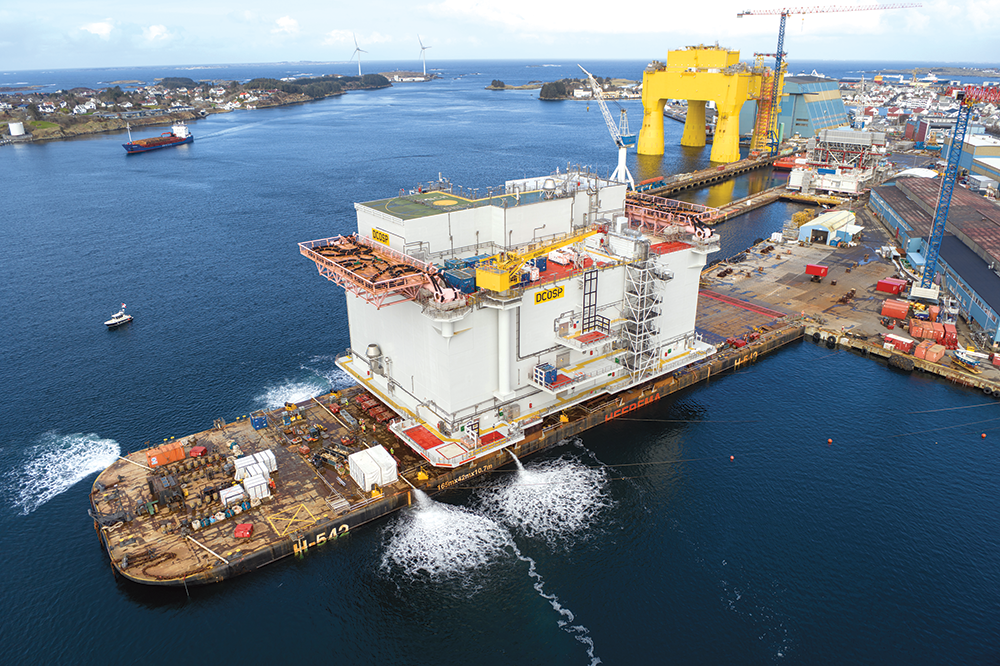
The substations are critical components, collecting and converting the power from the transformers and sending the electricity ashore to power homes. They were constructed in stages at two different locations in Thailand and Norway. With fabrication split between two yards in different parts of the world, and a specialist vessel chartered to move the substations, careful planning and management of personnel and equipment was needed to ensure everything ran to schedule.
Hundreds of axle lines in two places
Mammoet assisted with the three execution phases of each substation: the load-out in Thailand, the load-in in Norway, and the final weighing and load-out for transport to the North Sea. The biggest challenge was sourcing the large number of self-propelled modular transporters (SPMTs) required to perform the three phases across two locations.
In Thailand, Mammoet provided 338 axle lines to move the 7500 ton structures. In addition, a further 344 were needed in Norway – 264 for the load-in, plus a further 80 for the substations’ weighing and second load-outs to accommodate their final weight of 9350 tons.
This brought the total number of axle lines used for the project to 682, which were sourced from Mammoet’s global fleet of over 5000, and delivered on container vessels and via land transport.
A variety of tidal, engineering and logistical challenges needed to be overcome to facilitate their load-out and load-in operations. Following precise configuration, SPMTs lifted the substations using their onboard stroke, following which they were transferred to or from oceangoing vessels.
Jacking was made even smoother through the fabrication of special grillage beams for the SPMTs. These allowed the loads from the SPMT trailers to be transferred to the strongest points of the topside. Two bespoke load-out frames ensured the substations stayed firmly in position when transported on the SPMTs. The first of these travelled with the Dogger Bank A substation from Thailand to Norway, remaining there not only for that load-in, but also its load-out, and the load ins and load outs of the Dogger Bank substations.
In Thailand, the substations had to be driven a kilometre over public roads to reach the port. Fences had to be removed and a temporary gravel slope constructed so that the SPMTs could avoid using the main entrance. Once inside the terminal, the substations were transported via SPMT onto a heavy load carrier using RoRo ramps. The SPMTs lowered the modules onto the vessel’s grillages before disembarking with the interface beams and the load-out frame.
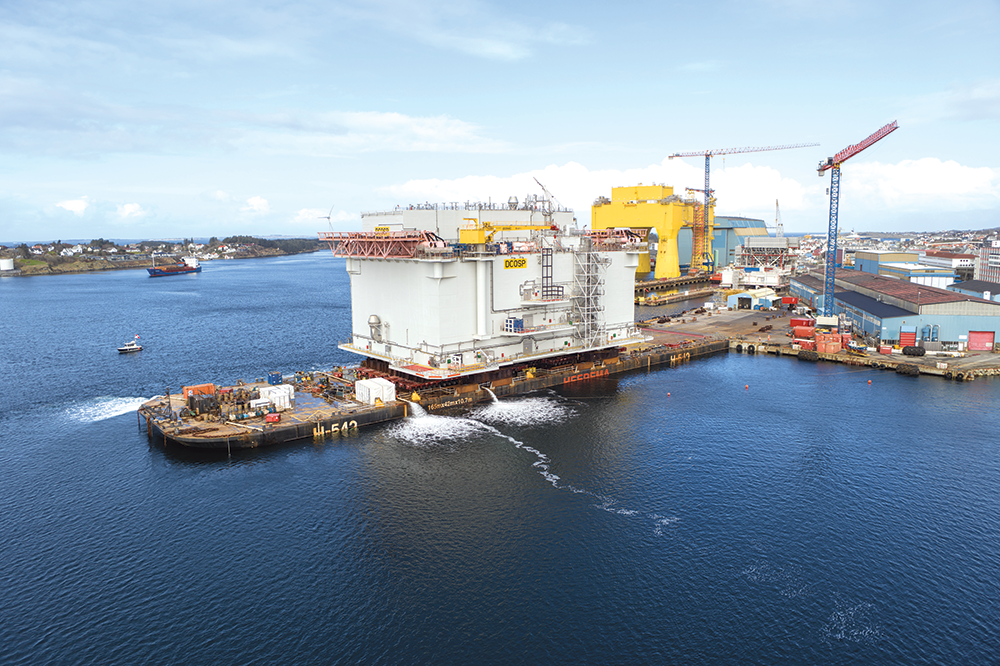
It took 45 to 50 days for each substation to travel from Thailand to Norway. Due to the allowable ground-bearing pressure being higher in Norway, fewer axle lines of SPMT were needed for the load-in operation. The substations were driven off the vessel and taken to a yard near the quayside. There, they were placed onto temporary supports for the final fabrication work to take place. Once each substation was completed, a total of 36 weighing jacks and loadcells performed a weighing operation. This process was repeated three times to get an average measurement and determine the final weight and COG.
For the final load-out operation, 344 axle lines of SPMT were used to accommodate the additional weight of the now-installed electrical transformer equipment. Mammoet supported with the ballasting of the barge. A total of 16 submersible ballast pumps, each with a capacity of 1000 cubic metres per hour, were used to pump water in and out of the barge to keep it level during load transfer.
The fleet and flexibility to deliver
“One of the things Mammoet does so well is to be flexible,” said Dorien Frequin, branch manager Norway at Mammoet. “We help our clients whenever there are small changes to their plans, and our teams work together to adapt to these changes. Our engineering department works closely with our project managers, who work closely with our planning team to source the equipment needed, and that can all happen in a very short timeframe. From sourcing hundreds of axle lines of SPMTs from multiple global locations to working closely with Aibel to refine the three execution phases, meticulous planning and effective communication were essential to the success of this project.”
For more information contact Mammoet Global,






© Technews Publishing (Pty) Ltd | All Rights Reserved
 printer friendly version