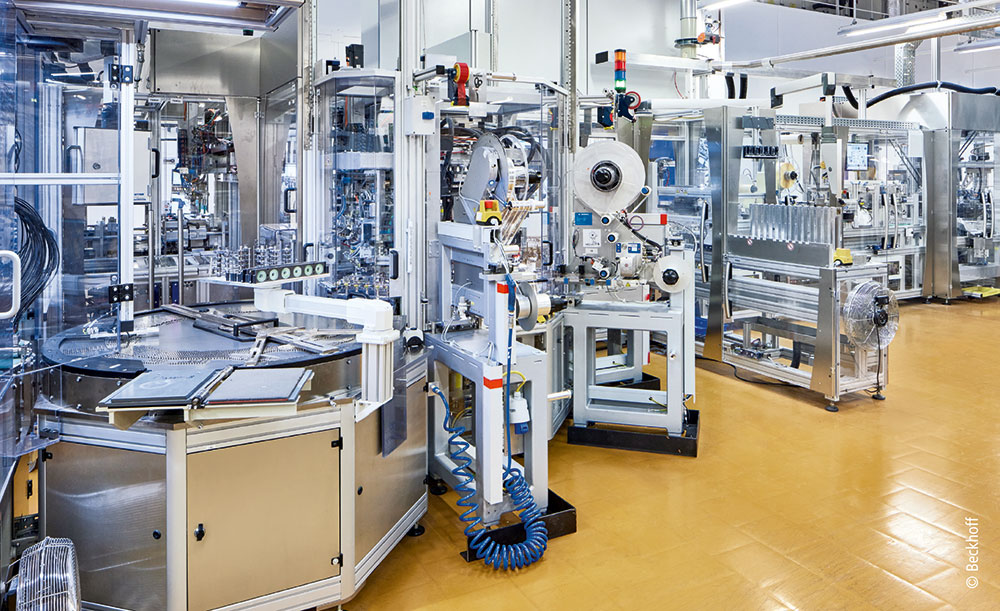
Only high-precision labelling reliably puts hearing aid batteries into a deep sleep.
When packaging products as small as microbatteries, it goes without saying that precision is just as important as speed and efficiency. This is particularly true of hearing aid batteries, which can only maintain their performance by being hermetically sealed with a label to keep them in a state of deep sleep until they reach the end customer. High-precision labelling processes are key here, and this is where KOCH Pac-Systeme comes in with its packaging line equipped with Beckhoff technology for the end customer, VARTA.
Pfalzgrafenweiler-based KOCH Pac-Systeme has been developing and implementing customer-specific, modular blister machines and packaging lines for the consumer goods, healthcare, and contact lens sectors for over 50 years. This also includes microbatteries, as in the case of the complete packaging line for VARTA in Ellwangen. The internationally active specialist in microbatteries uses this system to package hearing aid batteries with a special technical feature. These zinc-air batteries lie completely dormant until they come into contact with atmospheric oxygen.
Klaus Schöbel, head of Efficiency & Data Management at VARTA, explains exactly what this property of microbatteries means for packaging technology. “The positive terminal of the battery has air holes that facilitate contact with atmospheric oxygen; however, premature contact with air would cause the battery to dry out and lose its available capacity. To ensure the batteries can be delivered to the end customer without a loss of capacity, the holes have to be sealed airtight during the packaging process with protective film in the form of a label, essentially putting the batteries into a kind of deep sleep.” Jürgen Welker, director of Automation and Technology at KOCH Pac-Systeme, adds, “It is precisely this technique of being able to apply a high-quality seal with maximum precision that represents the special feature of this packaging line. A huge amount of development effort has been invested in the transfer technology and optical inspection systems to ensure that only correctly sealed batteries are transported further in the process.”
Close cooperation for an optimal solution
The overall machine building responsibility for this sophisticated system lay with KOCH Pac-Systeme, where consistent modularisation meant that both standard machine modules, and specially developed workstations, could be used. These workstations were developed in close cooperation with VARTA to create an optimal overall solution. Michael Bühler, software engineer at KOCH Pac-Systeme, notes, “The optical control of the label position on the battery represents a clear example of where the expertise on both sides could be combined. We were able to come up with a self-optimising, camera-based system that can also handle the enormous variety of around 1500 packaging types, with an extremely low error rate of less than 0,02%.”
Schöbel cites the data link to the ERP system as yet another special feature. “When the relevant production order is scanned in at a packaging line, all necessary production parameters – such as print data or label types and colours – are loaded directly into the machine control system from the higher-level databases. System operators can also count on comprehensive documentation, which is essential for error-free handling, given the large variety of types and numerous packaging variants, and ensures batch changes can be made on the fly.”
When it comes to flexibly and efficiently implementing specific customer requirements, KOCH Pac-Systeme has to be able to rely on universal and open control technology. Welker adds: “This packaging line contains a wide range of technologies and machine concepts. After all, it’s not just about packaging, it’s also about the interaction of product processing and handling, and it is precisely through overall concepts like this that PC-based control from Beckhoff really comes into its own. The open and modular control platform opens up a host of possibilities for us to integrate any necessary functions flexibly, such as packaging, handling, testing and even third-party components.”
From blister to transport packaging
The diverse process sequences within the packaging line equipped with Beckhoff control and drive technology start out with the production of the blisters. These are created from a supplied film, which is heated, shaped, and punched accordingly. The blisters are transported further via a pallet system and loaded with the microbatteries, which have previously undergone electrical checks, as well as visual checks in the plant itself, to ensure correct labelling. In the next step, the blisters are sealed with a card to form individual packs complete with a quality label and the expiration date, which is also verified via cameras. Finally, the system stacks the individual packs in a small cardboard box before these are checked for filling weight and their own respective labels, and subsequently grouped to form a larger transport pack.
Schöbel explains that it is not only this process sequence that has to run as efficiently as possible: “The notable focus with this packaging line, as with every one of our new systems, was also on optimising changeover times. This is because the numerous packaging variants mean that the systems have to be changed over six times a day, on average.” Welker confirms this, adding, “Minimising setup times is another important goal for us. We have already achieved significant improvements in this area in recent years. In the case of the new packaging line, there is also the fact that the system performance has increased from 15 to 18 pallet feed cycles per minute compared to the previous system. This is via the highly efficient blister stacking by the delta robot at the end of the system implemented with Beckhoff Drive Technology.”
Powerful drive technology with future potential
The PC-based drive technology controlled with TwinCAT NC I ensures fast and precise process sequences throughout the system. The approximately 50 servo axes are implemented via AX5000 servo drives and AM8000 servomotors from Beckhoff. Efficient use of installation space is a crucial factor for Bühler, who points out, “At KOCH Pac-Systeme, we consistently rely on Beckhoff’s One Cable Technology. This saves an enormous amount of material and installation effort, not to mention space, with further advantages including the avoidance of wiring errors and the use of an electronic identification plate. For optimum use of the available installation space, we also use compact drive technology from Beckhoff in our machines wherever possible, especially the 48 V versions of the EL/ELM72xx servomotor terminals or the EP72xx EtherCAT Box modules. In some applications, these already account for over 30% of the servo axes.”
Welker sees future optimisation potential in the motion environment, and particularly in the new modular ATRO industrial robot from Beckhoff: “We see an immense advantage in this technology because our plants are always full of pick-and-place units. ATRO would allow us to save on space considerably, compared to the previous mechanical axis systems with servomotors, and in terms of software, machine modularisation would be optimally supported and simplified.”
Sustainability through system-integrated measurement technology
Sustainability is particularly important in the packaging sector, as Schöbel is keen to emphasise. “To take one particular example, we are currently working together with KOCH Pac-Systeme on the possibilities of plastic-free packaging. A second major topic is energy consumption, in terms of not only minimising it, but also looking at the exact distribution of the respective energy consumption in relation to the individual battery types. The latter, in particular, is not easy due to our extremely diverse production environment. The measurement technology integrated into the PC-based control system from Beckhoff helps to collect sufficient current data and transfer it to a central database for further evaluation. With the complex integration of non-electrical areas such as compressed air, vacuum and cooling water, this is certainly another longer-term project.”
Welker also confirms the importance of sustainability, and explains the energy-saving mode of the systems: “In energy-saving mode, almost all field devices are completely switched off and only the control station PC remains ready for operation. This is the prerequisite for being able to start up the systems automatically, according to the work shifts or workloads, for example, and in good time before the start of production. It also allows us to ensure our manufacturing processes are as energy efficient as possible.”
Unified production HMI
The diversity of the production processes at VARTA poses challenges not only in the collection of energy data, but also in terms of operating and monitoring the wide range of machinery and equipment. Schöbel describes the solution. “We have developed a central interface that runs via an industrial PC and works for all systems, regardless of manufacturer. The basis is the CP3216 multi-touch Panel PC with 40 cm display, which we get from Beckhoff as a plug-and-play solution, complete with a customer-specific software image. The plan is to implement around 300 devices throughout our production processes. These will also serve as communication interfaces between the plants and our cloud applications for material handling or bookings, for example. The system is based on an SQL database, whose key features include the ability to implement a central change history and centralised production control.”
| Tel: | +27 11 795 2898 |
| Email: | info@beckhoff.co.za |
| www: | www.beckhoff.com |
| Articles: | More information and articles about Beckhoff Automation |






© Technews Publishing (Pty) Ltd | All Rights Reserved
 printer friendly version