



The philosophy of lean principles is a big trend in the pharmaceutical industry. It emphasises using time and resources as efficiently as possible in order to reduce waste and focus on value-added activities.There are many ways in which time and resources can be wasted in the pharmaceutical factory. For example, ineffective error proofing and quality inspection procedures can result in product contamination and recalls, leading to wasted material production time. In addition, communication throughout the factory can take up significant time and resources unless there is a solution in place to streamline messages.
A long-term solution to the challenge of waste must allow manufacturers to not only increase efficiency in the short term, but also learn from inefficiencies and make data-driven adjustments for continuous improvement. Here are four examples of how lighting solutions can help increase efficiency by addressing common sources of wasted time and resources in pharmaceutical manufacturing.
Inspection lighting
Reliable manufacturing of pharmaceutical products requires comprehensive inspections. It is extremely important to identify particulates or foreign substances of any size to avoid contamination and product recall. Often, this is accomplished by visual inspections, since automated inspection systems are not always feasible. But even manual inspections are prone to error, especially if lighting conditions are not ideal for visual verification.
Since many of the particulates are extremely small, it is important to have bright and highly uniform illumination in inspection stations, so operators can effectively verify the quality of products. An example is confirming that there are no contaminants present on an IV bag or glass vial. Fluorescent bulbs tend to flicker from changes in intensity, which can compromise inspection accuracy, and they must be frequently changed. In contrast, bright, uniform LED lights allow operators to detect minute particulates reliably and efficiently, improving quality control and reducing the risk of wasted time and materials.
Pick-to-light sensors
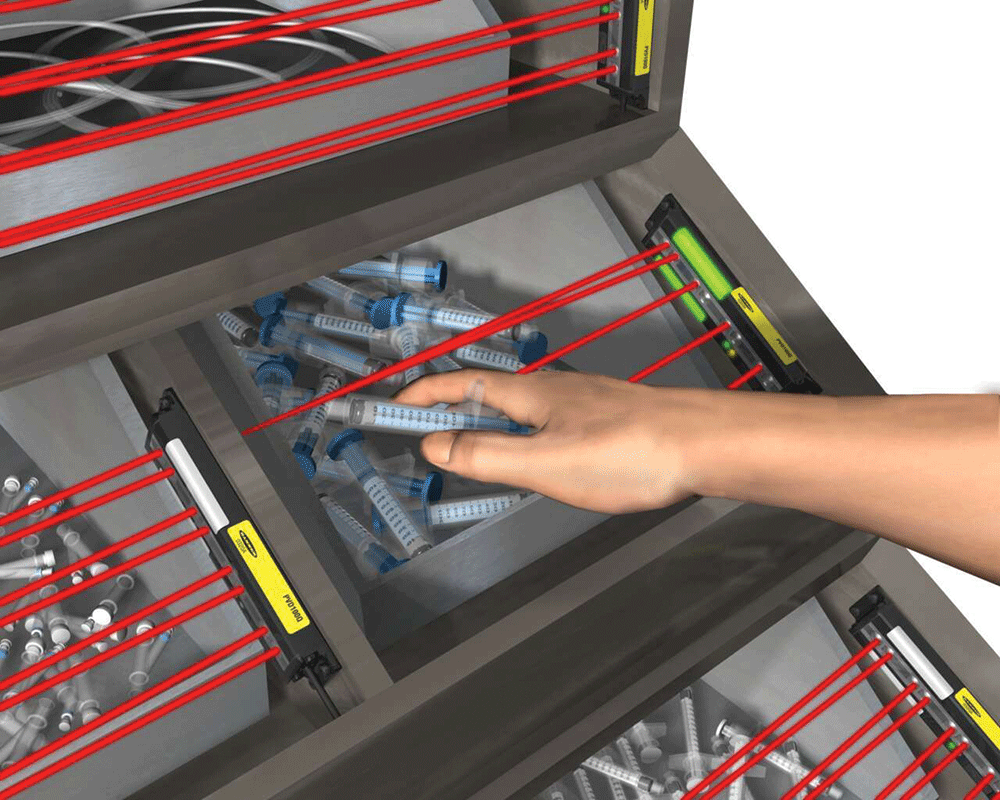
Assembly processes can also be streamlined with the use of light. For example, in kitting applications it is important to include all of the correct parts in each kit. Errors can occur if there are many different parts to remember or if an operator becomes distracted. To reduce the risk of error, pick-to-light sensors can be interfaced with a process controller programmed with the correct assembly sequence in order to guide the assembler to the correct parts in the correct order.
As the assembler takes a part in sequence and breaks the beam, the sensor detects that the part was removed and it sends an output signal to the controller. The controller then verifies if the correct part was taken, and the controller signals the pick-to-light sensor of the next bin in the pick sequence to light up. The system can also be configured to signal the assembler that an incorrect pick has occurred.
A pick-to-light system increases task efficiency by simplifying job training, increasing quality control and reducing the need for rework and inspections. It also speeds the resumption of work after breaks and other distractions.
Indicator lights
Communication can also be a source of wasted time, and the visual factory allows for communication to occur seamlessly. Indicator lights can be used to indicate environmental status information for clean rooms like current temperature and humidity. This allows employees to identify rooms that need attention immediately. They can also be used as visual guidance when assistance is needed on machines. For example, lights can be configured to indicate when a machine requires an action, such as replenishing labels. The use of indicator lights simplifies communication of problems and allows issues to be addressed quickly, so normal operation can resume.

Wirelessly connected lights
To ensure efficient processes throughout the pharmaceutical factory, machine operators must quickly and easily determine the status of machines. Tower lights equipped with wireless communication capabilities display a visual indication of an event for immediate action. They can also transmit wireless alerts to operators outside of the visual range. This helps operational problems to be identified and addressed immediately.
In addition, machine data can be wirelessly transmitted and stored for long-term data logging and analysis. In other words, not only can operators quickly respond to alerts as they occur, but a history of alerts can also be stored and analysed offline for use in overall equipment effectiveness calculations. This data can also be used for predictive maintenance, further saving on costs and time.
In summary, lean manufacturing seeks to reduce wasted time and resources throughout the factory. The right kind of industrial lighting can help increase efficiency and reduce material waste, while ensuring product quality, and compliance with local and international regulations in the pharmaceutical industry.
| Tel: | +27 11 453 2468 |
| Email: | sales@turckbanner.co.za |
| www: | www.turckbanner.co.za |
| Articles: | More information and articles about Turck Banner Southern Africa |






© Technews Publishing (Pty) Ltd | All Rights Reserved
 printer friendly version