



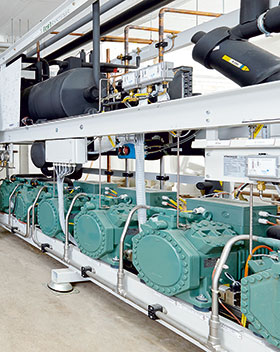
Tekloth, a German-based specialist for technical building systems, used PC-based technology to develop the complete control system for a compound CO2 refrigeration system. The installation is used as a cooling unit for a deep freezer for smoked and cured pork. After the meat has been smoked, it is shock-frozen at a temperature of -18°C. But, because it is still warm, a large amount of moisture is introduced into the process which collects on the evaporator where it freezes. As a result, conventional systems must be defrosted in regular intervals.
Since defrosting requires considerable energy, Tekloth completely redesigned the compound refrigeration system to be more efficient. The company’s Marco Möllenbeck explains: “Due to the special system design and corresponding control functions, our solution does not require regular defrosting like conventional installations. What makes it special is a switching valve that allows changeover from regular cooling (RC) to deep-freezing (DF) operation.”
Two operating modes combined in a single system
With the switching valve, the system can be operated for regular cooling in the so-called ‘transcritical’ range, or as a booster with DF and RC compressors. Tekloth’s Christoph Holtschlag elaborates: “By switching operating modes, the system initially cools and dehumidifies at an evaporation temperature of about 6°C. The elevated RC evaporation temperature keeps frost on the evaporator to a minimum. When the room temperature reaches 4°C, the system switches to the RC-DF booster mode.”
The RC mode provides energy-optimised cooling in the regular cooling temperature range, while dehumidifying most of the product surface – all with minimal freezing of the heat exchanger in the evaporator. After the circulation defrosting stage and switching to RC-DF booster mode, the chamber and the product are cooled to -18°C. Depending on the product quantity and the time it stays in the chamber after the target temperature has been reached, the need for intermediate defrosting may be completely eliminated.
PC-based control as an open and flexible control platform
Stefan Bollmann, who works in project planning and sales at Tekloth, believes there are many good reasons for implementing the complex sequence control with PC-based control technology: “We benefit from the ability of Beckhoff control technology to meet industrial requirements in all our projects. In addition, the systems’ modular structure and open programming environment make them flexible and enable an exceptional degree of innovation. As a result, we were able to program the sophisticated controls for this compound refrigeration system ourselves, which allowed us to maintain total control of the machine software. In addition, system changes and modifications in response to customer requests can be implemented quickly and easily.”
Another benefit is the consistent use of PC-based control technology across platforms, as Holtschlag explains: “Whether we build heating, cooling, ventilation or building automation systems with individual or centralised controls, we can implement all open and closed-loop control requirements with Beckhoff hardware and software. This kind of universal applicability allows us to employ our software modules in all areas. The system openness and its support for a wide range of bus types used in buildings is another contributing factor. The Beckhoff platform offers everything we need to keep our processes in-house, implement them efficiently, and deliver added value to the customer compared to standard offerings on the market. This absolutely applies to the compound refrigeration system, because no standard refrigeration controller provides this switching capability from regular cooling to deep-freeze mode.”
Optimised closed-loop process control
A Beckhoff CP2716 multi-touch panel PC serves as the operator interface hardware for automation, data recording and visualisation tasks. The modular I/O system is custom-configured with digital and analog bus terminals that collect data from all sensors and actuators as well as control-relevant values. The control system integrates components such as PT1000 sensors, high, medium and low-pressure sensors, temperature sensors and CO2 sensors. It also handles operation feedback from the various units as well as target and actual values and closed-loop control values.
The system acquires over 150 data points, with value changes in one-minute intervals, to provide a complete image of the process status. If a malfunction occurs, data changes are registered in one second intervals and can be buffered at this high resolution for up to one hour. “As a result, the process is under total control,” concludes Holtschlag. “The flexible implementation with PC-based control was critical to ensure our ability to accumulate the necessary knowledge in-house and advance our refrigeration technology. We conducted much electrical and software engineering to reflect the refrigeration process in our control technology and provide it with many new features compared to standard refrigeration systems. Making this possible were the many additional features available with PC-based control technology, such as graphical user interfaces, data trend mapping, fault signal logs and email notifications. Features like these enable us to implement individual customer requirements in the best possible manner.”
For more information contact Michelle Murphy, Beckhoff Automation, +27 (0)11 795 2898, [email protected], www.beckhoff.co.za
| Tel: | +27 11 795 2898 |
| Email: | [email protected] |
| www: | www.beckhoff.com |
| Articles: | More information and articles about Beckhoff Automation |






© Technews Publishing (Pty) Ltd | All Rights Reserved
 printer friendly version