



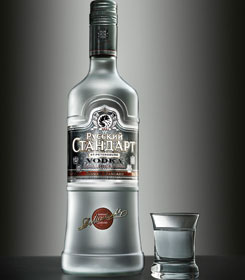
The word vodka means ‘little water’ in Russian. Vodka was described as Russia’s national drink as early as in the 14th century. Some 500 years later, in 1894, after centuries of unregulated production, Dmitri Mendeleev, Professor of Chemistry at St. Petersburg University, and later the creator of the Periodic Table of Elements, established the absolute standard for vodka distillation. His perfect balance of 40% alcohol by volume gave Russian vodka a precise formula for what had been, until then, a process closer to alchemy than chemistry.
Established in 1998 by Roustam Tariko, one of the most successful entrepreneurs in Russian history, Russian Standard brought this groundbreaking formula for perfect vodka distillation to the 21st century levels of quality.
“After years of watching our motherland abandon its vodka producing heritage, we made history by launching a new premium vodka, distilled and bottled exclusively in Russia, using only the finest Russian ingredients,” he comments on the company website. “By employing a unique blend of centuries-old tradition, a passionate attention to detail and state-of-the-art distilling techniques, we have created a classic Russian vodka unrivalled anywhere in the world.”
Based on Mendeleev’s principles for vodka, the company devised a strict four-tier production protocol consisting of mashing and fermenting, distillation and rectification, filtration and relaxation, and bottling and packaging.
Not the biggest, but the best distillery in Russia
In 2010, Russian Standard acquired a distilling plant in Buinsk, the capital of the Republic of Tatarstan. The distillery had been built in 2003 as a turnkey delivery by a Finnish company called JPI Process Contracting Oy for the local government. Metso’s Value Added Reseller (VAR) partner at the time, N-Prima, had supplied a Metso DNA automation system for the plant.
“As the target of Russian Standard is always to improve the quality of its products and to optimise its business, it decided to acquire a distillery of its own,” explains Bahodyr Uzakov, director of the Buinsk distillery. He was involved in building the distillery but left in 2005 to work for Russian Standard’s St. Petersburg plant. “I was among the people who recommended the acquisition of the Buinsk distillery since I had been working there before as a chief engineer and knew both its technology and automation system very well.”
The Buinsk distillery produces spirit and dry distillery dregs. The latter are used for making dry feed for cattle and fertilisers. The plant processes 60 000 tons of winter wheat per year. The production capacity of spirit amounts to 6000 decaliters per day. Russian Standard transports this spirit from Buinsk to St. Petersburg for further processing. “Our distillery is not the biggest one in Russia, but it is the best with the newest technology and the latest process equipment,” Uzakov adds.
Automation to the maximum
Although the distilling plant was reasonably new when acquired by Russian Standard, the new owner wanted to make some changes. The company decided to carry out a major modernisation project costing €12,5 million, to implement the latest technologies available.
“During the past two years, we have added a new grain cleaning unit to our production, improved the quality of water, the rectification process and the safety interlock system, for example,” says Pavel Devin, head of the automation system department.
The modernisation project included a Metso DNA upgrade supplied by the original equipment manufacturer, Metso. The existing VME controllers were upgraded to modern high-capacity ACN technology. Process safety is now guarded by a HIMA safety interlock system, also supplied by Metso. According to Devin, the process line as well as auxiliary processes such as the water supply, cooling water, air supply, power supply, pumps, pressure and air temperature, are now automated to the maximum.
“First of all, we appreciate system reliability. Second, it is now easier to operate the process. The details that we especially like in the Metso DNA system are the built-in Timeline Machine tool in which events can be analysed and the remote monitoring,” Devin says. “Other beneficial tools are the Metso DNA Engineering Loop Auto Tuner and the Metso DNA Report Tracer as part of Metso DNA Historian to see real-time trends.”
Cheers to co-operation
The main part of the modernisation project has been completed, and the Buinsk distillery was re-opened in May 2012. However, there are still a lot of plans for the future. According to Aleksander Pirogov, chief engineer, one of them is a one-button start of the processes such as fermentation. Recently, the fermenters, wort aeration unit and yeast machine have been partially automated – a project to be completed later.
So, co-operation between Russian Standard and Metso to boost the level of automation, and consequently the quality of company’s flagship premium Russian vodka, will continue through services and modernisations. Cheers to that.
| Tel: | +27 31 502 9350 |
| Email: | kevin.mariemuthu@valmet.com |
| www: | www.valmet.com/flowcontrol/ |
| Articles: | More information and articles about Valmet South Africa, Flow Control |






© Technews Publishing (Pty) Ltd | All Rights Reserved
 printer friendly version