September 2011System Integration & Control Systems Design
PSY systems introduces visible speed indicating system for automobiles.
The T3L from PSY Systems is a visible optical speed indicating system that contributes to road safety by allowing motorists to understand the speed-change intentions of the vehicle in front. It consists of an ABB CPU operating in conjunction with the conventional vehicle braking indication systems.
In most braking systems, when the vehicle’s brake pedal is depressed the rear red brake lights illuminate. Vehicles fitted with additional rear window or boot spoiler brake indicating systems only mimic the same rear red brake lights. A typical unindicated speed change scenario would be a driver maintaining a constant pressure on the accelerator pedal while travelling along an inclined road and actually losing speed. Without T3L technology there is no indication to the following motorist of the change.
Designed for both OEM and retrofit markets, the T3L unit has a display indicator situated at the rear of the vehicle, either in the rear window or embedded in the boot or roof spoiler. It also has a standard vehicle speed sensor. Both display and sensor plug into the ABB CPU unit with speed changes represented by various arrangements of coloured lights on the rear of the vehicle.
Display methods
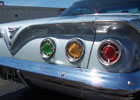
In the bar strip system the light strips vary in length to indicate speed change rates. If the red LED strip is on and varying in length, the vehicle is decelerating; if the amber LED strip is on and varying in length, the vehicle in front is maintaining speed and if the green LED strip is on and varying in length, the vehicle in front is accelerating. When the wave strip system is used, the light strips vary in shape to indicate the three scenarios and in the tri-state system, fixed shape light strips change colour.
Installation options
For the retrofit market a standalone system has been designed. A speed sensor is installed to sense any part of the vehicle’s rotational mechanism, this being directly proportional to the velocity. Alternatively a speed signal can be fed from the vehicle’s electronic system. This is fed into the T3L unit’s ABB CPU to analyse speed differences, the result being transferred to the display unit, indicating speed changes via colour LEDs or alphanumeric displays.
For the OEM market an integrated speed sensor is installed.T3L algorithms are programmed into the vehicle’s computer. The speed signal is fed into the vehicle’s computer to analyse speed differences. The result is transferred to either the T3L display unit or the vehicle’s rear lighting system.
Why integration defines the next competitive edge in pulp and paper
System Integration & Control Systems Design
ABB’s Arvin Ramjee argues that fragmented automation, assembled from different suppliers at different stages of a plant’s lifecycle has become one of the pulp and paper industry’s most overlooked commercial risks, and that true integration, rather than surface-level connectivity, is what delivers measurable business value.
Read more...Integrated automation enhances water treatment at dairy facility Process Dynamics
System Integration & Control Systems Design
Process Dynamics delivered the electrical, instrumentation, control and automation integration for an advanced water treatment and reverse osmosis system at a major South African dairy processing facility, achieving a 50% reduction in the client’s water utility costs.
Read more...Intelligent process control is reshaping cement production in Africa
System Integration & Control Systems Design
Advanced process control, predictive analytics and automation are helping African cement producers cut energy use and stabilise output as they contend with rising electricity costs and tighter margins.
Read more...Process Dynamics – Integrated Automation for Dairy Water Treatment Process Dynamics
System Integration & Control Systems Design Project and industry
Process Dynamics delivered the electrical, instrumentation, control and automation integration for an advanced water treatment and Reverse Osmosis (RO) system at one of South Africa’s ...
Read more...New SI programme strengthens Schneider Electric’s partner ecosystem Schneider Electric South Africa
System Integration & Control Systems Design
Schneider Electric’s SI Energise 2.0 programme offers system integrators a competency-based framework to develop deeper expertise in EcoStruxure and AVEVA software, enabling them to deliver full-lifecycle industrial automation solutions.
Read more...AI and smart solutions for underground proximity detection systems
System Integration & Control Systems Design
Booyco Electronics explains why fitting proximity detection systems underground is far more complex than installing sensors, and how integration, data and intelligent analytics are helping mines manage the challenge.
Read more...Why cloud-ready BMS is reshaping building operations Schneider Electric South Africa
System Integration & Control Systems Design
Smart sensors and non-contact radar are reshaping industrial measurement, feeding connected platforms that predict failures before they happen.
Read more...Project and industry
System Integration & Control Systems Design
Transforming crushing plant operations through integrated automation.
Controlgear Instramac was engaged to deliver the electrical control and automation systems for a new crushing plant within the ...
While every effort has been made to ensure the accuracy of the information contained herein, the publisher and its agents cannot be held responsible for any errors contained, or any loss incurred as a result. Articles published do not necessarily reflect the views of the publishers. The editor reserves the right to alter or cut copy. Articles submitted are deemed to have been cleared for publication. Advertisements and company contact details are published as provided by the advertiser. Technews Publishing (Pty) Ltd cannot be held responsible for the accuracy or veracity of supplied material.










 printer friendly version