



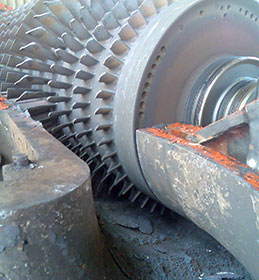
A turbine is a rotary machine in which the kinetic energy of a moving gas or fluid is converted into mechanical energy by causing a bladed rotor to turn. These machines are used throughout industry and are typically connected via a coupling to a compressor, pump or generator. The reliability and efficiency of the turbine are important operational parameters, but one must not forget about a key safety concern, namely turbine overspeed.
Overspeed happens when there is a sudden loss of load on the turbine. The outwardly directed centrifugal forces are some of the strongest acting on turbines. Therefore, if the rotational speed is allowed to surpass the maximum design speed, a catastrophic failure can result.
Types of protection systems
To avoid this, one requires an overspeed prevention system. These are often electro-mechanical combinations (hydro-mechanical, electro-pneumatic or electro-hydraulic types are also available), which sense the onset overspeed and automatically shut the unit down by closing (or opening) valves, solenoids, or any other devices necessary to bring the turbine to a safe halt.
Mechanical overspeed devices, such as trip bolts or trip rings, utilise moving parts surrounded in lubricating oil. Unfortunately, these mechanical devices can become stuck due to the ‘gelling’ or ‘lacquering’ of the surrounding lubricating oil. A trip bolt can also get stuck due to a rust coating that develops when the oil is contaminated with steam. This can cause a delay in the overspeed prevention or a complete failure to react at all. To ensure mechanical systems work properly, it is necessary to carry out an overspeed test at regular intervals, which can be expensive and dangerous for the following reasons:
• Testing generally requires an interruption of the production process. Often these interruptions are measured in millions of Rand, due to the expensive processes involved.
• To test the mechanical system, the turbine must be physically taken to the overspeed condition. If the mechanical system fails to operate during the test, it may be difficult to manually react in time to prevent a catastrophic failure. This has happened in the past in the power generation industry.
Electronic overspeed prevention does not rely on mechanical parts for actuation. These systems can be an important retrofit for a turbine installation to improve asset health. In short, speed sensors observe a rotating-pole toothed wheel, which gives a speed input to the channels of the electronic monitoring system. If an overspeed condition occurs, typically a signal will be sent to trip the turbine via the main isolation valve.
Magnetic and eddy current probes are sensor technologies that make electronic detection of turbine speed possible. (It should be noted that these sensors do not make physical contact with the turbine pole wheel.) The electronic signal generated by the probes needs to be converted to a speed value, which can be achieved by averaging the signal or counting the pulses generated from the pole wheel during a time frame and dividing it by the number of teeth. When the speed reaches the trip limit, a signal needs to be generated to safely stop the turbine using the main isolation valve.
Reliable operation of the main isolation valve can be achieved by utilising electro-hydraulic actuation, which allows for quick closing of the valve. It also has functionality for dither movements, which enables reliable operation because failure in position can be detected. Lastly, a two-out-of-three system (toots) sensor configuration has the potential to reduce spurious trips and increase fail-safe probability.
The improvement brought by electronic overspeed detection makes a compelling business case when retrofitting existing mechanical systems. It has the potential to improve asset health and allow for safer operation.
For more information contact Johan Maritz, SAIMC Secunda branch, +27 82 856 3865, [email protected], www.saimc.co.za
| Tel: | +27 11 312 2445 |
| Email: | [email protected] |
| www: | www.saimc.co.za |
| Articles: | More information and articles about SAIMC |






© Technews Publishing (Pty) Ltd | All Rights Reserved
 printer friendly version