



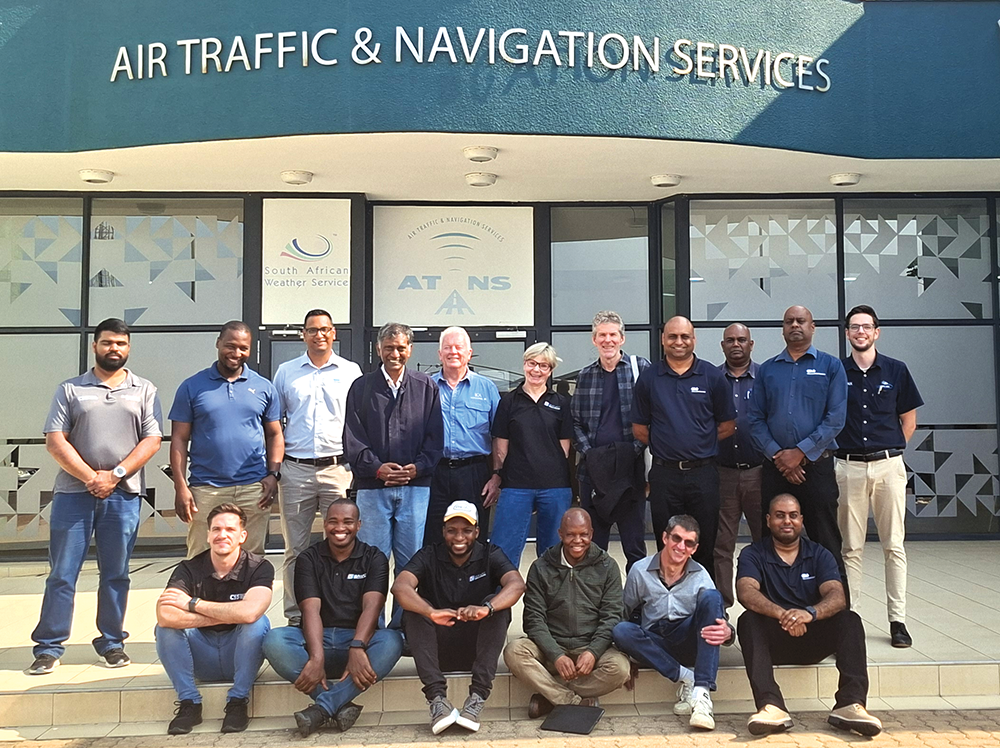
For a number of reasons, it had been a long time since the Durban branch of the SAIMC had been able to arrange a site visit, so when the opportunity arose to visit the Air Traffic and Navigation Services (ATNS) facility at King Shaka International Airport, we certainly came back with a vengeance.
Space was limited, but 22 excited SAIMC members gathered to meet our hosts, Krishnan Moodley, Manager: Technical Support FALE/Operations Technology, and technician Lungisile Hlongwa. Both were incredibly knowledgeable and generous with their time, giving us a fascinating insight into the complex world of Air Traffic Control.
Before heading off for the much-awaited ascent to Level 16 and the control tower, Krishnan introduced us to ATNS and the important role it plays in keeping South Africa’s skies safe. ATNS provides air traffic, navigation, training and associated services across South Africa and over the Indian and Atlantic Oceans. There is considerably more to it than the familiar image of an air traffic controller sitting in a tower talking to pilots. Navigation, surveillance and communications, together with the technical infrastructure supporting them, all must work together.
Investing in the next generation
We were also interested to hear about the organisation’s commitment to training. The ATNS Aviation Training Academy provides Air Traffic Services and Engineering Training, together with a range of aviation and safety-related courses, primarily across Africa.
There is a significant investment involved in training an air traffic controller, both in time and money. With a global shortage of trained controllers, ATNS is understandably keen to attract talented young people into the profession. Krishnan is clearly passionate about this and regularly hosts groups of learners at the facility, giving them an insight into the world of Air Traffic Management and, hopefully, encouraging some of them to consider it as a career.
So, if you have a son, daughter, grandchild or young person in your life wondering what to do with their future, perhaps a visit to ATNS should be on the list. With opportunities spanning air traffic control, engineering, technology and aviation, there is rather more to the organisation than sitting in a control tower talking to pilots.
For more information about careers and training opportunities, visit the ATNS Aviation Training Academy website at www.atns.co.za
A tower with a story
King Shaka International Airport itself has quite a story. Built to be operational in time for the 2010 FIFA World Cup, construction began in 2007 and the first commercial flights took off and landed there in May 2010.
The control tower, which dominates the airport landscape, was itself an impressive feat of engineering and floors 14, 15 and 16 were all built on the ground and hoisted up to the top of the tower central structure, making a total of 56 metres high.
The airport also has some rather unusual neighbours. The nearby Mount Moreland wetlands are home to one of the world’s largest Barn Swallow roosts, with millions of migratory birds gathering there during the southern African summer. Their presence presents an obvious aviation safety challenge, and radar technology is used to monitor bird activity and movements around the airport while the swallows continue to return to their roost.
Up in the tower
Then came the part we’d all been waiting for, the ascent to Level 16 and the control tower. Standing in the control room with 360 degree views, and watching aircraft being directed for landing and take-off, was for many of us like being in a movie. Our visit had deliberately been scheduled outside the busiest periods, but there was still plenty happening.
We then had a look at the approach side of the operation, where the scale of what was being monitored really began to sink in. We watched aircraft being directed to descend and reduce speed, while controllers kept track of the other traffic around them. The screens could be zoomed out to show a much wider area, with OR Tambo International Airport represented in the wider airspace picture and aircraft appearing as tiny moving symbols.
It was one of those moments when you realise that what looks fairly simple from the outside is anything but. For the technically minded members of the group, there was plenty more to take in. Krishnan and Lungisile demonstrated the ATC systems and explained the real-time processing and integration involved in bringing all the necessary information together for the controllers. We also saw the communication and radar display systems, the data centre and backup power facilities, and the mission-critical redundancy built into the operation.
One member said he was struck by the Thales integrated digital radar system and the integration of radar and communications across the national system. He also commented on the relatively small number of people required to manage such a critical operation, as well as the attention given to staff training and wellbeing.
For Mfanasibili, SAIMC Durban Branch general manager, it was the combination of sophisticated technology and highly trained people that stood out. He was especially impressed by the young professionals performing highly technical and safety-critical work with confidence and precision. Watching an aircraft’s journey from the parking bay through take-off, following its progress in real time and seeing the eventual handover to the area control centre at OR Tambo gave him a real sense of just how much precise coordination is involved. “It was reassuring to see that the next generation is more than capable of carrying this responsibility,” he said.
Mfanasibili also found parallels between the navigation and tracking principles and his own experience aboard drilling ships. The ATNS training programme, together with the design and construction of the King Shaka control tower, were also among his highlights.
More than planes and radar
King Shaka has also proved itself capable of handling some very large visitors. In 2014, British Airways used the airport for Airbus A380 pilot training, with King Shaka’s infrastructure, systems and relatively quiet airspace making it suitable for the programme.
While we were standing in the approach centre, we even spotted a Qantas aircraft on the system, still several hours away. Seeing an aircraft that was physically nowhere near us appearing on the screens was a pretty good reminder of just how vast the operation really is.
After an absorbing few hours, we left with a very different appreciation of what goes into every aircraft arrival and departure. There is a lot of sophisticated technology involved, of course, but also multiple systems, rigorous procedures and, most importantly, highly trained people making thousands of precise decisions.
Our thanks go to Krishnan Moodley and Lungisile Hlongwa for their time, their generosity and for giving us such a fascinating glimpse behind the scenes of an operation most of us normally only ever see from the passenger seat.
| Tel: | +27 11 312 2445 |
| Email: | [email protected] |
| www: | www.saimc.co.za |
| Articles: | More information and articles about SAIMC |






© Technews Publishing (Pty) Ltd | All Rights Reserved
 printer friendly version