



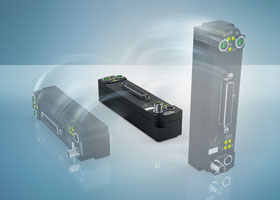
PC-based control and EtherCAT communication provide a high-performance platform, and not only for traditional control tasks such as PLC, motion control and control technology. The holistic Scientific Automation approach that Beckhoff pursues seamlessly integrates additional technology areas such as robotics, sophisticated measurement and data processing, as well as condition and energy monitoring. Rather than utilising a ‘black box’ solution that is complicated to integrate, measurement technology can be implemented and also retrofitted easily using standard I/O components and standard engineering processes. The main advantage lies in the basic system structure: The measured data are logged in a simple, cost-effective and highly scalable manner by EtherCAT terminals or IP67 modules and are then transferred via very fast EtherCAT communication to a high-performance industrial PC for processing.
From digital I/Os to complex signal types
The EtherCAT Box modules cover the typical range of requirements for IP67 I/O signals: digital inputs with different filters, digital outputs with 0,5 and 2 A output current, combination modules with freely selectable inputs or outputs, analog inputs and outputs with 16-bit resolution, thermocouple and RTD inputs, as well as stepper motor modules. With integrated XFC functionality, the EP1258 EtherCAT Box opens up a wide range of new applications, which in the past were not possible with an IP67 module. With eight digital inputs it logs fast binary signals from the process level and transfers them in an electrically isolated manner to the control system. The signals are furnished with a time stamp that identifies the time of the last edge change with a resolution of 1 ns. In this way signal variations can be traced exactly over time and related to the EtherCAT distributed clocks across the system.
Integrated acceleration and angle measurement
This diversity enables connection of almost any sensor and actuator type and the logging of complex signal types. A good example is the new EP1816-3008 EtherCAT Box. With 16 digital inputs it logs binary control signals from the process level and features two integrated 3-axis acceleration sensors. It is easy to install and can be used to implement cost-effective vibration and shock/oscillation monitoring directly in the field. It also supports inclination measurement in X and Y directions. The acceleration sensors with 16-bit resolution in the optional ranges ±2 g, ±4 g, ±8 g and ±16 g are realised as so-called MEMS (Micro Electronic Mechanical Systems). Compared with the conventional combination of sensors and separate data sampling, this solution is more cost-effective and easier to install and integrate in the control system. Furthermore, it offers another advantage: Two sensors, which are arranged at 90° angles, make the EP1816-3008 a redundant measuring system, and moreover, the results can be reliably verified in the controller. A typical application for the 3-axis acceleration box is vibration and shock/oscillation monitoring of machines and buildings. For example, vibrations of robot arms can be monitored exactly and with no great effort via the measured accelerations. For wood sawing machines, an EP1816-3008 mounted on the work table offers reliable monitoring of the saw blade angle adjustment thanks to its fast signal acquisition, as another example.
An efficient way to measure compressed air
The new EP3744 differential pressure measurement box is a compact and integrated solution for measuring, monitoring and analysis of compressed air supplies, which are encountered in almost all areas of industrial automation. This EtherCAT Box has six digital inputs, two digital outputs and four pressure inputs with integrated 6 mm fittings. The pressure is measured as the difference to the fifth pressure connection, which is fed via a hose into a protected environment for IP67 conformity. This all adds up to a compact standalone device for the direct measurement and monitoring of pressure in the field. On the one hand, it eliminates long routes and hose connections from the process to the control cabinet, and on the other hand, it facilitates separation of electric and pneumatic systems, as stipulated for many applications. The EP3744 can be used for operating pressure monitoring, for example. In addition, the decentralised and system-integrated pressure measurement is the ideal solution for the prompt detection and localisation of leaks. The EP3744 can also contribute to a trouble-free processing sequence: for example, the vacuum necessary for the gripping process in automatic pick-and-place machines can be monitored without great expense. To do this the EtherCAT Box needs only to be integrated into the compressed air supply to the suction gripper via a simple T junction.
Complete range of infrastructure components
For the consistent decentralised configuration of machine or system data acquisition, corresponding infrastructure components are required. The new EP9224 Smart Power Box even combines the infrastructure component with measurement functionality: The 4/4-channel power distribution enables the connection of four EtherCAT Box power supply branches. In each 24 V branch the current consumption for the control voltage and peripheral voltage is monitored, limited and switched off if necessary. All input voltage and output current values can be analysed in the controller via the process data. In the event of a fault, the continuous logging of relevant data such as current values or temperature facilitates troubleshooting. The data can be retrieved from a ring buffer in order to pinpoint the causes of faults.
EtherCAT supports virtually any topology, which can also be directly branched in the field using the EtherCAT Box modules. If several junctions are required at one point in the star topology, an EtherCAT junction can be used to branch the topology further. Analogous to the infrastructure components with IP20 protection, the EP9128 eight-way EtherCAT star hub offers the possibility to construct the branches of the topology with the smallest possible number of components in the IP67 world as well. The EtherCAT network is connected to the input port of the star hub and can be extended via the other seven ports.
The EP9521 and EP9522 EtherCAT/Industrial Ethernet modules for fast industrial Ethernet/100 Mbaud serve as media converters from optical fibre to copper and vice versa. Both media converters are suitable for multimode fibre-optic cables. In addition to the copper branch, the 2-channel EP9522 enables further optical fibre topologies to be configured via a second optical fibre port, while the single-channel EtherCAT Box EP9521 is used for direct transfers between the two media. The CU2608 IP 67 Ethernet switch is another important infrastructure component with robust design. In a compact plastic housing it offers eight d-coded M12 Ethernet ports, 10/100 Mbaud, half or full duplex, automatic baud rate detection, cross-over detection along with clear and fast diagnostics.
Software optimises measurement technology integration
The new TwinCAT 3 software generation, which is integrated in Microsoft Visual Studio, was designed to meet the needs of Scientific Automation, i.e. the convergence of automation and advanced measurement technology. The real-time environment is designed to enable almost any number of PLCs, safety PLCs and C++ tasks to be executed on the same or on different CPU cores. The new TwinCAT 3 Condition Monitoring library enables the utilisation of these options: Raw data can be logged with a fast task and processed further with a somewhat slower task. This is ideal for continuous measured data logging and independent analysis in a second task, based on a wide range of algorithms. The individual function blocks of the Condition Monitoring library store their results in a global transfer tray, a kind of memory table. From there the results can be copied to variables or processed further via other algorithms so that a customised measuring and analysis chain can be configured.
No Beckhoff-specific blocks or other modifications of the original model are required for creating Matlab/Simulink modules. The Matlab and Simulink coders generate C++ code, which is then compiled into a TwinCAT 3 module. Modules can easily be re-used through instantiation. The block diagram from Simulink can be visualised directly in TwinCAT for setting break points, for example.
TwinCAT Scope offers display options for all relevant Scientific Automation software signals. The View component is used for visualisation of signals in the form of charts and the Server component records the data on the respective target device. Scope is able to take precise measurement readings right down to the microsecond range and can visualise oversampling values from the EtherCAT measuring terminals, for example.
Accessories for efficient system configuration
The wiring for protection class IP67 is simplified significantly thanks to preassembled cables for EtherCAT, power and sensors. Wiring errors are effectively prevented, reducing commissioning times as a result. In addition, field-configurable connectors and cables are available for maximum flexibility. Combination I/O modules and the high signal granularity also reduce system costs.
For more information contact Kenneth McPherson, Beckhoff Automation, +27 (0)11 795 2898, k.mcpherson@beckhoff.com, www.beckhoff.co.za
| Tel: | +27 11 795 2898 |
| Email: | info@beckhoff.co.za |
| www: | www.beckhoff.com |
| Articles: | More information and articles about Beckhoff Automation |






© Technews Publishing (Pty) Ltd | All Rights Reserved
 printer friendly version