



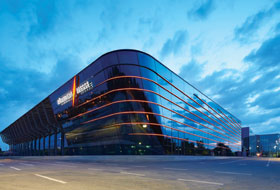
Beginning in spring of 2014, the Nuremberg Exhibition Centre featured a new highlight: the new, elegant steel and glass designed Hall 3A. Renowned London-based architect Zaha Hadid Architects is responsible for the impressive architecture, which sets milestones for technology, energy efficiency, and visual effects. Two sides of the floor-to-roof glass façade are equipped with modern LED lights, put into operation in June 2014. A CX5020 Embedded PC controls a total of 78 EtherCAT Terminals to ensure that the right colour appears in the right place at the right time. These terminals distribute the control signals in real time to the 105 600 LEDs with millisecond cycle times. RGB LED tubes, each barely eight centimetres long, are mounted on the façade in 11 rows of about 880 metres in length.
Challenge: Fast data transmission
From the outset, NürnbergMesse, operators of the Nuremberg Exhibition Centre, wanted to animate the dark glass façade of Hall 3A with light. The hall acts as a visual hinge between the buildings to the east and the south. In the project implementation, the work mainly focused on the complex task of controlling the LED light tubes. The exhibition company’s demanding specifications included, for example, programmable lighting scenes in RGB colours, time-dependent colour transitions with slow fade-ins and fade-outs, as well as operation by means of an iPad. It sounds simple, but it actually places extremely high demands on the technology. More than 16,7 million colour combinations per LED segment have to be distributed to around 60 substations and 105 600 LED tubes in four milliseconds via a bus with a length of more than 1000 metres.
In the tendering process, Lorenz Sprang from the project planning office iTectum was the most convincing with his Beckhoff control solution and was awarded the contract. Although Sprang was already well acquainted with Beckhoff controllers in building automation, this was new territory both for him and for Beckhoff. “Where real-time solutions are concerned, Beckhoff is mainly at home in machine control. To that extent, this was a special project for us,” said Wolfgang Negele from the Beckhoff branch office in Nuremberg, who supported Sprang. Such high data volumes and speed requirements are not common in building automation, which is usually concerned with the control of shading, lighting, or air conditioning equipment. “The great challenge was thus to find out how to transfer so much data in such a short time over such a large distance,” added Sprang.
Beckhoff and iTectum cooperated very closely on this project. The project had been completely calculated on a theoretical basis, and though it was regarded as feasible, no practical reference values existed and a pilot project could not be built and tested. “iTectum specified the configuration and the ball was then in Beckhoff’s court with regard to speed, the controller and data distribution,” explained Negele.
Colour transitions in a wide spectrum
The Nuremberg Exhibition Centre is delighted not only by the large variety of possible scenarios, but also by the simple operation. Wolfgang Hartmann, technical project manager at NürnbergMesse, can dial in to the control computer with his iPad and step outside in front of the façade of Hall 3A while still controlling the array. “We at NürnbergMesse want to market the façade illumination in future, so we can devise colour scenarios together with the customer to match the events or trade shows in question.”
The operation is actually very simple: the appropriate RGB values can be selected for each line on the colour selector and the RGB colour value entered. In total, 16,7 million combinations of red, green and blue are used to represent all the colour variations of the rainbow. The schedule for the switch-on and switch-off times can be stored in a configuration matrix. This enables the operator to plan and define scenes in advance for trade shows and other events.
The defined colours are prepared by a light design program and sent to a Beckhoff CX5020 Embedded PC via 12 DMX universes (lines), each with 512 channels. “However, DMX works relatively slowly with a data transmission rate of 9600 Baud and only enables the control of up to 170 RGB channels per DMX universe. Therefore, the data are converted to the much faster EtherCAT industrial Ethernet system for transmission and subsequently converted back into DMX signals. Apart from considerably lower wiring costs and higher flexibility, this is also advantageous with regard to maintainability, troubleshooting, and extendibility,” said Sprang.
EtherCAT enables maximum system speeds
The PC controller transmits new data with each DMX cycle, so that the resulting brightness or colour gradations can be relatively small. 13 ms is the cycle time in which a DMX protocol with 512 bytes is cyclically transmitted. If the controller cannot manage the calculation of new data within this time, it can only transmit again in the next cycle, i.e. after 26 ms. “You do notice this outside when dimming, because then the LED system begins to stutter,” explained Sprang. “The challenge in this project, therefore, was to ensure extremely fast control of the LED tubes and very high data throughput.”
This is precisely where EtherCAT, with its short transmission times, plays to its strengths. The CX5020 Embedded PC provides the control signals that the CU1128 EtherCAT star hub transmits in real-time to 50 DMX master blocks (EL6851 EtherCAT Terminals) in the glass façade. These convert the data back into DMX information again and distribute them to the 11 individual LED strands. “We manage in 4 to 6 milliseconds to take up 12 x 512 bits, to calculate them internally and distribute them across 50 substations more than 500 m away, to convert them there and output them again as DMX. That’s a demanding amount of data in the world of automation,” emphasised Negele.
“For that reason, the use of EtherCAT as the fieldbus system proved to be the key benefit, because with it, we can achieve the high overall speeds that are required,” concluded Sprang.
For more information contact Kenneth McPherson, Beckhoff Automation, +27 (0)11 795 2898, k.mcpherson@beckhoff.com, www.beckhoff.co.za
| Tel: | +27 11 795 2898 |
| Email: | info@beckhoff.co.za |
| www: | www.beckhoff.com |
| Articles: | More information and articles about Beckhoff Automation |






© Technews Publishing (Pty) Ltd | All Rights Reserved
 printer friendly version