



Advanced process control (APC) is the ‘in-thing’ in the modern control world with many plants in numerous industries applying it. The potential benefits to production and the financial bottom line are large, which is why many young control engineers are enraptured by its possibilities.
An important thing to take note of is that an APC control system’s outputs feed the set-points of the base-layer feedback controllers, which are the tools that will actually get the control valves to the correct place and hence get the controls to actually work. If the base-layer feedback controllers are tuned and operating correctly they will ensure that the correct amount of product is fed into the process to get to the desired set-point and to keep control variance to a minimum. If these base layer controllers do not operate efficiently, the APC systems will not operate well either.
Dr. Y Zak Friedman is one of the world’s leading experts in APC. To quote from one of his papers: “On-line process optimisation is worth working for, but without robust advanced controls it will never happen. I recently evaluated how well advanced controls worked in five refineries. Having spent money on such projects, the refineries faced a situation in which there was no measurable improvement in overall plant performance. These refineries are owned by different companies, yet they share a pattern of mistakes in administrating advanced controls.
“Everyone knows that building advanced controls on poorly tuned base layer is akin to building skyscrapers on quicksand. But, in the audited refineries, this was theoretical knowledge. The art of loop tuning demands a combination of skills not often found in one individual: process dynamics and control theory; process engineering and understanding of inter-loop interactions; and familiarity with the economic driving forces and operating objectives. The skill requirements, and also the fact that tuning is a time-consuming activity, lead to tuning practices such as cutting or adding to the gain whenever someone complains, but without conducting a test to identify the loop dynamics and without appreciation of the tuning objective for the loop.”
Real-world optimisation concerns
When companies implement APC systems, an early part of the programme is to optimise the base layer loops. Often they allow an unrealistically short period (in one case I saw only two to three weeks) to optimise several hundred loops. This is completely ridiculous and shows they have no idea of the complexities and realities involved in optimisation. I have been called into many plants which have implemented APC systems. Without exception the base layer control loops were far from optimised and were operating completely inefficiently in automatic. As mentioned many times in my articles this is because very few people understand how to go about optimisation as they do not understand the practicalities of feedback control. They think everything is a question of just tuning which they seem to believe will solve all problems. On the subject of tuning alone, it should be noted that very few people have any real knowledge on how to go about tuning, and most tuning is done by trial and error and results in closed loop performance that is far from optimum.
Some young APC engineers have very little plant experience and so little ability to optimise base layer controls. In one very large plant where I worked, a new team of APC people, mostly post-graduate degrees, actually proposed that the base layer was superfluous and that the APC should be connected directly to the valves. They had no idea of the realities of plant controls, valves seldom do what they are expected to do due to a myriad of other problems that include non-linearity, immeasurable load changes and changes in operating conditions to a few. The base layer regulatory controls are there to ensure that the processes do get to set-point irrespective of the imperfection of devices such as valves. There is no chance that APC could work at all without these base layer controls.
Practical examples of some peculiarities I have encountered
Many of the articles in this series deal with valve problems and I am always amazed at the different things I see when optimising controls. I am fortunate enough to have performed a great deal of optimisation work in numerous plants over many years, after optimising many hundreds of loops I am still finding interesting peculiarities in valves.
Here are three examples:
Figure 1 shows an open loop test on an important flow control loop. Steps of equal magnitude were made on the PD (controller output). The valve is very non-repeatable. It sticks at times. At other times it jumps, and it does not move the same amount each time. It is also about two and a half times oversized. (Oversized valves increase control variance by the oversize factor.)
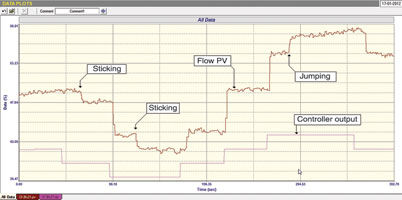
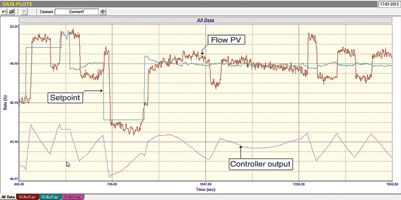
Figure 2 shows the performance in closed loop with a tuning that should have given critical damped response (ie, the fastest response to set-point without overshoot). It can be seen that the performance is terrible. On some of the set-point changes the valve sticks and then overshoots. One can see the controller’s integral term ramping back to try and get the valve back to the right place, and then the valve after sticking overshoots in the opposite direction. On several occasions a bad stick-slip cycle sets in. The important thing to note is that even with a valve as bad as this, the feedback control does manage to keep the process pretty close to set-point.
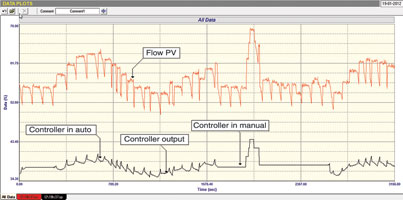
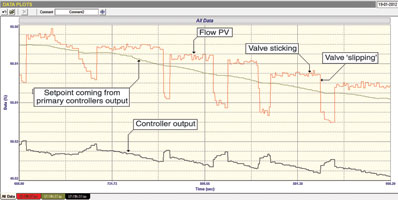
The next example is what I like to call ‘The Case of the Twitchy Valve’. This was really unusual valve behaviour. The valve was part of a secondary cascade flow control loop and approximately every one and a half minutes it would suddenly start closing very quickly and move about 5%. It would then recover and spring back to its previous position. This repeated continuously and it made no difference if the controller was in automatic or manual. Figure 3 shows this behaviour recorded over a period of close on an hour. Figure 4 shows an enlarged detail with the set-point ramping down slowly and the flow trying to follow it. It can be seen how the valve appears to be sticking and then slipping.
A physical examination of the valve confirmed that this behaviour was indeed valve movement and not some problem in the pump upstream from the valve. In actual fact the process people were very concerned with this valve behaviour as the pump was very special and expensive, there was concern that the ‘effective pulsing’ of the flow could eventually cause damage to the pump. As of present time nobody has yet been able to come up with an explanation for this weird behaviour and a strip down of the valve will only be possible during the next plant shutdown. Once again, even with terribly strange valve behaviour, the feedback control system managed to keep the process on set-point for most of the time.
The last example of terrible valve behaviour is of a pressure control system, the purpose of which is to keep the output pressure of a pump from going too high. The pump was feeding a tank which had a level control on it and Figure 5 shows a closed loop test on the level control where a set-point change was made. The pressure control was also recorded.
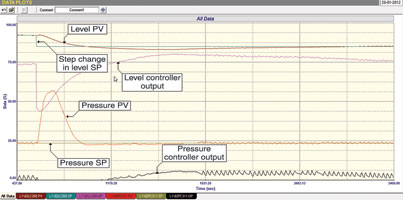
It can be seen that that the pressure controller is cycling. The reason for this is that the output of the pressure controller was operating at about 3%, because the pressure control valve was dramatically oversized. It is a well known fact that control valves do not operate well when controlling close to seat and there is a general rule of thumb that they should always operate above an opening of 20%. They tend to become very non-linear below that, and can cycle at small openings, as is happening in this case.
When the set-point of the level controller was stepped down, the pressure rose sharply in the line, and the pressure control valve was unable to deal with the disturbance in pressure; the output went to zero. The operators were very concerned with the cycle on the pressure control valve as it was feared this could have a damaging effect on the pump.
However the remarkable thing about this example is that although the pressure control was unable to catch the surge, the feedback control was still able, under normal operating conditions, to keep the pressure at set-point, even with the valve operating at such a tiny opening.
These examples illustrate the remarkable ability of feedback control systems to be able to keep processes at desired set-points in spite of relatively serious valve problems.

Michael Brown is a specialist in control loop optimisation, with many years of experience in process control instrumentation. His main activities are consulting, and teaching practical control loop analysis and optimisation. He gives training courses which can be held in clients’ plants, where students can have the added benefit of practising on live loops. His work takes him to plants all over South Africa, and also to other countries. He can be contacted at Michael Brown Control Engineering cc, +27(0)11 486 0567, michael.brown@mweb.co.za, www.controlloop.co.za
| Email: | michael.brown@mweb.co.za |
| www: | www.controlloop.co.za |
| Articles: | More information and articles about Michael Brown Control Engineering |






© Technews Publishing (Pty) Ltd | All Rights Reserved
 printer friendly version