



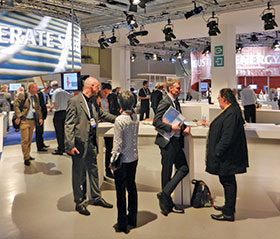
The Emerson ‘Global User’s Exchange’, for their customers and potential customers in Europe, Middle East and Africa, was held in Brussels in April. As with all the leading automation, control and instrumentation suppliers in the world, Emerson Process Management has developed this style of single company Expo, because it is difficult to present their whole product range and capability in any commercial, third-party exhibition: there would not be enough space. Indeed even in their own dedicated display hall, not all their product capability was on show.
The same is true of the presentations and keynote speeches. The Emerson business is so big, based on large automation projects, that these have to be the main focus of the management comments. Your SAI&C editor, Steven Meyer, has explained the Emerson presentations describing ‘Project Certainty’ in his report on the event. The fascinating detailed product and technology developments in temperature, analytical or corrosion instrumentation also on show did not get top billing, but they were there, in the background.
I have to declare that I need to understand a product or technology to become enthusiastic about it, and in general, I have found instrumentation easier to understand than automation software. Emerson has always put an emphasis on instrumentation, and invested in this by developing or acquiring innovative new techniques and companies in the area – more so than the other majors. Then by adding their own knowledge power, they add interfaces and capability, such as HART and Wireless communications, manufacturing technology, housings and mods for industry-wide approvals. So I am an Emerson fan. But because technology grows, it does become harder to understand the way these instruments actually work! For me, a visit to the Emerson Expo is like opening a treasure chest, filled with ideas and enthusiastic people available to explain their latest kit.
Wireless interfaces link everything
The Emerson dedication to WirelessHART communications with all instrumentation, as a standard option, opens up the possibility of adding modern technology sensors into existing plant and processes without the major hassles of adding new cables.
Rosemount temperature sensors have had a wireless capability from ‘Day 1’: and various companies made such wireless sensors capable of being clamped or strapped to the outside surface of a pipe, to make them totally non-intrusive, and easily re-positioned. The Rosemount engineers have gone one step further, recognising the measurement errors possible with an external sensor affected by the environment. They have developed X-well technology, available with a clamp for pipe ODs between 12 and 1200 mm, which incorporates a layer of thermal insulation 13 mm thick and covering a 300 mm length of the pipe. All this helps to bring the temperature sensor measurement closer to the actual pipe contents temperature, but in addition the electronics senses the ambient temperature, and uses a thermal conductivity algorithm to make a further correction, before transmitting the data over the wireless link.
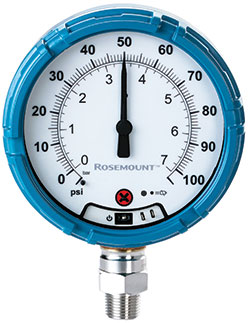
Similarly, Rosemount lateral thinking has applied wireless technology and piezo-resistive pressure measurement to the pressure gauge. This modern design of an ancient instrument replaces the original Bourdon tube measurement element with a modern sensor capsule, which uses the battery power to drive a needle around a 270° scale on a 115 mm indicator. Then the WirelessHART connection transmits the actual process pressure to a central monitoring system. This new indicator gauge is much safer than the old design – with two layers of process isolation from the gauge body it can withstand a 150x overpressure, and is much less affected by plant vibration.
Emissions monitoring
One of the most advanced product ranges demonstrated in Brussels came from Cascade Technologies, of Stirling in Scotland, which was acquired for Rosemount Analytical at the end of 2014. Cascade has developed some clever laser based systems for gas analysis, for example for Continuous Emissions Monitoring (CEM) systems, which allows them to measure for multiple gas types simultaneously. In the words of one of the experts, they effectively have up to nine lasers operating at different frequencies in one analyser, enabling monitoring for a similar number of gas concentrations. Similar systems have been used to monitor up to a total of 20 gases simultaneously. Their enthusiastic engineers were saying that following the Emerson involvement in the company, they would be launching four new products this year – but no data is available yet!
Another essential, but older, safety and emissions monitoring product range has been updated by the addition of an Emerson WirelessHART data link. In 2013, Emerson acquired Enardo, a Tulsa-based manufacturer of mechanically operated pressure and vacuum relief valves, which are used to protect storage tanks for oil/gas, petrochemical and pharma plants – Enardo is now part of the Fisher Regulators business. These valves relieve the tank vapour pressure when the tank is filled, or the temperature rises, or allow air to enter as the tank is emptied, preventing any pressure damage to the tank walls. But safety concerns and modern emission regulations require the valve actions to be monitored: and with no existing wiring installed to transmit such signals, the WirelessHART systems provide a simple solution.
Corrosion monitoring
It was way back in 2009 when Emerson acquired Roxar of Norway, who then specialised in systems for monitoring offshore wells and oil pipelines.
The technology involved in the Roxar sensors has developed a long way: they don’t just use ultrasonic detectors to measure the sound of sand and grit hitting the pipe walls! The ER corrosion sensors use a probe with a thin, exposed electrical conductor embedded in an insulator, inserted in the pipe wall. Corrosion of this element changes the resistance of the conducting path, which is monitored. Various designs are available, to adjust the sensitivity of the sensor. LPR probes are Linear Polarisation Resistance probes, which are electrochemical, so require the presence of a conductive liquid, like water, to function. The current response achieved when a small (10-20 mV) known polarisation is applied between the electrodes exposed to the liquid, gives the corrosion rate, using electrochemical theory. These Roxar sensors with their CorrLog electronics are now available with WirelessHART communications, making them much easier to apply to any pipe work area that is considered at risk from corrosion – and for modern plants using different sources and compositions of feedstock, the corrosion rates can vary significantly from one batch to the next.

Nick Denbow spent thirty years as a UK-based process instrumentation marketing manager, and then changed sides – becoming a freelance editor and starting Processingtalk.com. Avoiding retirement, he published the INSIDER automation newsletter for 5 years, and then acted as their European correspondent. He is now a freelance Automation and Control reporter and newsletter publisher, with a blog on www.nickdenbow.com






© Technews Publishing (Pty) Ltd | All Rights Reserved
 printer friendly version