


System Integration & Control Systems Design


Pervasive sensing changes the fundamentals of automation

November 2014 System Integration & Control Systems Design

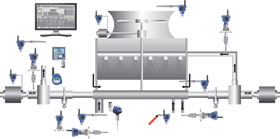
We are entering a new age in industrial automation and it is called ‘pervasive sensing’. Brought about by the advent of wireless technologies and the reduction of the cost of sensors, this event enables oil and gas refineries, chemical plants, mining sites and other industrial facilities to expand their use of sensors and extend the focus beyond traditional process control. Pervasive sensing allows the industry to get more and deeper data faster, providing it with greater visibility to operate increased safety, reliably and profitably.

Previously, the industry was limited to monitoring conditions that were critical to producing efficiently. Maintenance and reliability were addressed by conducting manual checks, which was time-consuming, inefficient, costly, and sometimes even risky – especially for personnel working in distant and hazardous production environments. And because finding failures was dependent on the frequency and quality of the manual checks, maintenance teams would usually discover equipment issues when the damage was already too big. While the industry has already recognised that this is not the ideal set-up, most producers stick to this practice because it provides reasonably stable operations.

Industrial wireless and affordable sensors are the drivers

The availability of wireless, non-intrusive, affordable and easy-to-use sensors that can continuously monitor and detect operations is changing the status quo. Many industrial facilities are quickly adopting pervasive sensing strategies to be able to anticipate impending equipment failures and prevent unplanned outages. Plant personnel, for example, use a variety of wireless sensors to detect motor bearing or seal failures, identify pump cavitation, monitor equipment temperatures, and quickly see an array of faulty conditions that can affect operations.

In addition, industrial facilities are taking advantage of sensing technologies to extract value from their operations. An International Energy Agency (IEA) study states that regardless of which segment of industry one is in, there is a potential for 50% improvement in energy use, which is a big opportunity to save energy costs.

Safety and the environment are the focus

Safety and environment are focus areas of pervasive sensing. The industry wants the same thing in any plant anywhere in the world, and that is to achieve zero incidents. A global oil and gas producer with a hydrocarbon production facility in Belgium, for instance, implemented a wireless leak detection system that has enabled it to gather information from sensors which continuously monitor hazardous areas such as storage tanks, valves and pipelines throughout the plant, and to deliver information to the control system so plant personnel can be instantly notified of any leaks.

Because of wireless technology, this producer was able to eliminate the need for new instrumentation cabling and associated trenches and ducting, saving an estimated 50% of the cost and 90% of the time required to install a conventional wired system.

Pervasive sensing solutions are currently being deployed in many industrial facilities around the world today. As sensors continue to advance and wireless technologies continue to be widely adopted, the industry will be able to address its challenges and increase its ability to maximise production returns. The first step in harnessing pervasive sensing is to conduct an audit of the plant assets and current work practices and identify opportunities where sensing should be added.

For more information contact Ron Raubenheimer, Emerson Process Management, +27 (0)11 451 3700, [email protected], www.emersonprocess.com


Credit(s)


Share this article:
Share via emailShare via LinkedInPrint this page

Further reading:

Project and industry
System Integration & Control Systems Design
XEL EE was contracted to deliver the complete electrical, control and instrumentation scope for the upgrade of a gold mine's water treatment facilities in Tanzania.

Read more...
Turning system integrators into trusted technology partners
Schneider Electric South Africa IT in Manufacturing System Integration & Control Systems Design
Schneider Electric’s Alliance Partner Programme is repositioning system integrators from hardware suppliers into lifecycle-value partners. Oriel Soupen explains the competency framework, certification model and real-world results that are already helping African system integrators win higher-value, longer-term engagements.

Read more...
When digital twins move from concept to critical tool
IT in Manufacturing System Integration & Control Systems Design Maintenance, Test & Measurement, Calibration
Digital twins are moving out of the lab and onto the mine, the factory floor and the transport network where they predict failures before they happen. Amritesh Anand looks at where they earn their keep, the data and integration work behind them, and the security questions every organisation should ask before switching one on.

Read more...
Best practices for managing the MRO supply chain in Africa
RS South Africa System Integration & Control Systems Design
RS South Africa outlines how strong data governance and digital tools can turn maintenance, repair and operations procurement into a strategic advantage across Africa.

Read more...
Containerised Solar Solution Accelerates Delivery of Riverside 3 MW Power Plant
Proconics System Integration & Control Systems Design
Proconics was engaged by NewFields to deliver the electrical integration solution for the Riverside 3 MW Solar Power Plant in Zimbabwe. The project required a compact, modular approach that could simplify deployment, minimise site works, and support rapid commissioning in a remote location.

Read more...
Modern Energy Metering Solution Enhances Reliability and Reporting for Major Power Utility
SAM Systems Automation & Management System Integration & Control Systems Design
This project involved the implementation of a modern energy metering system for a major power utility operating within the industrial automation and energy management sector. The objective was to improve the reliability, accessibility, and accuracy of energy data while simplifying infrastructure and reducing system complexity.

Read more...
PCS Global
PCS Global System Integration & Control Systems Design
PCS Global led a digital infrastructure initiative in a southern African data centre setting, aiming to merge several essential operational systems into one cohesive platform. The objective was to break down silos, enable real-time decisions, and ensure seamless operation in a mission-critical environment.

Read more...
Seamless migration from ET 200M to ET 200SP HA for future-ready automation
Moore Process Controls System Integration & Control Systems Design
Moore Process Controls undertook a modernisation initiative spanning the mining, petrochemical, and oil & gas sectors. This project involved upgrading legacy Siemens ET200M I/O systems to the advanced ET200SP HA platform.

Read more...
Proconics Modernises Refinery Tank Automation with Compliance-Focused, Brownfield Upgrades
Proconics System Integration & Control Systems Design
Project & Industry Proconics was engaged to modernise automation and SCADA systems across a refinery tank farm. The project involved complex brownfield integration, aligning new automation with existing ...

Read more...
Project & Industry
System Integration & Control Systems Design
Project: Upgrading essential automation and SCADA systems at a coal mine.    Outcome: A modern, stable automation and SCADA environment with reduced technical debt and easier support, ready for expansion. ...

Read more...


While every effort has been made to ensure the accuracy of the information contained herein, the publisher and its agents cannot be held responsible for any errors contained, or any loss incurred as a result. Articles published do not necessarily reflect the views of the publishers. The editor reserves the right to alter or cut copy. Articles submitted are deemed to have been cleared for publication. Advertisements and company contact details are published as provided by the advertiser. Technews Publishing (Pty) Ltd cannot be held responsible for the accuracy or veracity of supplied material.


© Technews Publishing (Pty) Ltd | All Rights Reserved

