October 2026Maintenance, Test & Measurement, Calibration
High-speed imaging has become an important engineering tool in applications where events occur too quickly for conventional imaging systems to capture and analyse effectively. Vision Research, a manufacturer of high-speed digital imaging systems, has expanded its Phantom range with its C-series cameras, designed for applications ranging from crash and safety testing to materials analysis and other high-speed research.
The C-series includes the Phantom C540 and C980 cameras, together with C540J and C980J versions developed specifically for crash and safety testing. The cameras incorporate low-noise sensors and are designed to deliver synchronised, artefact-free images under demanding test conditions.
For crash testing, the C540J and C980J are intended for both onboard and offboard applications. Their ruggedised design is rated to withstand acceleration forces of up to 170G, allowing the cameras to operate in the severe conditions encountered during vehicle impact testing. The systems are available with 4 and 8 megapixel sensors respectively. Standalone versions provide the same resolutions without requiring a separate junction box, packaging C- series imaging performance into a compact, self-contained camera suitable for applications where installation space and system complexity are important considerations.
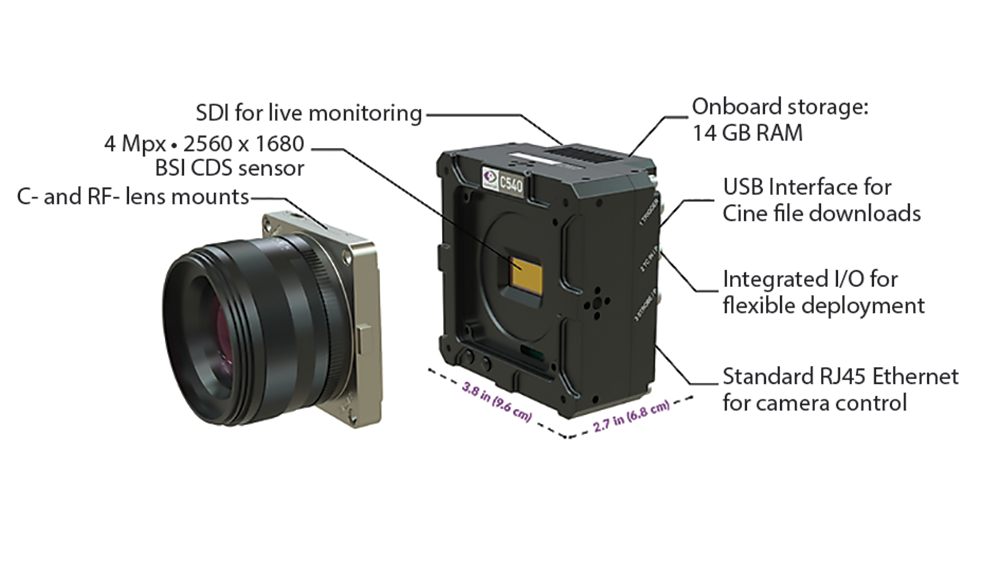
The Phantom C540 offers a maximum frame rate of 1140 frames per second at its maximum resolution of 2560 x 1680 pixels. It incorporates a 15,3 mm 1-inch sensor, has a minimum exposure time of 2 µs, and is equipped with 14 GB of RAM. The Phantom C980 provides a maximum resolution of 3840 x 2160 pixels, with a maximum frame rate of 1180 frames per second. It uses a 22 mm 4/3-inch sensor and also offers a minimum exposure time of 2 µs, with 28 GB of RAM.
Beyond the camera hardware itself, successful high-speed imaging depends heavily on understanding how to configure and use the equipment for a particular application. Factors such as frame rate, exposure time, lighting, triggering and image analysis can have a significant effect on the quality and usefulness of the resulting data.
Vision Research addresses this through its Phantom Academy which provides hands-on technical and web-based application-specific training for engineers working with high-speed imaging. Courses are presented by Vision Research engineers and invited industry specialists, combining technical principles with practical field examples and experience using high-speed imaging equipment. Advanced hands-on training covers specialised imaging applications and techniques, including ballistics and range applications, materials analysis, shadowgraphy and Schlieren imaging.
A Phantom Academy event is being planned for South Africa in 2027. The training will be conducted using the latest Phantom high-speed camera systems, and attendance will not be restricted to existing Phantom users. Engineers and researchers who do not currently own a high-speed camera, as well as those using equipment from other manufacturers, will also be able to attend.
From recording the dynamics of a vehicle impact to examining material behaviour and visualising rapidly changing flow phenomena, high-speed imaging provides engineers with a way of slowing down an event digitally so that its behaviour can be studied in detail. Vision Research products and Phantom Academy training are represented locally by Horne Technologies.
Electrostatic spark discharge – when static strikes back Wearcheck
Maintenance, Test & Measurement, Calibration
WearCheck technical manager, Steven Lumley explains how static electricity accumulates in modern low-conductivity lubricants, why compact system designs and fine filtration make ESD more likely, and how to recognise the degradation it leaves behind.
Read more...SKF extends remanufacturing expertise to bearing clearance modification SKF South Africa
Maintenance, Test & Measurement, Calibration
Using its clearance modification expertise, SKF helped a mining equipment OEM salvage spherical roller bearing inventory that would otherwise have been scrapped, confirming a new capability within its remanufacturing services and avoiding redundant procurement.
Read more...When maintenance-system compliance starts replacing plant reliability Wearcheck
Maintenance, Test & Measurement, Calibration
WearCheck ARC division manager, Annemie Willer argues that the greatest threat to effective maintenance is no longer a lack of technology, but the gradual replacement of technical judgement by CMMS compliance, leaving no one owning the machine.
Read more...Nitration: the acid you didn’t see coming Wearcheck
Maintenance, Test & Measurement, Calibration
Nitration is as destructive as oxidation in many engines but far less understood. WearCheck technical manager, Steven Lumley explains how nitrogen oxide gases degrade lubricants, why the process is difficult to detect, and what oil analysis can reveal before damage occurs.
Read more...KSB makes mechanical seals for its own pumps and other brands
Maintenance, Test & Measurement, Calibration
KSB Pumps and Valves is expanding its range of mechanical seals to fit its own pumps and competitor brands. The portfolio covers component and cartridge seals, API 682-compliant systems, slurry and high-pressure seals, and ATEX-certified solutions, supported by refurbishment and field service capabilities.
Read more...Omniflex delivers ICCP systems in London Omniflex Remote Monitoring Specialists
Maintenance, Test & Measurement, Calibration
Omniflex has supplied impressed current cathodic protection systems for landmark London buildings, protecting reinforced concrete from corrosion and extending the service life of commercial, retail and heritage sites.
Read more...Modernising acid cooler protection without disrupting production Omniflex Remote Monitoring Specialists
Maintenance, Test & Measurement, Calibration
Omniflex has supplied an advanced anodic protection control system to phosphate producer Foskor, replacing a legacy transformer rectifier system while maintaining uninterrupted production. The distributed PowerView CP solution provides remote monitoring and DCS integration.
Read more...Engineering partnership delivers longer life for vibrating feeders in mining
Maintenance, Test & Measurement, Calibration
OST-Africa’s combination of VISAM vibrating motors and advanced rubber mounting technology has helped Euro Sales achieve a 30 to 40% increase in component life on vibrating feeders at several major mining operations, with zero mount failures in the first 12 months.
Read more...When oil can’t take the heat Wearcheck
Maintenance, Test & Measurement, Calibration
Unlike the slow ageing of oxidation, thermal breakdown is the sudden chemical collapse of a lubricant under excessive heat. Steven Lumley of WearCheck explains how it happens, where it strikes, and how oil analysis detects it.
While every effort has been made to ensure the accuracy of the information contained herein, the publisher and its agents cannot be held responsible for any errors contained, or any loss incurred as a result. Articles published do not necessarily reflect the views of the publishers. The editor reserves the right to alter or cut copy. Articles submitted are deemed to have been cleared for publication. Advertisements and company contact details are published as provided by the advertiser. Technews Publishing (Pty) Ltd cannot be held responsible for the accuracy or veracity of supplied material.










 printer friendly version