



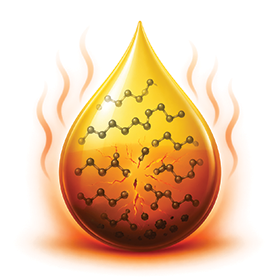
In the world of machinery, stress comes in many forms; from load and contamination to operating conditions, and few are as relentless or unforgiving as heat. Every lubricant has a limit known as thermal breakdown. Unlike oxidation, which slowly ages the oil over time, thermal breakdown occurs when temperatures rise beyond what the lubricant can chemically withstand. Rather than a gradual decline, it is the point where the oil stops performing and starts failing. When oil cannot take the heat, it breaks.
What thermal breakdown is
Thermal breakdown is the decomposition of lubricant molecules due to excessive heat. As temperatures increase, they eventually exceed the strength of the chemical bonds holding the hydrocarbon molecules together. Once this threshold, also known as the thermal stability limit is crossed, these bonds begin to rupture. This process is commonly referred to as thermal cracking.
Typically, this becomes significant at temperatures above approximately 200°C where the lubricant is no longer stable and begins to degrade rapidly. At these conditions the oil is no longer just ageing, it is chemically breaking down at a molecular level.
What happens inside the oil
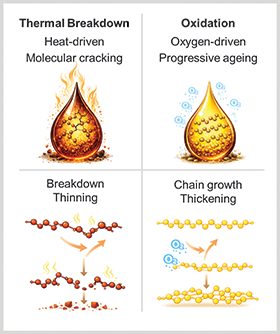
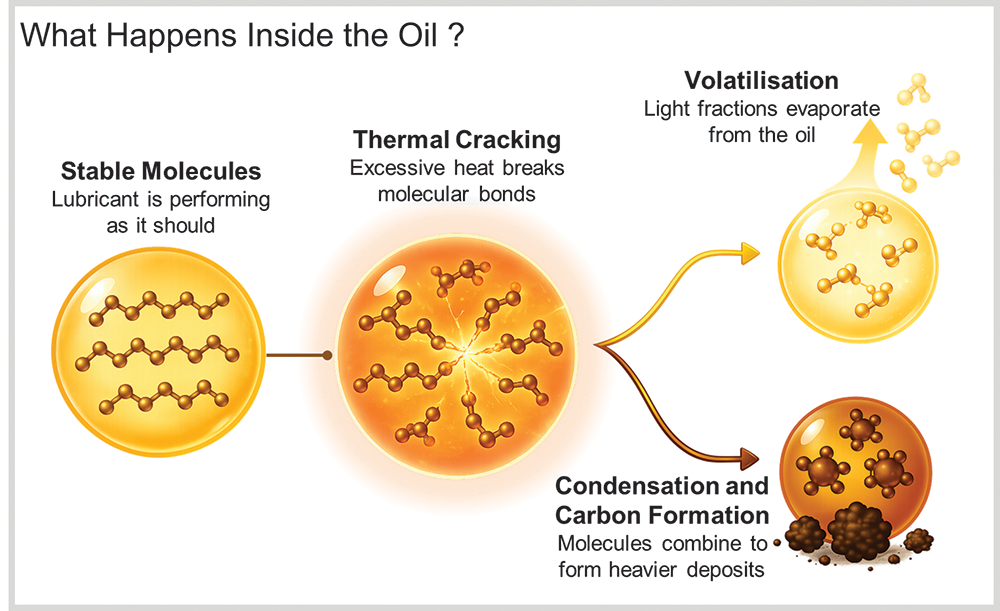
When thermal cracking occurs, the lubricant does not degrade through a single mechanism. Instead, two competing processes take place.
Molecular cleavage and volatilisation
Large hydrocarbon molecules break into smaller, lower molecular weight molecules during thermal cracking. While many of these remain relatively light, some can recombine into heavier, unstable structures that contribute to deposit formation. At the same time, some of these smaller molecules are light enough to evaporate and leave the system entirely, meaning that no deposits are formed from this portion of the process. As a result, oil volume may decrease and volatility increases, effectively causing the oil to boil off its lighter components.
Condensation and carbon formation
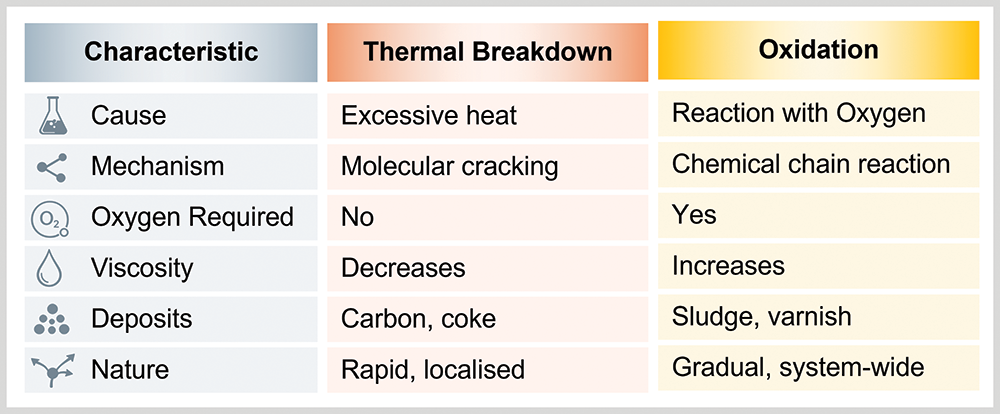
The remaining molecules behave very differently. In the absence of oxygen, they can recombine and condense, undergoing structural rearrangement and forming increasingly complex carbon structures. Over time this leads to the formation of lacquers, carbonaceous residues and coke, the final and most severe form of deposit. These deposits are hard, brittle and bond strongly to surfaces, in contrast to the softer sludge and thin varnish films typically associated with oxidation.
The signature effect on viscosity
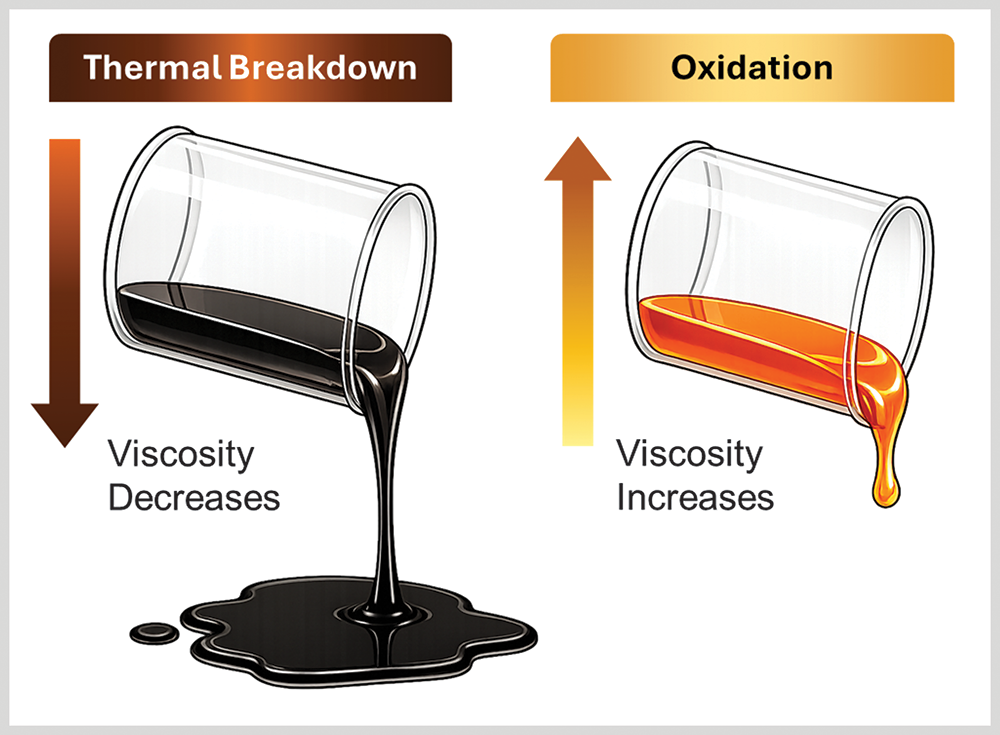
One of the most important indicators of thermal breakdown is its effect on viscosity. As large hydrocarbon molecules crack into smaller, lighter molecules, the oil becomes progressively thinner. This reduction in molecular size directly translates into a decrease in viscosity. This difference is critical in oil analysis and often provides the first clue as to which degradation mechanism is dominant. At the same time the additive system is also under stress. Antioxidants, dispersants and anti-wear additives all have thermal limits, and at elevated temperatures they can degrade or become inactive, further accelerating lubricant failure.
Where and why it happens
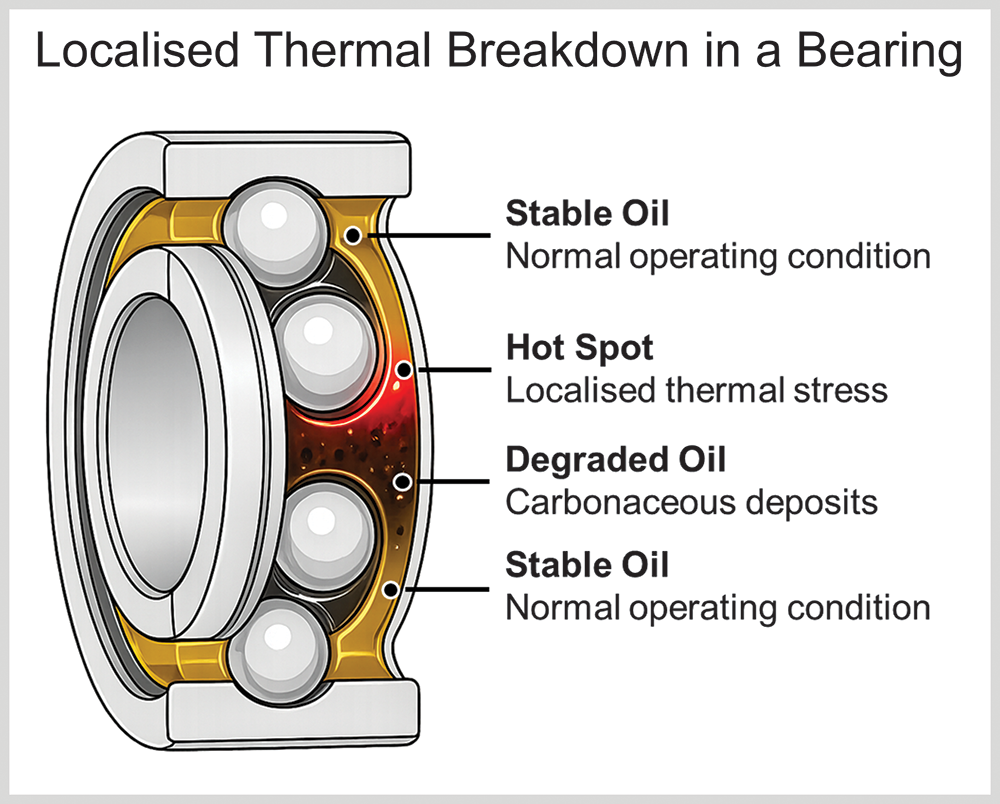
Thermal breakdown is rarely a system-wide phenomenon. Instead, it tends to occur in localised hot spots where temperatures spike well above the bulk oil temperature. Typical locations include:
• Heavily loaded bearings
• Gear-tooth contact zones
• Piston-ring zones
• Compressor-discharge areas
These are areas where:
• Heat generation is high
• Oil flow is limited
• Heat removal is limited
Even when bulk oil temperatures appear acceptable, these localised zones can exceed 200°C, triggering thermal cracking.
Temperature, the breaking point
Temperature is the dominant driver of thermal degradation. While increasing temperature accelerates all degradation processes, such as oxidation, thermal breakdown occurs when the lubricant is pushed beyond its thermal-stability limit. A useful rule of thumb is that for every 10°C increase above around 75°C, the life of the oil is effectively halved. By the time temperatures approach 200°C, this reduction becomes extreme and the lubricant’s life is reduced to a fraction of its intended service life. At these extremes, degradation is no longer a slow chemical process, it is a rapid failure mechanism.
Thermal breakdown vs oxidation
Thermal breakdown and oxidation are often confused, and while they can occur simultaneously, they are fundamentally different processes. Oxidation is a progressive ageing process, whereas thermal breakdown is more closely associated with rapid lubricant failure. The two can also interact. At elevated temperatures, thermal cracking produces unstable, highly reactive molecules that accelerate oxidation, compounding the degradation process.
Consequences for machinery
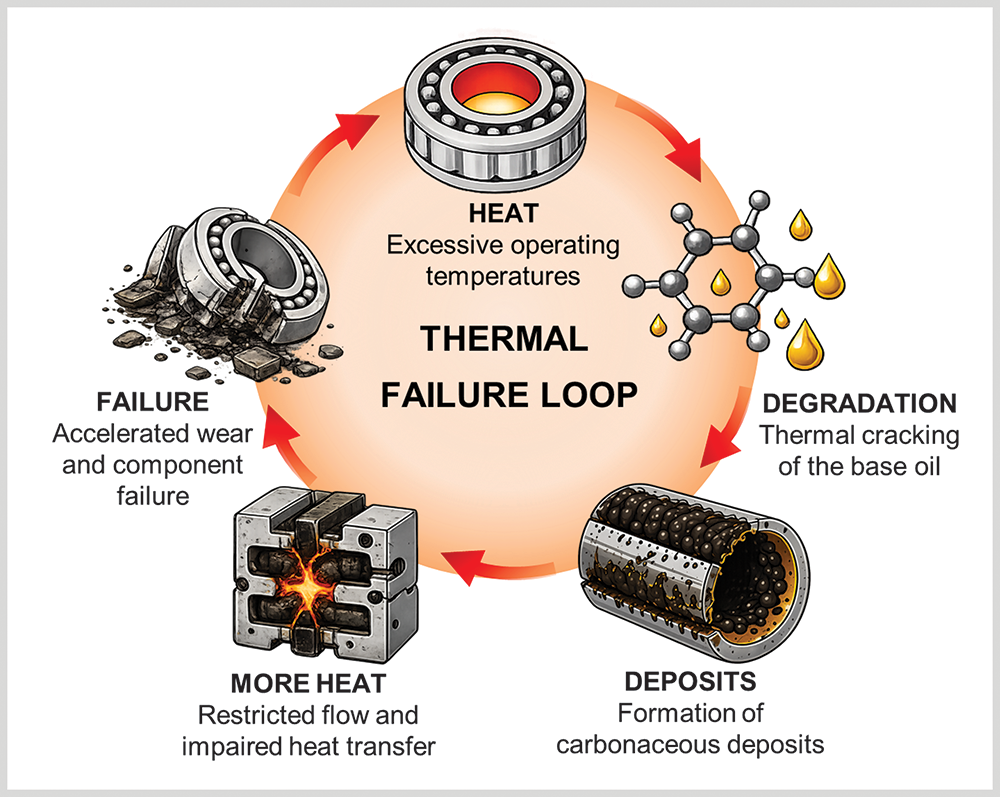
Thermal breakdown has immediate and often severe consequences. As the oil loses viscosity, the lubricating film becomes thinner, increasing the likelihood of metal-to-metal contact and accelerating wear rates. At the same time, carbonaceous deposits begin to form and adhere to surfaces, restricting oil flow, impairing heat transfer and promoting the development of further hot spots. In extreme cases this can lead to a feedback loop where heat drives degradation, degradation forms deposits and these deposits generate even more heat, eventually resulting in rapid component failure.
Detecting thermal breakdown through oil analysis
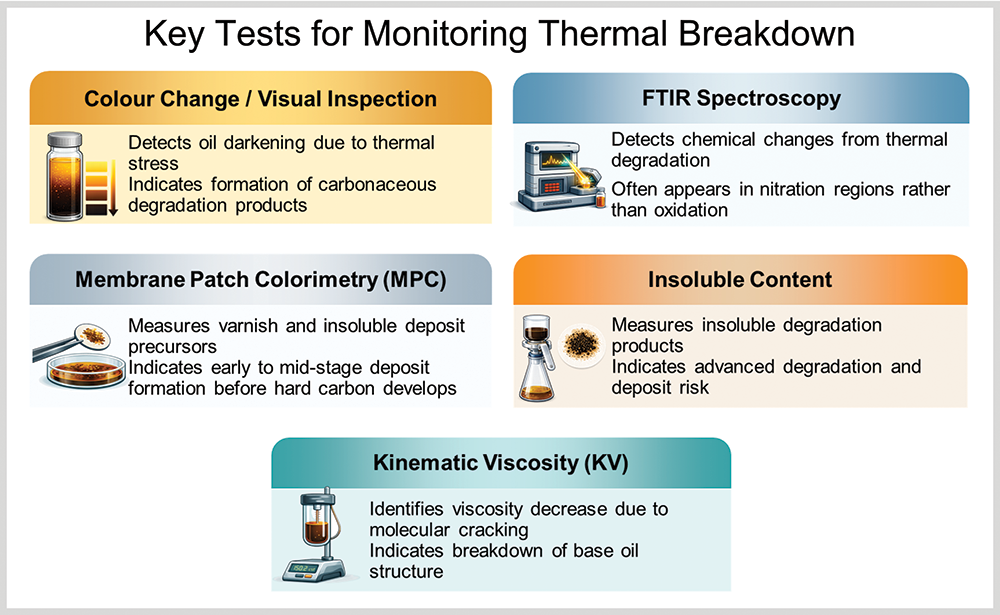
Thermal degradation is not always obvious in its early stages, but there are several indicators that can point to its presence. One of the earliest and most visible signs is a change in oil colour. As thermal breakdown progresses, the oil typically darkens due to the formation of carbonaceous and insoluble degradation products. In more severe cases, the oil may appear dark brown or even black, indicating significant thermal stress. The key tests used to assess thermal breakdown are summarised below.
Unlike oxidation, acid number may show little or no change in the early stages, making it a less reliable standalone indicator of thermal breakdown. As a result, thermal degradation is best identified through a combination of visual inspection and supporting analytical trends, rather than a single definitive test.
The reality of thermal breakdown
Thermal breakdown is typically a sign that something has gone wrong, rather than an inevitable ageing process. It reflects underlying issues such as excessive heat, poor cooling, overloading or design limitations that lead to the formation of localised hot spots. While filtration may remove some of the resulting deposits, it does not address the root cause. If the temperature problem persists, the oil will continue to degrade.
Final thought
If oxidation is the slow ageing of oil, then thermal breakdown is its sudden collapse. Understanding the difference is critical, because while oxidation can be managed, thermal breakdown demands intervention. Left unchecked, it does more than degrade the oil, it removes its ability to function altogether. When this happens, failure is not far behind.
| Tel: | +27 31 700 5460 |
| Email: | [email protected] |
| www: | www.wearcheck.co.za |
| Articles: | More information and articles about Wearcheck |






© Technews Publishing (Pty) Ltd | All Rights Reserved
 printer friendly version