



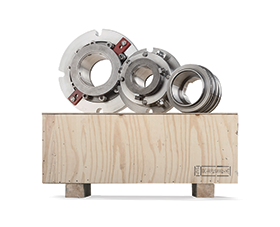
KSB Pumps and Valves continues to expand its range of mechanical seals for its own pumps while introducing solutions suited to a wide number of competitor pumps and applications. The company has developed and manufactures its own range of mechanical seals matched exactly to the purpose of different pumps, produced to the same exacting standards as its equipment.
“Most people know KSB as a pump manufacturer and are surprised to learn that we also design, manufacture and support our own range of mechanical seals for nearly every pump type, and that we are continually expanding our portfolio to meet customer needs,” says Phumelela Ngcobo, KSB SupremeServ sales engineer for mechanical seals.
Mechanical seals are essential for the reliable operation of many pump types. Their primary purpose is to prevent the pumped material from leaking along the rotating shaft, ensuring that the fluid stays safely contained within the pump and does not leak into the surrounding environment.
Ngcobo explains that KSB’s own mechanical seal range originated from its continuous drive to improve pump performance. During the development of one pump range, KSB engineers encountered recurring seal failures that could not be resolved by changing operating practices alone.
“Because we know and understand pump designs, we have a detailed understanding of hydraulic performance, shaft behaviour, bearing arrangements, and the operating conditions inside the seal chamber. This allowed our engineers to identify the root causes of the failures, and develop sealing solutions specifically designed to overcome these challenges,” he says. “Today, our range includes sealing solutions for the vast majority of KSB pumps, together with universal mechanical seals suitable for many competitor brands. Where a standard solution is unavailable, our engineering team will develop custom sealing systems based on pump dimensions and detailed process information supplied by the customer.”
The range includes component and cartridge mechanical seals in single and dual arrangements, pump-specific sealing solutions, seals manufactured in accordance with DIN EN 12756, API 682-compliant sealing systems for process pumps, slurry application seals, boiler feed pump seals, high-pressure mechanical seals, and ATEX-certified sealing solutions for hazardous environments.
A significant advantage of this approach is the ability to offer customers complete sealing solutions from a single source. In addition to mechanical seals, the portfolio includes API 682-compliant seal support systems, piping plans, seal pots, heat exchangers, flow meters and associated instrumentation. Supplying these components as an integrated package ensures compatibility between the sealing equipment and support system, simplifying procurement, installation, commissioning and ongoing maintenance, while enhancing overall system reliability.
Material selection
Every application is unique and the materials selected for a mechanical seal are chosen to maximise reliability under specific operating conditions. For general industrial duties, reaction bonded silicon carbide is often the preferred choice, offering wear resistance and reliable performance across a wide range of applications. For more demanding services involving aggressive chemicals, elevated temperatures or higher operating pressures, sintered silicon carbide is typically specified for its corrosion resistance, higher mechanical strength and performance under severe operating conditions.
Carbon is widely used as a seal face material for its self-lubricating properties and low coefficient of friction, making it suitable for clean fluid applications including food and beverage processing. For more demanding conditions involving higher temperatures and pressures, antimony-impregnated carbon is often specified for its improved mechanical strength, wear resistance and thermal conductivity. Where pumps handle abrasive slurries or fluids containing suspended solids, tungsten carbide is frequently selected for its hardness and resistance to abrasive wear.
“Standard metallic components are manufactured from 316L stainless steel, while highly corrosive applications may require upgraded materials such as super duplex stainless steel. Secondary sealing elements are carefully selected with elastomers, including FKM, EPDM and FFKM, specified according to the chemical compatibility and operating temperature of each application. There are many variables and it pays to deal with our team rather than to guess, because every seal is engineered using the most appropriate combination of materials for the customer’s operating conditions,” Ngcobo explains.
Industries served and aftermarket support
KSB mechanical seals serve a wide range of industries including mining, water and wastewater, petrochemical processing, power generation, pulp and paper production, chemical processing, food and beverage manufacturing, and general industry. These are supported by KSB SupremeServ’s dedicated refurbishment facilities which repair KSB and competitor mechanical seals.
“Every seal that enters our workshop undergoes a detailed inspection before refurbishment. Once assembly has been completed, seals are pressure tested to ensure they meet our quality standards, and no refurbished seal leaves our workshop without passing these tests,” says Ngcobo.
KSB’s aftermarket support extends beyond workshop repairs. Field service technicians provide mechanical seal installation, auxiliary system installation, commissioning assistance, seal failure investigations, and on-site technical support to assist customers in identifying the underlying causes of premature failures. KSB SupremeServ also offers technical training covering mechanical seal fundamentals, seal selection, API 682 piping plans, auxiliary systems, installation best practices, and seal failure analysis.
For more information contact Annett Kriel, KSB Pumps and Valves South Africa,






© Technews Publishing (Pty) Ltd | All Rights Reserved
 printer friendly version