



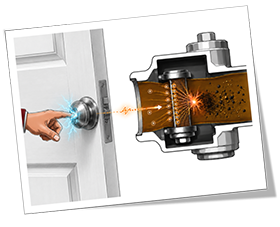
Static electricity is one of those small annoyances that rarely demands serious attention. The familiar moment of shuffling across a carpet, reaching for a door handle and meeting a tiny spark is mildly irritating and usually harmless, because the amount of energy involved is small and the environment is relatively forgiving. Put the same basic phenomenon inside a circulating oil system, where dry, low-conductivity oil moves at high velocity through filters, pipework and tight clearances, and that small spark becomes something far more destructive.
Inside a lubricant, static electricity does not just cause a momentary surprise. It can scar filter elements, generate free radicals, accelerate oil degradation and trigger the formation of varnish and sludge. This is electrostatic spark discharge or ESD: the point at which static electricity turns from a nuisance into a degradation mechanism.
What ESD is
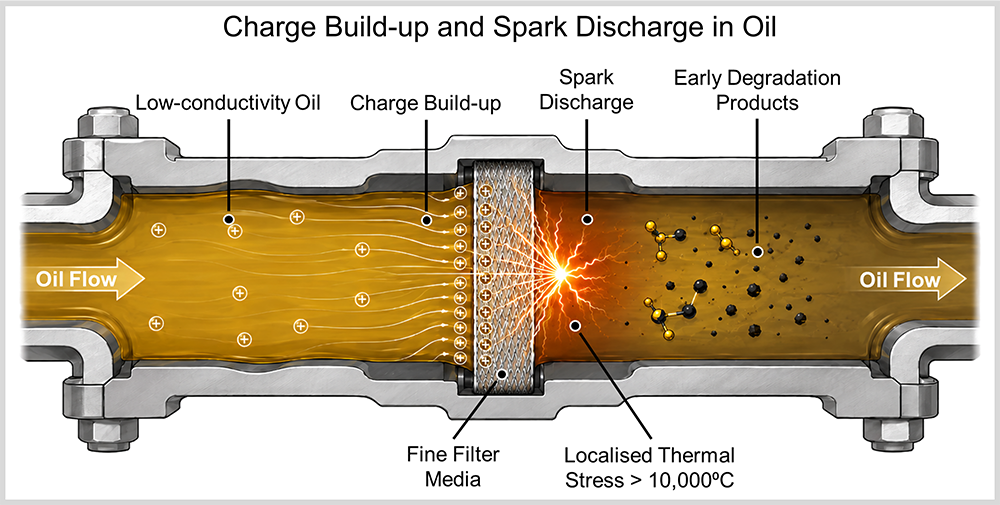
ESD occurs when static electricity builds up within a lubricant and suddenly discharges as a spark. As oil flows through a system, charge separation can occur between the oil and the surfaces it passes over. This is most likely when the oil is dry, clean, low in conductivity and moving quickly through tight clearances or fine filter media. If the charge cannot dissipate safely, it accumulates until it discharges, often at a filter element, sharp edge, reservoir surface or another release point. The spark may be microscopic, but the temperatures generated can be extreme. ESD sparks in oil can produce localised temperatures above 10 000°C, high enough to thermally stress or fragment oil molecules almost instantly.
Why modern systems are more vulnerable
ESD is not a new phenomenon, but it has become more noticeable in modern turbines, hydraulic and circulating oil systems. One reason is the shift from Group I to more highly refined Group II and Group III base oils. These oils are cleaner and more oxidation resistant, but they often have lower electrical conductivity because they contain fewer polar compounds. Conductivity determines how easily an oil can dissipate static charge. The lower the conductivity, the greater the risk that charge will build up rather than bleed away harmlessly.
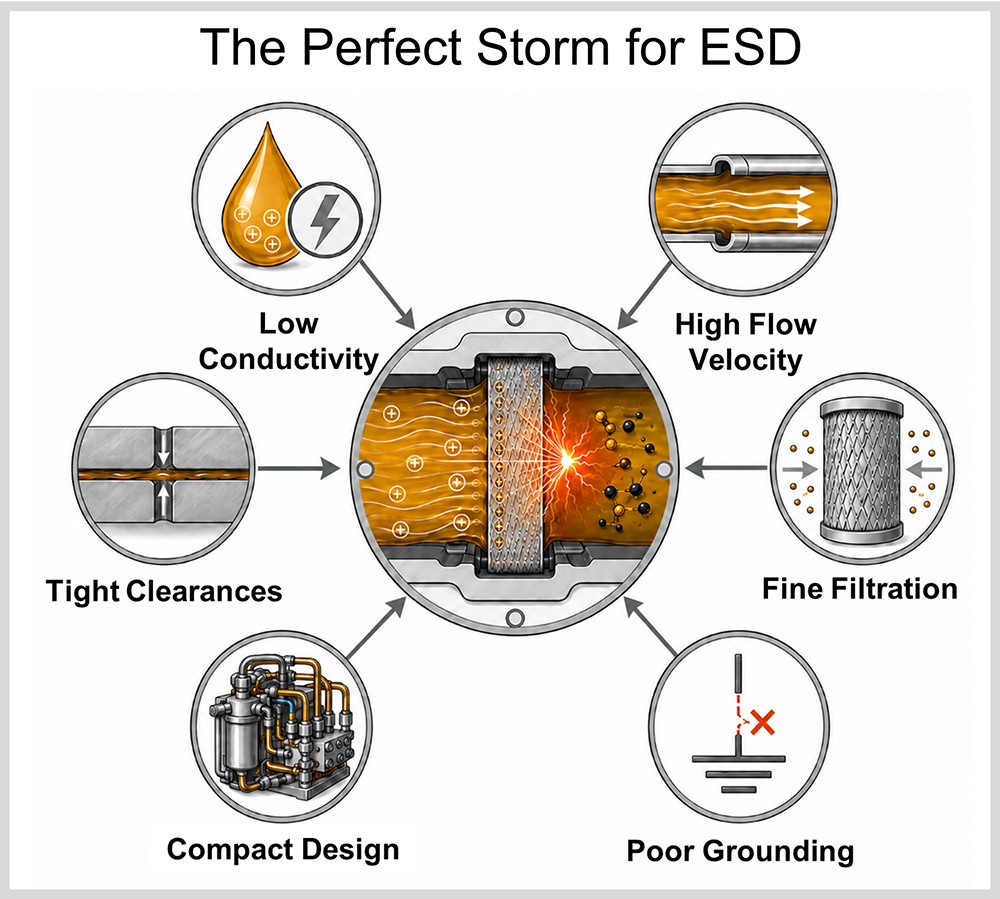
Modern system design can add to the problem. Smaller reservoirs, higher flow rates, finer filtration, compact pipework and tighter clearances all increase the opportunity for charge generation. Filters are especially significant, because oil is forced through fine media at high velocity. ESD is not the result of one isolated cause. It is typically the product of several factors converging: low oil conductivity, high flow velocity, fine filtration, poor grounding, and compact system design all creating the conditions for static discharge.
What happens inside the oil
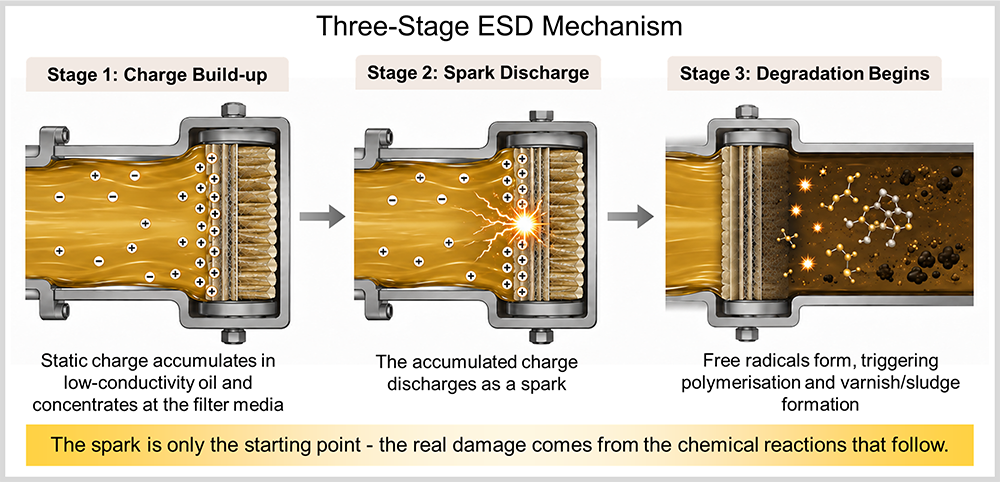
ESD can be understood as a three-stage process. Static charge builds up as oil moves through the system and interacts with pipes, filter media, hoses, valves and reservoirs. If the oil has low conductivity, the charge cannot dissipate quickly enough. The accumulated charge then discharges as a spark. The event is extremely localised and short-lived, but the temperature at the point of discharge can be high enough to break chemical bonds in the lubricant. The spark initiates chemical degradation; oil molecules fragment, free radicals form and polymerisation reactions begin. As these reactions progress, varnish precursors, sludge and insoluble degradation products are produced.
This is why ESD is so closely associated with varnish. The spark is only the beginning, but the real damage comes from the chain of chemical reactions that follows.
Different triggers, different damage
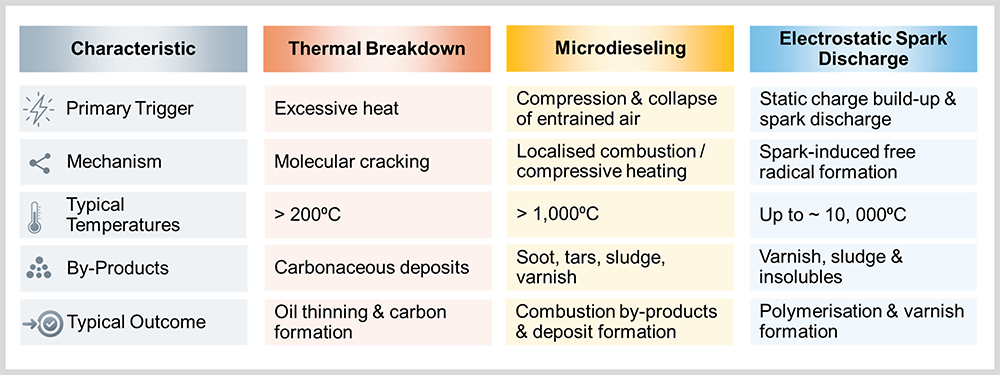
ESD is often grouped with thermal breakdown and microdieseling because all three involve highly localised degradation. However, the mechanisms differ. Thermal breakdown is driven by excessive heat and molecular cracking. Microdieseling is driven by rapid compression and collapse of entrained air bubbles. ESD begins with static charge build-up followed by spark discharge. The result also differs; thermal breakdown tends to thin the oil and form carbonaceous deposits, while microdieseling produces soot, tars, sludge and varnish-type material. ESD generates free radicals that promote polymerisation, leading principally to varnish, sludge and insolubles.
Where ESD occurs
ESD is most commonly associated with circulating oil systems, particularly turbine, hydraulic and transformer oils. It is most likely to occur where low-conductivity oil moves rapidly through fine filters, narrow passages or high-velocity zones. Mechanical filters are a common site. Tight-pore media and high filter-flux rates can generate significant static charge, leading to brief but intense spark discharges that thermally stress the oil and consume antioxidant additives. Practical warning signs include faint clicking, ticking, buzzing or crackling near filters or reservoirs while the system is running. Burnt patches or pinholes in filter media are also classic indicators of static discharge.
Consequences for machinery
ESD damages both the lubricant and the machine. In the oil, it accelerates degradation, depletes antioxidants and promotes varnish precursors, sludge and insolubles. The oil may darken, thicken or show increased varnish potential before obvious mechanical symptoms appear. In the machine, varnish can stick servo valves, restrict oil flow, reduce heat transfer, plug filters and increase wear. Sparks may also burn pinholes through filter media, allowing particles to pass through instead of being captured.
Detecting ESD through oil analysis
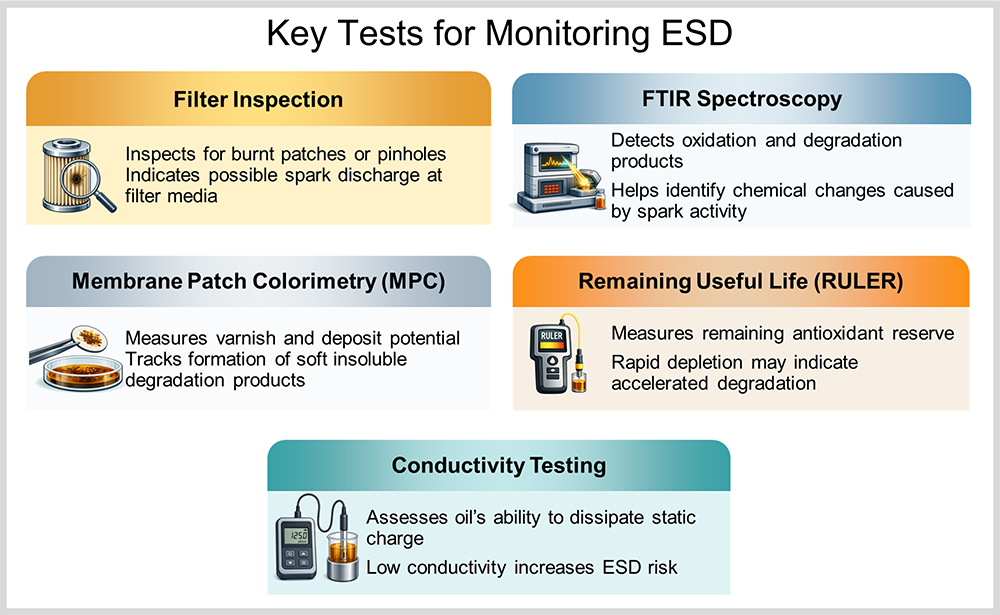
ESD can be difficult to confirm using a single oil analysis test. It is identified through a combination of field observations, inspection findings and laboratory trends. Useful clues include crackling or ticking sounds near filters, burnt or pinholed filter elements, abnormal varnish formation, rising insolubles and unexplained antioxidant depletion.
Final thought
The danger of ESD lies in its scale. The spark is microscopic, the event is brief and the bulk oil temperature may appear perfectly normal. But each discharge can break oil molecules apart, generate free radicals, consume antioxidants and begin the slow formation of varnish and sludge. Changing the oil may remove the symptoms but will not address the problem if the system continues to generate and discharge static. In lubrication systems, static charge may be unavoidable, but damaging discharge is not. The next instalment in this series will explore electrostatic spark discharge in transformer oils specifically.
| Tel: | +27 31 700 5460 |
| Email: | [email protected] |
| www: | www.wearcheck.co.za |
| Articles: | More information and articles about Wearcheck |






© Technews Publishing (Pty) Ltd | All Rights Reserved
 printer friendly version