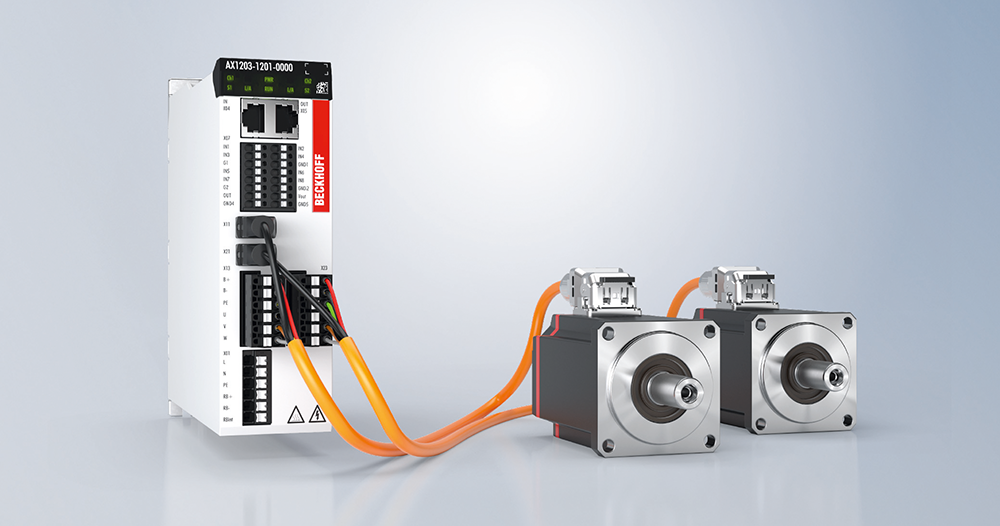
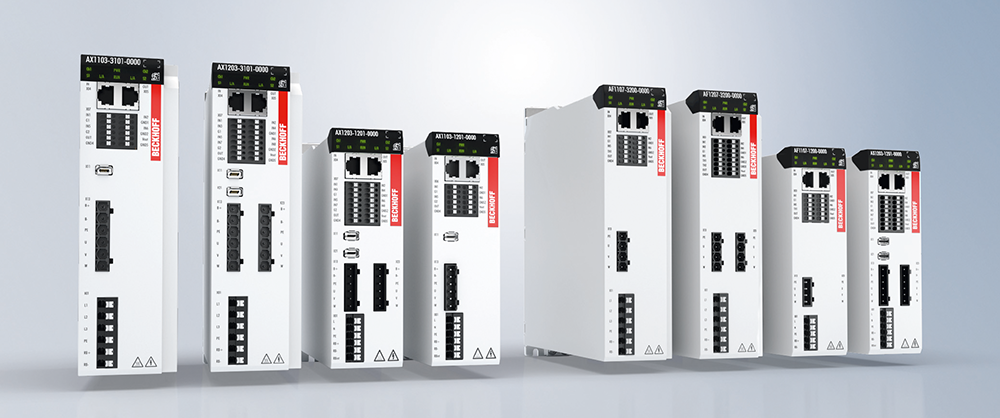
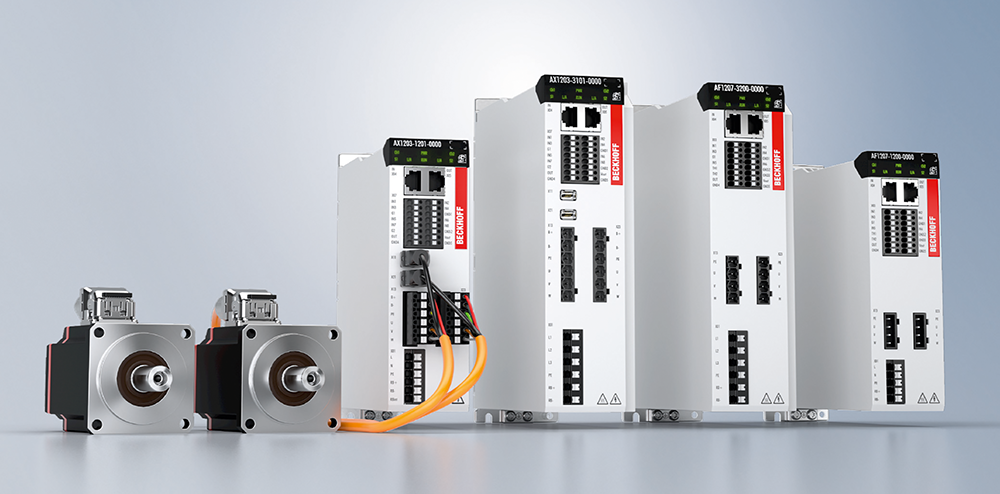
Global cost pressure in machine building is forcing many designers to re-adjust the balance between performance and affordability. This applies in particular to standard applications in series machines and exports to price-sensitive markets. Solutions are needed that reduce investment costs without requiring significant compromises in functionality and quality. Beckhoff is responding with an economy drive system. This is a co-ordinated platform of servomotors, servo drives and variable frequency drives that enables compact, cost-efficient machine concepts with full integration into the world of PC-based control.
Diversity in industrial production is constantly increasing. While high-end applications still require the fastest possible cycle times and extremely accurate synchronisation, the need for solid automation solutions that are attractive from a cost perspective is also growing. Until now, designers have often faced a dilemma. Either they use oversized drives in order to remain within the familiar system environment, or they switch to cheaper alternatives but increase system complexity and engineering costs.
A technological balancing act
The challenge when developing the economy drive system was to retain the key features of advanced servo technology while significantly reducing complexity and hardware costs. The result follows a platform strategy in which servo drives and variable frequency drives are closely related in terms of technology and share housing concepts and power electronics.
The central element of the new topology is the AX1000 servo drive. It covers the rated current range from
Servo technology for the global market
The AX1000 is a perfect match for the newly developed AM1000 synchronous servomotor. Featuring an extremely compact design and available in common international flange dimensions of 40, 60 and 80 mm (I1, I2, I3), the motor covers a power range up to 1000 W at 230 V, or 1700 W at 400 V.
For machine builders it is essential that, even in the economy segment, established features are still available. The AM1000 supports One Cable Technology where power and feedback signals are transmitted via a single motor cable, dramatically reducing cabling effort and the risk of errors during installation. The motor has low to medium inertia, making it ideal for dynamic positioning tasks in packaging machines or handling systems. With battery-free encoders in single or multi-turn configurations, the system eliminates the need for maintenance-intensive battery changes in the field.
Variable frequency drive with dual-axis topology
The AF1000 variable frequency drive is an exceptional innovation within the economy drive system. While dual-axis modules are established in servo technology, their availability with variable frequency drives is entirely new. Using the same hardware platform as the AX1000, the AF1000 is also offered in a dual-axis version. Essential components such as the EtherCAT interface, the housing, the microcontroller and the power supply are shared by both axes, significantly reducing cost per axis; both axes operate on a common DC link, so regenerative energy from a braking axis can be reused directly, improving system energy efficiency; and integrating two variable frequency drives in a housing just 50 mm wide, or 60 mm for three-phase, enables control cabinet designs with high power density.
The AF1000 covers a power range from 370 to 5,5 kW, and is suitable for synchronous, asynchronous and reluctance motors in sensorless operation, whether V/f or vector control. This makes it a suitable drive for conveyor belts, pumps or fans within a more complex machine.
Reduction in hidden costs
The economic advantage of the economy drive system lies not only in component price, but also in the reduction of peripheral costs and installation times. One feature is the internal generation of the 24 V control voltage directly from the DC link. This means no separate 24 V power supply is required to supply the drive electronics and the motor brake. The 24 V generation permanently draws energy from the DC link, which increases the voltage reserves for dynamic braking processes and delays activation of the internal braking resistor, lowering heat generation in the control cabinet. All connections, except optional safety inputs, are accessible from the front, improving ergonomics during installation.
One platform, one tool
The key difference from cost-optimised solutions from other suppliers is that this system integrates completely into the Beckhoff motion platform. Both the AX1000 and AF1000 are fully fledged EtherCAT devices. There is no break in communication and no need for gateways. Commissioning can be carried out via Drive Manager 2 in TwinCAT which already supports all existing Beckhoff drives, so users do not need to learn additional third-party tools. The electronic nameplate on the AM1000 enables plug-and-play commissioning, and diagnostic and tuning features such as autotuning and Bode plot are available without restriction for the economy drive system.
No compromises are made in relation to functional safety. The AX1000 supports TwinSAFE by default for the implementation of drive-integrated safety functions STO/SS1 in accordance with IEC 61800-5-2, and is optionally available with many other TwinSAFE safety functions.
Conclusion and outlook
With the economy drive system, Beckhoff demonstrates that German manufacturing and cost efficiency are not contradictions. The expansion of the drive portfolio enables modular scaling of applications without sacrificing control quality: from high-performance axes with the AX8000 multi-axis system or the standalone AX1000, to cost-efficient conveyor drives with the AF1000, all based on one automation platform. This strengthens the competitiveness of machine builders who need to serve global markets with reliable, yet economical, technology.
| Tel: | +27 11 795 2898 |
| Email: | [email protected] |
| www: | www.beckhoff.com |
| Articles: | More information and articles about Beckhoff Automation |






© Technews Publishing (Pty) Ltd | All Rights Reserved
 printer friendly version