



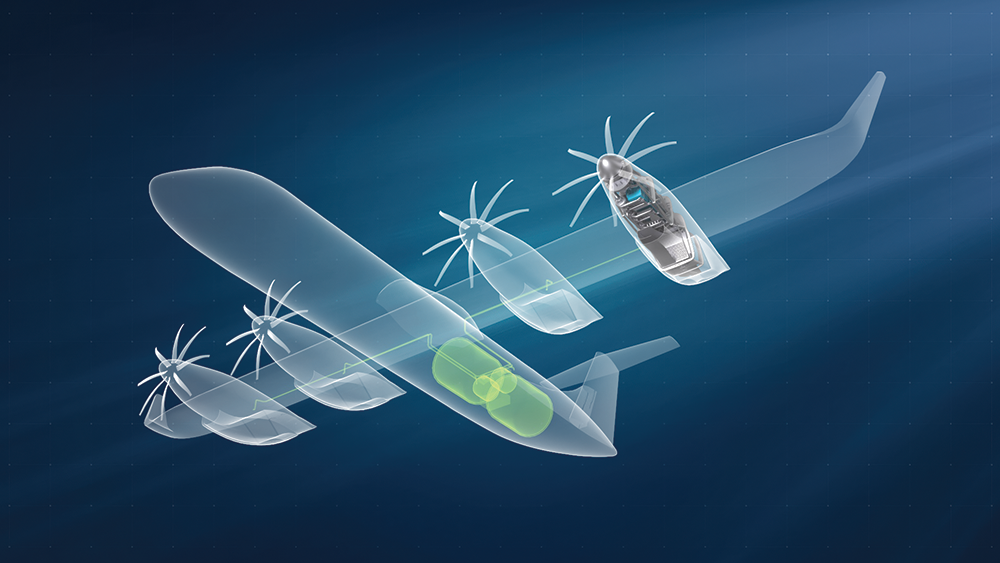
The race to decarbonise aviation has taken an important step forward with Airbus and MTU Aero Engines announcing plans to establish a joint venture to develop hydrogen-electric propulsion systems for commercial aviation. While the project represents a breakthrough for aviation, it also illustrates how sustainable manufacturing is increasingly being driven by collaboration, advanced production technologies and integrated industrial ecosystems.
The joint venture combines Airbus’ expertise in commercial aircraft design and liquid hydrogen technologies with MTU’s capabilities in propulsion systems, fuel cell development, certification and maintenance. Its mission is to industrialise hydrogen-electric propulsion systems for commercial aviation, taking them from research and prototype testing through certification and ultimately large-scale manufacturing.
Manufacturing for net-zero aviation
Aviation is one of the most difficult sectors to decarbonise because of the high energy density required for long-distance flight. Hydrogen fuel cells offer one of the most promising alternatives to conventional gas turbines by generating electricity electrochemically rather than through combustion. Hydrogen reacts with oxygen inside the fuel cell to produce electricity that powers electric motors, with water vapour as the primary by-product and no direct carbon dioxide emissions.
For manufacturers, the challenge extends well beyond replacing an engine. It requires an entirely new production ecosystem that integrates hydrogen storage technologies, high-power electric motors, advanced composite materials, cryogenic systems, fuel cell stacks, power electronics, and sophisticated digital control systems.
From laboratory to production line
One of the joint venture’s principal objectives is to accelerate the transition from research programmes to certified industrial products.
“Our planned joint venture is the next logical step in our shared vision of a hydrogen-based propulsion concept for aviation,” says Bruno Fichefeux, Airbus’ head of future programmes. This transition requires manufacturing processes capable of consistently producing fuel cell components to extremely tight tolerances while maintaining aerospace quality standards. Automated assembly, digital quality control, advanced inspection technologies and predictive maintenance will all play important roles in achieving the reliability demanded by commercial aviation.
Industrial digitalisation is expected to underpin every stage of development. Digital twins will enable engineers to simulate system performance before physical production begins, while AI-driven design optimisation can shorten development cycles and improve component efficiency. Advanced manufacturing execution systems, industrial IoT platforms, and automated test facilities will provide continuous quality assurance throughout production.
Building an entirely new supply chain
Production will depend on reliable supplies of green hydrogen, specialised cryogenic storage tanks, membrane electrode assemblies, high-performance catalysts, lightweight composite structures, high-voltage electrical systems and sophisticated thermal management equipment. This will require closer collaboration between aerospace manufacturers, chemical producers, materials suppliers, automation companies, and energy providers than has traditionally existed within the aviation sector.
Supporting the ZEROe programme
The collaboration forms a key part of Airbus’ ambitious ZEROe programme, which aims to introduce the world’s first zero-emission hydrogen-powered commercial aircraft by 2035. For MTU, the venture represents an opportunity to redefine aircraft propulsion.
Implications for industrial automation
The project also demonstrates the growing role of automation and process control in enabling sustainable manufacturing. Hydrogen production, liquefaction, storage and handling require precise instrumentation, continuous monitoring and rigorous safety systems. Manufacturing fuel cell stacks demands automated assembly processes capable of micron-level precision, while hydrogen testing facilities rely on advanced sensors, pressure control, leak detection and real-time diagnostics.
These requirements create opportunities across the automation sector for suppliers of industrial instrumentation, control systems, digital twins, robotics, machine vision, and predictive maintenance technologies.
Beyond the engine
The companies acknowledge that technological innovation alone will not deliver hydrogen-powered aviation. A supporting hydrogen ecosystem must also be established, including production and distribution infrastructure, airport refuelling systems and international certification standards.
This systems-level approach reflects the broader evolution of sustainable manufacturing. Decarbonisation is no longer achieved simply by making existing products more efficient. Instead, it increasingly requires redesigning products, production methods, supply chains, and supporting infrastructure as an integrated whole.
Although significant technical and commercial challenges remain before hydrogen-powered passenger aircraft become commonplace, the Airbus-MTU partnership shows how collaborative innovation, digital manufacturing and industrial automation are converging to create the next generation of sustainable manufacturing technologies.
For more information visit www.tinyurl.com/3nhk24s9






© Technews Publishing (Pty) Ltd | All Rights Reserved
 printer friendly version