



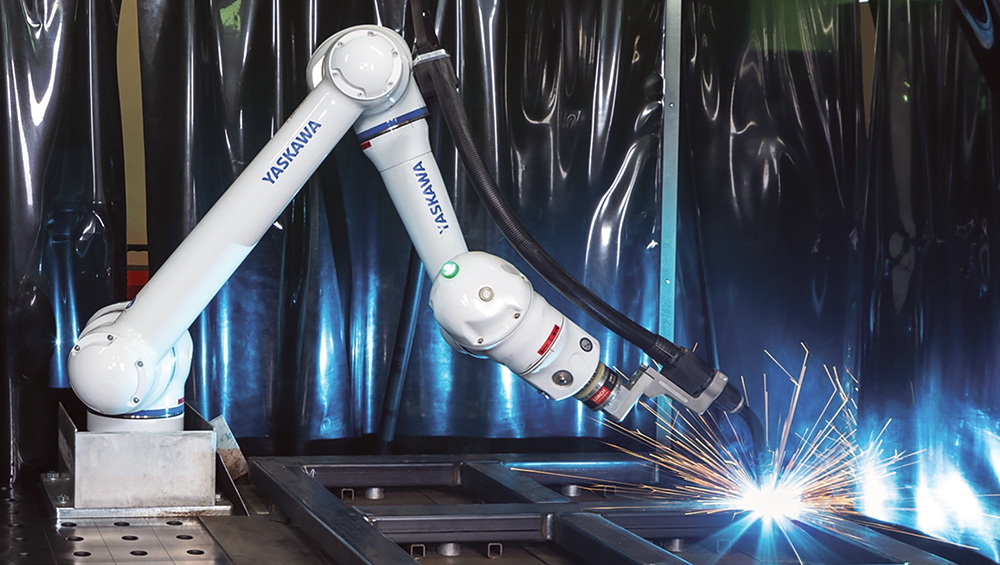
A growing number of mid-sized manufacturers are exploring automation because they are under increasing pressure to remain competitive in a demanding operating environment. Rising input costs, inconsistent production conditions, skills shortages, customer quality expectations and the need for greater efficiency are forcing manufacturers to rethink how they scale and sustain operations.
Meanwhile, automation is becoming more practical, more flexible and more financially accessible than many businesses realise.
It is no longer necessary to replace entire production environments with fully automated factories. Instead, many manufacturers are adopting targeted, low-risk automation strategies focused on solving specific operational bottlenecks.
This could involve automating a single palletising process, introducing robotic welding for repeatable tasks, or integrating a robotic cell into an existing production line to improve consistency and throughput. In many cases, the objective is not full replacement, but smarter production support.
One of the most significant developments in recent years has been the ability to retrofit automation into existing facilities. Historically, robotics often required purpose-built production environments and extensive infrastructure changes. Today, modern robotic systems are far more modular and adaptable, allowing manufacturers to integrate automation into current factory layouts without completely redesigning operations.
For mid-sized businesses operating under tight capital constraints, this flexibility is significant. Manufacturers can phase automation into operations incrementally, prioritising areas where the return on investment is most immediate. This lowers risk while allowing businesses to build operational confidence over time.
One of the keys to making automation more accessible is the availability of advanced simulation software. Before investing in equipment, manufacturers can now model robotic solutions in a virtual environment, allowing them to evaluate cycle times, production throughput, robot reach, accessibility and return on investment with a high degree of confidence.
This significantly reduces project risk and helps customers make informed decisions about where automation will deliver the greatest operational benefit. At the same time, simulation technology has evolved beyond simple robot path validation. Modern platforms, such as Yaskawa’s MotoSim and Motoman NEXT digital engineering environment, enable the simulation of complete production systems, integrating robots, peripheral equipment, material flow and process logic into a comprehensive digital model.
These capabilities support increasingly sophisticated automation requirements, allowing manufacturers to optimise complex processes, validate concepts before implementation and accelerate commissioning while minimising disruption to existing operations. While robotics still represents a significant investment, manufacturers are increasingly evaluating automation through a broader operational perspective rather than purely an upfront cost.
Downtime reduction, improved product consistency, reduced scrap, lower rework rates, higher throughput, and the ability to maintain production quality under labour pressure all contribute to long-term value. In many environments, these gains can have a direct impact on profitability and customer retention.
In South Africa, manufacturers are facing persistent shortages of experienced technical skills in areas such as welding, machine operation and production supervision. Automation helps businesses stabilise quality and output while enabling skilled workers to focus on higher-value responsibilities such as programming, quality assurance, optimisation and maintenance.
Another important shift is the growing suitability of robotics for high-mix, lower-volume production environments which are common across southern Africa’s manufacturing sector. Advances in robotic software, programming simplicity and flexible tooling have made it easier for manufacturers to handle varying product types and shorter production runs without sacrificing efficiency. This opens automation opportunities to industries and businesses that may previously have considered robotics impractical.
For many mid-sized manufacturers, automation is increasingly becoming a growth strategy rather than simply a cost-saving exercise. Businesses that can improve consistency, scale output reliably and meet stricter customer specifications are often better positioned to secure larger contracts, support localisation initiatives, and compete within regional and export markets.
The reality is that manufacturers no longer need to become mega factories to benefit from automation. The technology is becoming more scalable, more adaptable and more aligned to the operational realities of modern manufacturing. The companies seeing the greatest success are those taking practical, focused steps toward smarter production.
| Tel: | +27 11 608 3182 |
| Email: | |
| www: | www.yaskawa.za.com |
| Articles: | More information and articles about Yaskawa Southern Africa |






© Technews Publishing (Pty) Ltd | All Rights Reserved
 printer friendly version