



Feed producers across Africa are operating in an increasingly complex and volatile environment. Alongside rising input costs and ongoing supply chain instability, the sector is also facing renewed pressure from animal health challenges that disrupt livestock markets and demand patterns.
These combined pressures are forcing producers to rethink how they operate, balancing cost control, production efficiency and the need for greater flexibility in an unpredictable market. Alec Audie, area sales manager at Bühler Southern Africa shares insight on how feed producers are responding to these challenges across the region, and how Bühler’s solutions and services can contribute to support efforts to improve efficiency, manage costs and increase operational flexibility
How can feed producers, with the support of Bühler, navigate cost pressures, disease outbreaks and supply instability in Africa’s feed industry?
Feed producers are currently managing a combination of economic and biological pressures, from rising fuel and raw material costs to ongoing disruption caused by foot and mouth disease.These challenges are shifting priorities toward cost control and operational stability, with expansion becoming more selective.
To remain competitive, producers need to focus on efficiency, flexibility and feed safety. This means ensuring production systems can adapt quickly to changing demand across species and regions, while maintaining consistent product quality.
It also requires stable, repeatable processes that reduce variability and support continuity, even under volatile conditions. Bühler supports this by optimising key production stages and enabling greater process control, allowing producers to respond more effectively to both cost pressures and market disruption.
Where are the quickest efficiency gains in feed production today?
The most immediate gains are typically found in the core processing stages, particularly grinding, mixing, conditioning and pelleting. These areas account for a significant share of both energy consumption and overall production cost.
Improving particle size distribution, optimising steam application and enhancing pellet durability can significantly reduce waste while increasing output per ton of input. Even incremental improvements in these processes can deliver meaningful cost savings in high-volume operations.
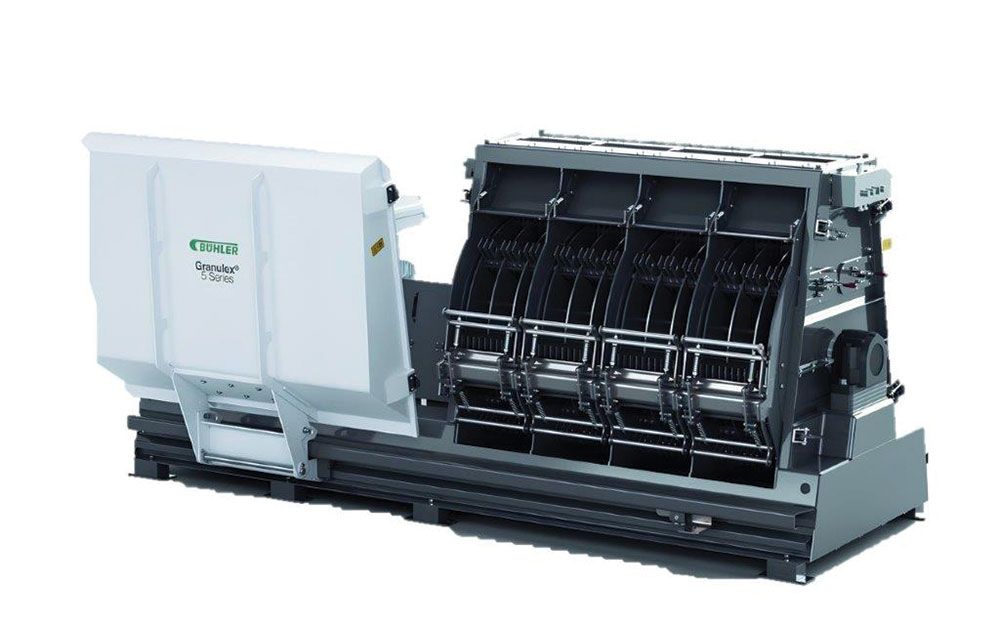
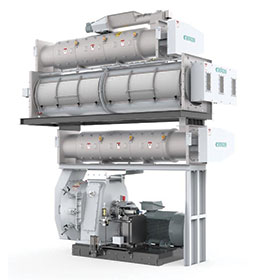
High-performance technologies such as Bühler’s KUBEX pellet mill, combined with the Hysis conditioning system, as well as efficient grinding solutions like Granulex, enable higher throughput with lower specific energy consumption, delivering fast and measurable efficiency gains.
How can producers manage raw material variability while maintaining feed quality and safety?
Volatility in the availability and quality of key inputs, such as maize and soy, is an ongoing challenge across African markets, particularly as producers shift toward more locally sourced raw materials. While this reduces exposure to currency fluctuations and import costs, it often introduces greater variability in composition.
Maintaining consistent nutritional quality under these conditions depends on precise process control. Effective conditioning and uniform treatment of raw materials are critical to improving digestibility, ensuring homogeneity and safeguarding feed safety.
Advanced conditioning systems, such as Bühler’s Hysis, play an important role in homogenising inputs prior to pelleting, enabling producers to maintain consistent quality even when working with variable raw materials.
How can feed mills maintain stable production in energy-constrained environments?
Energy instability, including loadshedding in many parts of Africa, presents a significant challenge to production continuity. In this context, producers need to prioritise efficiency, resilience and rapid recovery.
Practical measures include investing in energy-efficient equipment, implementing automation to stabilise key processes and ensuring systems can restart quickly after interruptions. Automation plays a critical role in maintaining consistent conditioning and pelleting performance, reducing variability and minimising the impact of power disruptions.
Maintaining stable throughput, even under fluctuating power conditions, is essential to avoiding downtime and protecting feed quality. As already mentioned, our integrated solutions such as the KUBEX pellet mill combined with the Hysis conditioning system, supported by automated process control, help optimise conditioning, reduce energy demand and maintain consistent production even under unstable power conditions.
What role do digitalisation and innovation play in building long-term resilience?
Digitalisation offers significant potential to improve visibility, control and decision making in feed production, but it must be implemented in a practical and scalable way.
The first step is establishing basic process transparency, focusing on critical control points such as conditioning and pelleting. From there, targeted automation can be introduced to stabilise operations, reduce human error and ensure consistent performance across key process stages. This ultimately translates into higher uptime, improved resource efficiency and more stable production.
Digital services, such as Plant Essentials, support this approach by providing real-time visibility into key performance indicators enabling faster, data-driven decision making and measurable operational improvements.
What is next in Africa’s feed industry?
As pressure on Africa’s feed industry continues to intensify, the ability to produce more efficiently and reliably from limited resources will become increasingly important. Scalable, efficient feed production systems not only support individual business performance, but also play a critical role in strengthening food security and livestock productivity across the continent.
Bühler’s broader global strategy reinforces this focus on efficiency, sustainability and food system resilience. The company supports its customers in growing their businesses while lowering their footprint in many ways; from offering new state-of-the-art solutions to optimising current systems through services that include machinery refurbishment, digital process control and predictive maintenance. These services lead to higher productivity and yields, resulting in better returns on investment alongside a positive environmental impact.
For more information contact Taryn Browne, Bühler Southern Africa,






© Technews Publishing (Pty) Ltd | All Rights Reserved
 printer friendly version