Metal deactivators are an important additive in lubricating oil formulations, especially with the growing use of non-ferrous metals, notably copper- and aluminium-containing alloys, that can be prone to the negative effects of staining and corrosion. The ions of these metals are also catalytically active and act as reaction sites that can trigger lubricant degradation through oxidation of the base oil.
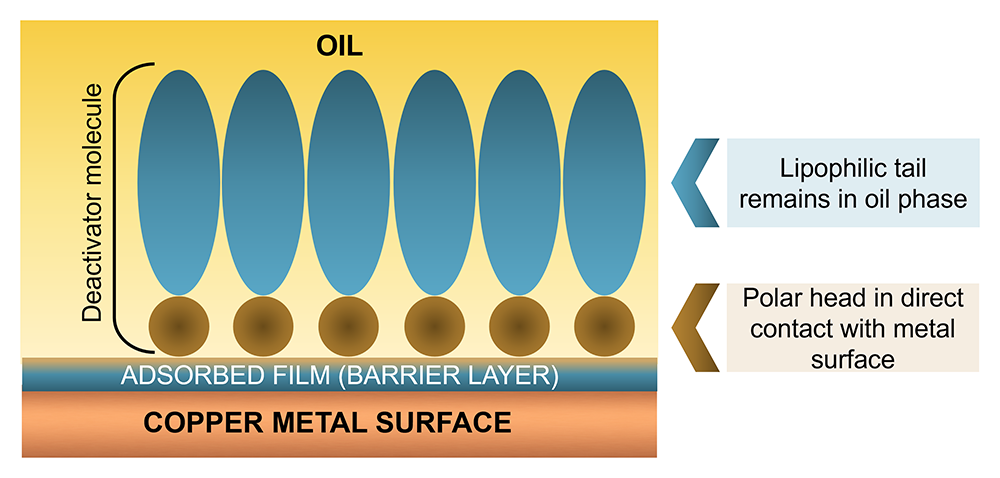
Metal deactivators belong to the corrosion-inhibitor class of additives, and work their magic on metal surfaces, especially non-ferrous metals, and also on wear particles that are dissolved or suspended in the oil. These specialised additives contain surface-active molecules that adsorb on metal surfaces. The mechanism for how they function involves the formation of an inactive barrier film that inhibits cathodic and/or anodic reactions that can accelerate oxidation and cause corrosion.
Metal deactivators are typically organic compounds that contain nitrogen or sulphur atoms. These atoms have a high affinity for metal ions and can form strong, stable bonds with them. This allows the additives to neutralise or deactivate these metal ions in the oil, which reduces their negative effects.
Lubricant blenders add metal deactivators to oils, primarily to protect copper and yellow metals in most automotive and industrial lubricants, including greases and metal-working fluids.
The protective film that metal deactivators form on a metal surface is also thermally stable, water insoluble and chemically bonded.
Smarter motor technology for high-performance industrial automation Adroit Technologies
Motion Control & Drives
Adroit Technologies is bringing Mitsubishi Electric’s EM-A series permanent magnet motors to Africa, offering servo-like speed and position control at a lower cost by combining patented sensorless control with the FR-E800 inverter to eliminate encoders while achieving IE5 efficiency.
Read more...A smarter approach to simplifying motion architecture
Motion Control & Drives
n motion system design, the wiring and drive placement between motor and drive are often decided by default, yet they shape a machine’s cost, footprint and adaptability. Kollmorgen sets out how single-cable and decentralised architectures simplify the cabinet.
Read more...Robotic case packer achieves 99% uptime Rockwell Automation
Motion Control & Drives
DCC Automation designed a new robotic case packer for a nutrition supplement manufacturer using delta robots and a unified Rockwell Automation control platform, cutting changeover time from 45 minutes to 5 minutes, and achieving 99 to 99,5% uptime against the previous 10% per-shift downtime.
Read more...igus puts 3D-printed wear materials to the test igus
Motion Control & Drives
A new igus white paper compares its tribological iglidur 3D-printing materials directly with conventional POM, reporting lower wear, more stable friction and up to ten times longer service life in gear testing for customised, low-volume and replacement components.
Read more...Electrostatic spark discharge – when static strikes back Wearcheck
Maintenance, Test & Measurement, Calibration
WearCheck technical manager, Steven Lumley explains how static electricity accumulates in modern low-conductivity lubricants, why compact system designs and fine filtration make ESD more likely, and how to recognise the degradation it leaves behind.
Read more...SEW-EURODRIVE’s expanded local engineering capability SEW-EURODRIVE
Editor's Choice Motion Control & Drives
At Electra Mining Africa, SEW-EURODRIVE demonstrated how its expanded local engineering capability, digital technologies and lifecycle support strategy help customers improve reliability, energy efficiency and total cost of ownership across the full life of their drive assets.
Read more...Latest Danfoss automation drive Bearing Man Group t/a BMG
Motion Control & Drives
BMG has launched the Danfoss iC7-Automation enclosed variable speed drive range in South Africa, backed by significant local stockholding of 400 V models up to 710 kW, approved warranty workshops, and DrivePro digital asset management support.
Read more...Severe-duty workhorses powering mining
Motion Control & Drives
Mining machines such as rock crushers, pumps and conveyors need motors that combine high torque with robust enclosures, seals and cooling. WEG Africa explains how severe-duty motors deliver more than a decade of reliable performance in harsh conditions while meeting modern energy-efficiency standards.
Read more...When maintenance-system compliance starts replacing plant reliability Wearcheck
Maintenance, Test & Measurement, Calibration
WearCheck ARC division manager, Annemie Willer argues that the greatest threat to effective maintenance is no longer a lack of technology, but the gradual replacement of technical judgement by CMMS compliance, leaving no one owning the machine.
Read more...Looking beyond the spec sheet when choosing motion architecture
Motion Control & Drives
When machine builders focus only on torque, speed and price, engineering time, integration effort and long-term maintainability get overlooked. Kollmorgen explains how thinking at the system level, not the component level, leads to better motion architecture choices.
While every effort has been made to ensure the accuracy of the information contained herein, the publisher and its agents cannot be held responsible for any errors contained, or any loss incurred as a result. Articles published do not necessarily reflect the views of the publishers. The editor reserves the right to alter or cut copy. Articles submitted are deemed to have been cleared for publication. Advertisements and company contact details are published as provided by the advertiser. Technews Publishing (Pty) Ltd cannot be held responsible for the accuracy or veracity of supplied material.











 printer friendly version