



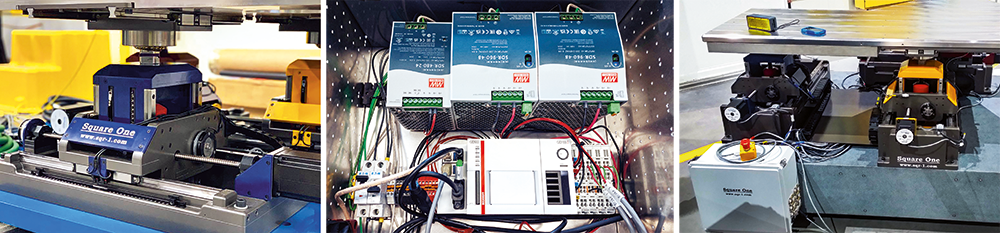
At the SLAC National Accelerator Laboratory in Menlo Park, California, an advanced robotic system by Square One Systems Design and Beckhoff speeds up high-energy physics experiments. Streamlining operations, the Tri-Sphere Robotic Positioning System increases the utilisation of ‘beam time’. This helps with maximising access for researchers and improving research outcomes.
Square One’s patented Tri-Sphere robot is a state-of-the-art parallel robot whose design was tailored to meet the rigorous demands of high-energy physics research. Like revolute jointed industrial robots, the Tri-Sphere offers six degrees of freedom in movement. However, unlike traditional robots, the Tri-Sphere robot delivers huge payload capacity, ultra-high precision and a compact design that fits seamlessly into tight spaces. The Tri-Sphere also conforms to the Experimental Physics Integrated Control System standard (EPICS), which is widely adopted in the physics community. EPICS provides researchers and technicians with a standardised control system architecture and software toolkit to interface with and control high-end equipment. This improves process tracking performance and optimises analysis of the metadata gathered during experiments.
SLAC’s deployment of Tri-Sphere robots is part of larger upgrades to their Linac Coherent Light Source (LCLS), the world’s most powerful X-ray free-electron laser (XFEL). A recent upgrade (LCLS-II) increased the capabilities of the original system from 120 pulses per second to 1 million pulses per second, and a future upgrade (LCLS-II-HE) will increase the X-ray energy. In simple terms, this opens up an entirely new realm for advanced research projects that were previously considered impossible by scientists, including a new generation of solar energy technologies, superconductors and advanced drug discovery.
Breaking through the limits of physics research
The unique design of the robot offers several advantages to accommodate the rapid succession or ‘removal and replacement’ of complex research setups, and operate in the demanding environment typical of facilities like LCLS. The robot’s compact geometry means it can fit into the tight confines of a mainstay in research facilities, the hutch, or the equipment used in research facilities where X-ray beams pass through test samples. The robot’s high-precision positioning system ensures that it can precisely move research equipment into beams as narrow as 100 nm.
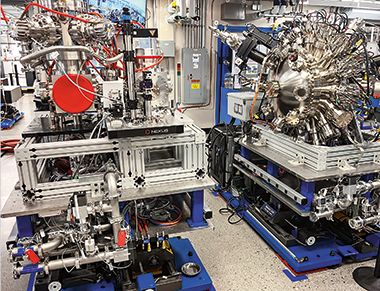
Tri-Sphere is not only accurate, it’s also very strong, supporting rapid movement and repositioning of heavy objects with the accuracy required to perform cutting-edge experiments. “The robot is designed with heavy payloads in mind, and has the ability to handle up to 5440 kg, which is essential when positioning heavy objects in national labs like SLAC,” explains Bob Viola, director of engineering at Square One Systems Design. “This performance far exceeds that of conventional robots that may be more suited to industrial use.”
Maximising beam time is essential to accommodate as many experiments as possible. “National labs, like SLAC, are literally priceless national resources and every second of beam time counts,” emphasises Viola. “The ability to perform quick changeovers without compromising precision or reliability is a game-changer.”
Jace Walsh, chief controls engineer at Square One, explains further: “The Tri-Sphere’s asymmetric work envelope and software-tunable rotation point provide unmatched versatility and precision, allowing it to adapt to a wide range of experiments. This flexibility is crucial for experiments where the ability to quickly and accurately reposition experimental setups can significantly impact research outcomes.”
The Tri-Sphere upgrade integrates automation and control technology from Beckhoff across multiple experimental hutches, allowing SLAC to conduct high-precision experiments with minimal downtime. The staff can set up a new centre for the beam in the Tri-Sphere’s user-friendly front-end software, dial in new configuration settings, and enter new height parameters and rotation settings.
The SLAC robotic systems are mounted on air casters. This enables the robots to be quickly moved in and out of different hutches. The Tri-Sphere can handle delicate samples with precision, another key advantage. “The robot features a vacuum transfer system to ensure that the system can handle a wide variety of container types without damage, including delicate products with soft-touch finishes,” says Viola. “This is crucial for experiments using highly sensitive sample materials.”
Automating what’s next in research and discovery
The integration of PC- and EtherCAT-based control technology from Beckhoff has been instrumental to the success of the Tri-Sphere Robotic Positioning System. The Tri-Sphere currently relies on Beckhoff CX2033 embedded PCs as the primary controller, leveraging real-time EtherCAT communication and high processing speeds to handle all automation and control tasks seamlessly. The CX2033 runs TwinCAT NC PTP software for motion control.
EtherCAT’s automatic addressing of the highly modular devices, numerous wiring topology options, and high device count of up to 65 535 devices in one network, ensure a robust and scalable network infrastructure. In addition, the compact size of the EtherCAT terminals allows them to fit easily into compact enclosures distributed throughout the Tri-Sphere robot. EtherCAT terminals can also incorporate compact drive technology from Beckhoff with the
Beckhoff TwinSAFE I/O terminals and Safety over EtherCAT (FSoE) technology provide robust machine safety functionality that integrates seamlessly with SLAC’s personnel and equipment protection system for monitoring the safety status whenever personnel are in a hutch and initiating e-stops if they’re ever needed. “TwinSAFE supports these unique safety requirements, ensuring safe access to the hutches at all times and reliable control of these powerful positioners,” says Viola.
The Tri-Sphere system is also compatible with the seismic anchoring requirements typical of installations in California. This ensures that the systems can withstand seismic activity and maintain their precise positioning.
A promising future for leading research projects
“When SLAC can prepare an experimental work setup on a Tri-Sphere outside of the working hutch without shutting down the beamline, it speeds things up,” Viola says. “The system reduced the time required for SLAC experiment changeovers from two days to just 12 hours.”
Mathew Garcia, business development leader at Beckhoff USA, echoes this sentiment. “The Tri-Sphere project is a testament to the collaborative efforts of Square One and Beckhoff. It’s exciting to see how our technology is helping improve research outcomes and efficiencies at SLAC and other facilities.” The Tri-Sphere, as demonstrated by its successful deployment at SLAC, is helping overcome key challenges in many areas of scientific research. With proven flexibility and performance to adapt to a wide range of difficult testing spaces, the system has since been deployed at other world-renowned laboratories to help reach the next big discovery.
| Tel: | +27 11 795 2898 |
| Email: | [email protected] |
| www: | www.beckhoff.com |
| Articles: | More information and articles about Beckhoff Automation |






© Technews Publishing (Pty) Ltd | All Rights Reserved
 printer friendly version