



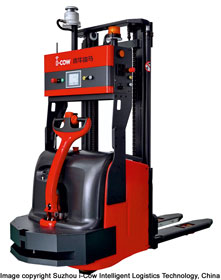
Besides building self-driving industrial vehicles and logistics handling robots, Suzhou i-Cow Intelligent Logistics Technology develops control technology and software algorithms for laser-based navigation systems used in automated guided vehicles (AGVs). A comprehensive control solution from Beckhoff is not just enabling the Chinese tech company to develop better-performing products more efficiently, but is helping these products to meet the requirements of Industry 4.0 and the Made in China 2025 initiative as well.
As the industrial sector continues to evolve rapidly, the need for flexible and intelligent logistics systems is on the rise. Driverless transport systems have a hugely important role to play in this arena, and i-Cow has launched a broad range of driverless forklifts equipped with a laser-based navigation system, designed to meet the needs of automated warehouse logistics across industries as diverse as food and beverages, automotive and electronics manufacturing. The company also offers AGV manufacturers and integrators custom solutions for incorporating i-Cow’s core technology into their own hardware.
Laser navigation: a flexible and economical logistics tool
The core challenge for advanced AGV systems used in warehouse logistics is to navigate flexibly and efficiently through the racks of inventory. One solution here is computer-aided vehicle control based on laser technology, which not only lets vehicles navigate freely within the warehouse space but also offers cost advantages, because it does not rely on fixtures embedded in the floor. i-Cow’s laser-guided AGVs can automatically pick up and deposit goods on warehouse shelves. The laser navigation system works with just a single vehicle, but is also capable of supporting multiple vehicles when combined with a traffic management system.
To meet the tough technical challenges involved in this type of navigation, i-Cow’s system relies comprehensively on control components from Beckhoff. The system is controlled by a CX5130 Embedded PC with a dual-core Intel Atom CPU running TwinCAT 3 software and incorporates a CP6907 Control Panel with 5.7-inch touchscreen for visualisation and operator interaction. TwinCAT 3 PLC HMI provides a user interface for easy configuration of AGV parameters, AGV positioning, and troubleshooting problems occurring at rack locations in the warehouse. To achieve the levels of speed and precision needed for laser-based navigation, the system uses XFC oversampling terminals. Beckhoff has also supplied a TwinSAFE solution that integrates safety features seamlessly into the overall system.
A powerful control platform: the Embedded PC
The compact CX5130 Embedded PC handles all the control functions required for laser navigation. It replaces a conventional navigation-control system and communication module used previously, bringing down both space requirements and costs. The software functionality includes a laser navigation algorithm and a control loop for AGV drive and steering axes, both written in C++ code, plus control logic for a single AGV, the TwinCAT 3 PLC HMI for visualisation, planning software, and a TCP/IP communication program for the automatic charging station.
“We chose the CX5130 for its performance, range of interfaces and compact design,” explains Yongping Pan, head of R&D; at i-Cow. As a DIN rail-mounted Embedded PC, it takes up much less space than the previous control systems. Another advantage is that the Beckhoff bus terminal system supports a variety of fieldbuses, including CANopen and Profibus, so it’s compatible with our existing peripheral devices. In addition, the Embedded PC has Ethernet ports and supports a variety of protocols, making it easier for us to implement wireless communication.”
Precise, high-speed laser navigation with XFC
When an AGV is navigating by laser, a built-in laser scanner performs rapid rotating sweeps to capture reflective markers located around the operating area. The exact position of the AGV can only be computed once a sufficient number of markers have been scanned. Precise, high-speed, scanning is crucial here. To achieve this, i-Cow uses an EL1262 XFC EtherCAT digital input terminal with oversampling. Capable of performing up to 1000 sampling operations in 1 ms – which corresponds to a sampling cycle of 1 µs – it supports exceptionally high-resolution target-value and actual-value acquisition that meets the high speed requirements of laser navigation.
Versatile software for even higher performance
The TwinCAT 3 control software complements the powerful hardware perfectly. One key benefit from i-Cow’s perspective is that TwinCAT 3 can be programmed in C++ and is able to call up modules. This simplifies both the development process in general and migration of the navigation control algorithm in particular. In addition, due to its flexibility and modular design, TwinCAT 3 is an efficient development environment suited to creating a range of software components, and enables i-Cow engineers to work collaboratively as a team.
“The ability to work with C/C++ as a programming language is really valuable for us because we’ve gained a lot of experience with it over the years and it allows us to implement complex function blocks,” explains Zhifei Yu, head of i-Cow’s development department. “If a process lets us code in C++, we can embed the function blocks quickly and easily in TwinCAT 3, as is the case with the laser navigation code, which is written in C++. TwinCAT 3 also allows individual program tasks to be distributed across multiple CPU cores. This means that the computing power of multi-core CPUs such as the CX5130’s can be leveraged to enable programs to execute faster.”
Saving time and money with an integrated safety solution
Although AGV systems with laser navigation can take on much of the workload in a warehouse, they still need to work alongside people. Collision protection is therefore a crucial function. Here, i-Cow has opted to deploy a comprehensive solution using TwinSAFE. This is implemented using an EL6900 TwinSAFE Logic EtherCAT terminal, an EL1904 TwinSAFE digital input terminal and an EL2904 TwinSAFE digital output terminal.
The AGV chassis is fitted with safety sensors all the way round that are scanned via the EL1904 input terminal. If the sensors detect an obstacle in an AGV’s safety zone while it is moving, the TwinSAFE system responds immediately, first engaging the emergency brake on the AGV’s drive axis, then cutting the power to the drive after a preset delay.
“Using TwinSAFE to fully integrate a safety solution into the control technology eliminates the need for a separate safety system and all the extra effort it would have involved,” elaborates Haixia Wang, i-Cow’s safety officer. “Our solution also reduces cabling costs and development time.”
Working together to deliver future-proof solutions
Since i-Cow began using Beckhoff components to implement laser-based navigation on its forklift AGVs in early 2016, collaboration between the two companies has steadily widened and intensified. Automation solutions from Beckhoff are now also being implemented in magnetically guided shuttles and in vehicles for smart rack systems, both currently under development.
“The PC-based automation platform’s openness and flexibility give us the latitude to solve a wide range of application problems,” concludes Wang Ping, i-Cow’s chief executive officer. Leveraging the exceptional performance of the PC-based control technology, we’ll be able to continue to meet the increasing requirements of control systems well into the future.”
| Tel: | +27 11 795 2898 |
| Email: | [email protected] |
| www: | www.beckhoff.com |
| Articles: | More information and articles about Beckhoff Automation |






© Technews Publishing (Pty) Ltd | All Rights Reserved
 printer friendly version