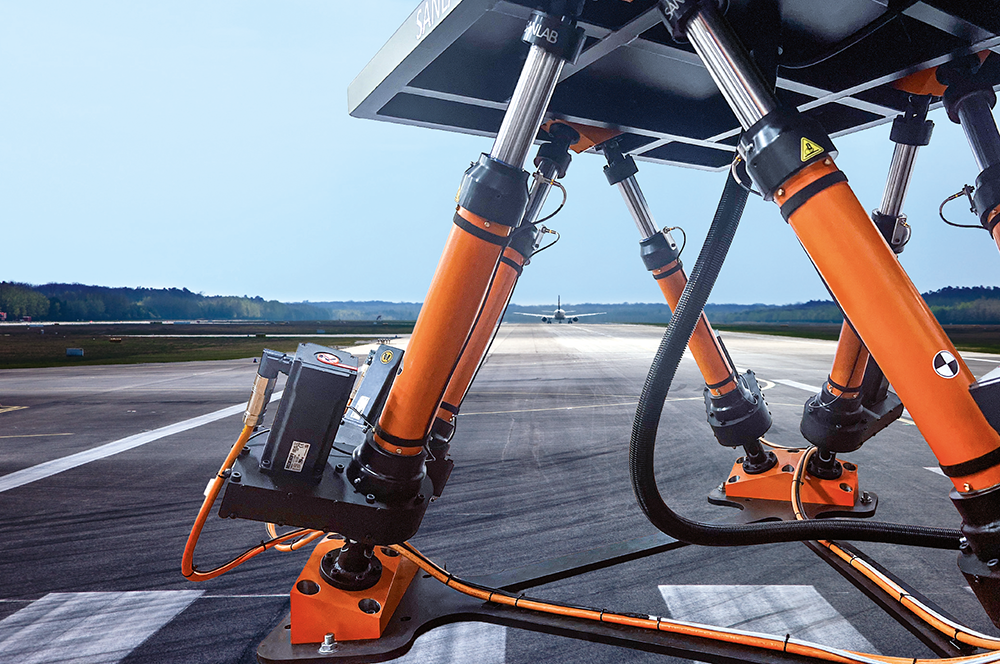
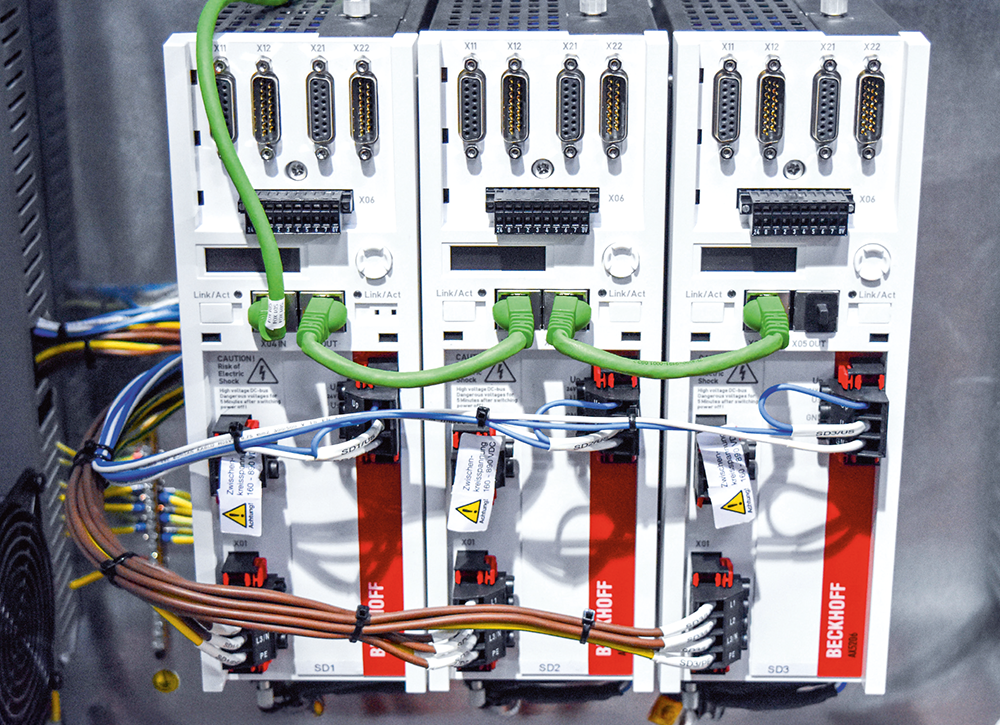
How realistic a simulation is perceived depends on the similarity of the image, sound and motion elements to the original, and on the harmony between them. Dynamic motion platforms with six degrees of freedom play a crucial role in achieving realistic simulation experiences. Turkish specialist, SANLAB is a leader in motion platforms and simulation technologies. At the heart of these platforms are application-specific servo drives, servomotors and industrial PCs for real-time control, which are supplied by Beckhoff from a single source, and are therefore, perfectly matched to each other.
Based in Istanbul, SANLAB, focuses on real-time robotic technologies and develops motion platforms with six degrees of freedom (6DOF) that can be used in the production and R&D; phases of industries with simulation and testing requirements. In fields such as the aerospace, automotive, testing and simulation industries, this 6DOF moving platform technology enables reduced prototyping and R&D; times as well as accurate, error-free product manufacturing and testing. For example, the technology can be used as a driver-in-the-loop simulator to test mathematical models and AI systems in the automotive industry. Furthermore, simulations for training qualified staff are developed under the SANLAB Learning Technologies brand. These simulations are used in university research and in the training activities of chambers of commerce, chambers of industry, municipalities, universities and private companies.
How the 6DOF motion platform works
6DOF motion refers to the translational and angular motions of any object in the x-axis, y-axis and z-axis. In the simulation world, structures called parallel manipulators or Stewart platforms are used to reproduce the motions. Actuators that convert the rotary motion generated by the servomotor into a linear motion can be used to realise different motion profiles for travel, speed and acceleration as required. Motion cueing algorithms are used to ensure that the motions generated by the platform can be perceived as realistic by humans. These algorithms are based on the functional principles of the vestibular system, i.e., the human body’s organ of balance.
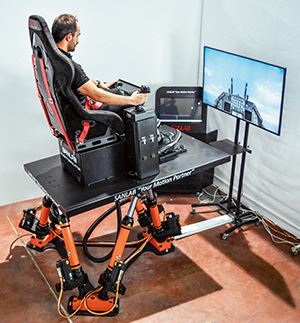
Particularly in systems such as the dynamic simulation of aircraft, the system solves the kinematic equations in real time and calculates the position information of the engines in order to generate the desired speed and acceleration values. This requires high computing power. The motor position values must also be transmitted to the motors via servo drives in a dynamic structure. The application requires the servomotors to have a low moment of inertia and to be able to generate high torque values with low currents. With this in mind, SANLAB’s experts believe that for dynamic systems such as flight simulations, all components must be chosen from high-performance products, from the industrial PC controlling the system to the servo drives and servomotors. This is why the decision was made in favour of PC- and EtherCAT-based control and drive technology from Beckhoff.
High control technology requirements fulfilled
According to SANLAB, the fact that the necessary high system dynamics require high performance from all the control and drive components used is just one aspect. In addition, due to the changing requirements of the various application areas it is of great importance that the proposed control solutions are scalable and flexible in terms of both costs and performance optimisation. As SANLAB develops its own control algorithms on the basis of C++, the development environment must also have a structure that enables reliable real-time operation. With a view to achieving the fastest possible project development, short delivery times and high product quality, solutions are required that shorten engineering time while offering high hardware compatibility via EtherCAT, and a flexible development environment.
As a company that develops systems with different numbers of axes for different requirements, SANLAB co-founder Evren Emre says that the scalable Beckhoff product range helps considerably with control optimisation, particularly with regard to industrial PCs with processors from Arm to Xeon. “Switching to the EtherCAT infrastructure from Beckhoff enables us to develop more dynamic systems and fully utilise the high computing power that we can access with PC-based automation. Especially in the development of our control algorithms, the TwinCAT software platform allows real-time operation via the C++ infrastructure. This saves engineering time and enables the end-to-end use of this engineering environment, and even the implementation of more dynamic and precise control algorithms with shorter cycle times. Ethernet-based communication protocols and complete software and hardware solutions for compatibility with various fieldbuses help us to create a fast and reliable system for communication with external systems and simulation software.”
End-to-end, PC-based automation
The flight simulator application is based on the real-time playback of telemetry data from a simulation application on a 6DOF simulation table. The system uses a C6025 ultra-compact Industrial PC with an Intel Core i5 processor which is integrated with the simulation software, and converts the received telemetry data into motions. This processor works at a clock rate of 4 kHz to convert the data from the simulation system into real-time actuator movements.
In the case of 6DOF motion platforms, high-dimensional matrix calculations, such as kinematics and Jacobi, must be solved accurately and in real time. Performing all these operations at high speed and in a stable manner has a direct impact on the sensitivity, response and overall performance of the platform. Synchronised and precise control of the six axes at the same time is a very demanding process, and therefore, advanced control technologies with high processing power and stability are required. This is achieved with the AX5206 2-channel servo drives, whose advantages Evren Emre explains as follows: “In addition to the dynamic performance that the system had to offer, Beckhoff servo drives were chosen for their compact design. This means that the system, which is equipped with six servomotors, only requires three servo drives and therefore has a very compact structure. The fact that the servo drives are well-suited to optimisation and traceability offers further advantages as a basis for systems where portability is important. The high dynamics of the motion platform are also well supported by the AM8041 servomotors with a low moment of inertia.”
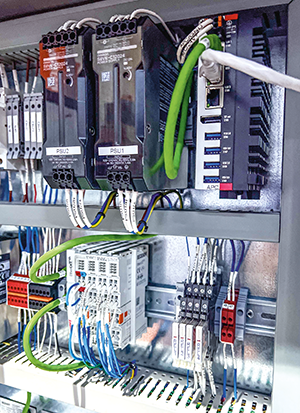
According to Emre, Beckhoff control technology is characterised by high cycle rates of up to 16 kHz in real-time applications. Especially in simulation applications, where the telemetry data taken as a reference is generated as realistically as possible, such high cycle speeds make a significant difference. The wide Beckhoff product range combined with the extensive optimisation and fine-tuning options of the Beckhoff servo drives, servomotors and I/O cards enabled SANLAB to achieve a cost- and performance-efficient system configuration. In addition, the systems that have been created can be monitored with many functions via EtherCAT using various parameters.
Emre adds: “The TwinCAT software, which enables development in the C++ language in particular, makes a significant contribution to minimising development times with its ready-made modules, libraries and functions. Considering the effectiveness and market share of the EtherCAT architecture, the fact that the solution can also be applied to third-party products results in considerable flexibility. It is also important to us that the automation component is more than ‘just a purchased product’. It should include technical support and after-sales service, and the Beckhoff branch in Istanbul also subscribes to this philosophy.”
| Tel: | +27 11 795 2898 |
| Email: | [email protected] |
| www: | www.beckhoff.com |
| Articles: | More information and articles about Beckhoff Automation |






© Technews Publishing (Pty) Ltd | All Rights Reserved
 printer friendly version