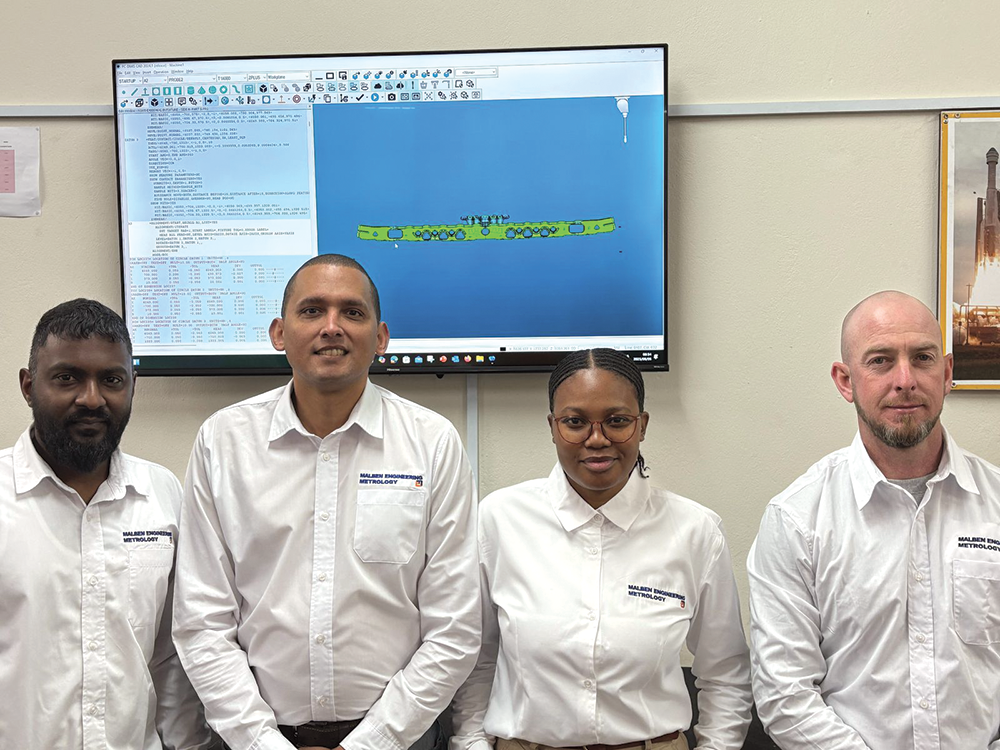
Pressing and welding have been at the core of Tier 1 automotive supplier, Malben Engineering for 50 years; but it is the company’s investment in its state-of-the-art metrology laboratory which has set it apart.
“The metrology laboratory, which effectively analyses the ‘pulse rate’ of the entire plant, supports the production process and determines overall production compliance by providing the data which quite literally sets the company free,” explains plant manager, Jithin Kottikkal. This expression ‘the data sets you free’ perfectly encapsulates the company’s data-driven approach to ensuring that each completed part fully meets the stringent safety and dimensional accuracy standards of its OEM customers, as well as the company’s own even more stringent in-house requirements. Kottikkal adds that in the past, prototype parts and tools were made and tested, but today’s software and scanning technology not only reveals if anything is out of specification within minutes, but confirms if reverse-engineered modifications will work.
Investing in consistency
Head of metrology and welding quality systems, Cheslyn Reid, explains that Malben’s investment in statistical process control (SPC) ensures the consistency of metal pressings OEMs assemble using robots and cannot accept components which vary from their tight specifications and tolerances. The same goes for the sophisticated welding robots responsible for Malben’s sub-assemblies.
Pressings are tested every 15 minutes using component-specific measuring jigs designed around locator data files provided by customers. Customer-specific level 1 and 2 points are identified to ensure that their specifications are met. Level 3 and 4 points are then added to complete Malben’s own SPC checks.
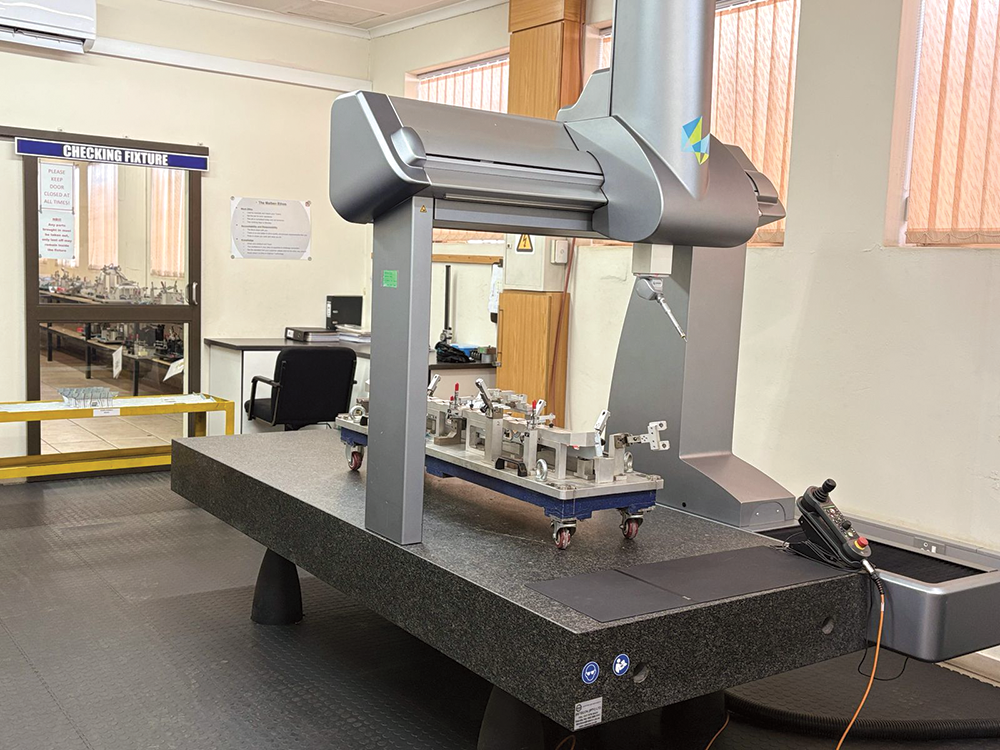
Reid says that Malben insists on using more points than typically used by others. “We would rather spend a little longer checking a part. We place a lot of emphasis on stabilising pressings, focusing on variation reduction and aiming for repeatability. We track all material variances, including mechanical properties, to drive press setup consistency and ensure repeatability. Should a problem be detected via the checking fixture, a component is immediately sent to the metrology laboratory, which is equipped with CNC-controlled profile measurement systems as well as two 3D blue light laser point cloud scanners,” he explains.
Investing in speed
The super-fast scanners can scan up to 1,2 million points per second in a straight line. Unlike comparable equipment, they do not need to be pre-prepared and marked before analysis: “We can pick up our equipment and ‘go for gold’ immediately. We can scan smaller components in the laboratory and larger components measuring up to 5 metres long in the tool room as these scanners are fully portable. We leapfrog by setting up the arm, scanning a section and then moving on to the next segment. Within just four minutes, precise and accurate data is available.”
He adds that Malben has also invested in software that enables reverse engineering. “If a tool breaks or cracks, we scan the tool. We have the software to reverse engineer and manufacture the same section of a tool that needs to be replaced. The scanning process creates a software mesh of the physical part, which is then compared to the CAD model to identify potential problems and make adjustments.”
Senior metrologist, Clayton Venkanna continues: “The scanners and the coordinate measuring machine (CMM) provide the first data scan, which we overlay onto the CAD model. In this way, we complete a dimensional analysis using colour maps to define a deviation from the CAD model. The colour map visually enables us to check real-time data and plot from part to part. We can see the specific point where the last part ran and where we are currently running.”
For Reid, it is important to understand the process capability which delivers a consistent part, taking into account any deviations while also ensuring that even these remain consistent throughout entire production runs. Shifts indicate that something important has changed in the process.
“Speed is also critical,” adds Venkanna. “Presses run at up to 20 strokes per minute. You cannot keep a press standing waiting on the results. Immediate action and quick responses are critical. That way, we support our production team faster, which is what sets us apart.”
Investing in data
One of the first component manufacturers to use red light scanners in 2015, Malben had upgraded to ultra-accurate blue light scanners by 2021. Equipment suppliers provide internal training and software updates for the highly skilled team operating the laboratory. “It is not just the machines, but their application and integration into our operational and quality system which is really important. We use our equipment and technology to its full capacity to guide all of our technical decisions and make critical judgment calls,” Kottikkal stresses.
With contingencies in place to cover breakdowns, a CMM which can verify the accuracy of its blue light scanner counterparts, and staff trained to ensure there are no interruptions to this vital SPC process, Malben is perfectly equipped to achieve the highest quality standards. In a sector that is constantly evolving, Malben remains committed to investing in the latest measuring technology.
“Investment decisions are driven by the scope of new work that is sourced. We need to ensure that new equipment is cost-effective and allows us to meet our customer requirements regarding quality and tolerances,” Reid concludes.






© Technews Publishing (Pty) Ltd | All Rights Reserved
 printer friendly version