



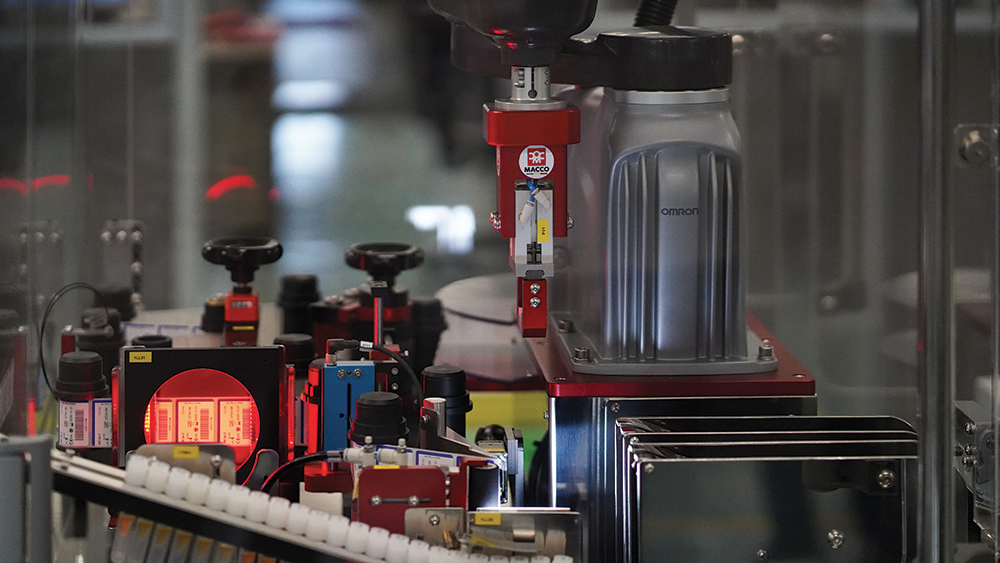
Werfen has implemented a new automated machine for the supply of reagents to drug toxicology laboratories, built by MACCO in collaboration with OMRON and Marini Pandolfi. It uses OMRON SCARA robots and advanced vision systems to ensure reagent quality through vertical handling and labelling process of test tubes.
Werfen is a leading multinational in-vitro diagnostics company. With a team of over 7000 employees in more than 30 countries and a presence in over 100 territories, the company develops and supplies instruments, reagents and data management solutions that support clinical decisions in patient care on a daily basis.
In recent years, Werfen has faced a significant increase in demand from clinical laboratories, particularly from the toxicology sector. One challenge in particular has been to meet the growing demand for control and calibration materials for the analysis of biological samples that are safe and easy to use, and in compliance with the diagnostics industry’s requirements.
“Over the last few years, we have developed controls and calibrators for the toxicology line, offering customers a solution in disposable test tubes that are clearly identified by a barcode, traceable and easy to use,” explains Bruno Costantini, plant manager at Werfen Ascoli Piceno manufacturing centre. “This has had a really big impact on the market, resulting in an increase in production volumes. Therefore, it was necessary to automate the production process and to avoid the risk of contamination or deterioration of the contents as far as possible. Test tubes for toxicology laboratories are filled with very sensitive reagents that need to be frozen and therefore cannot be turned upside down. This requires them to remain upright throughout the production process, including labelling”.
Robotic handling and vision systems for quality control
The Werfen challenge was taken up by MACCO, a company specialising in the design of automated solutions, which decided to build a new line based on SCARA robots and OMRON vision systems. These were designed to handle the entire process of filling and labelling test tubes in a vertical position, minimising the need for any manual operation, saving time, resources and reducing the risk of human error.
One of the main obstacles to the project was the labelling. “Conventional systems involve handling the test tubes on a conveyor belt in a horizontal position, but this would have compromised the quality of the reagents, a crucial aspect for guaranteeing reliable clinical results,” says Alessandro Bartoloni, general manager of MACCO. This is why the decision was made to use an OMRON i4L SCARA robot, which has developed an innovative patent-pending solution capable of picking up test tubes from the filling and capping station and manipulating them while keeping them upright throughout the labelling process.
“We analysed the application with MACCO’s technical department and found from the outset that the SCARA type was the most suitable to perform the tasks required by the specifications,” adds Giovanni Cortigiani, OMRON Robotics business developer. “In fact, this robot guarantees precise, stable and synchronised handling with the labelling system, ensuring accurate application of the label to each test tube. In this case, it also had to work in an extremely compact cell. That is why we chose a short-stroke model”.
The SCARA robot is accompanied in the labelling process by OMRON’s FHV7 smart cameras, intelligent vision systems that play a key role in quality control. The smart cameras not only check that the label is applied correctly, but also the quality of the barcode print and the position of the label on the test tube. In the event of an error, the system is able to reject non-conforming test tubes automatically, improving the quality and traceability of the entire production process.
Reliability and costs verified before startup
One of the key steps in the development of the new Werfen production line was the use of simulation prior to commissioning. This was made possible by the collaboration between OMRON and Marini Pandolfi, working together on a virtual model of the entire production process based on ACE simulation software. In this way, engineers from both companies were able to import the cell step files to replicate the virtual model in the application, allowing the software to be reused for debugging the machine.
“As this is a unique solution, it was essential to have an idea of the reliability of the system before starting to build it,” explains Bartoloni. “This is why, together with OMRON and Marini Pandolfi, we set up a simulation team to understand in advance whether the machine we were going to build would be able to perform the applications for which it was designed and within the timeframe”.
“Working with OMRON on the simulation gave us the opportunity to verify the reliability of the system and predict possible criticalities, thus reducing the risks associated with the implementation phase,” says Alessandro Fiore, application engineer at Marini Pandolfi. In particular, the simulation made it possible to optimise the entire production cycle, reduce the installation time and improve the performance of the system once it was up and running. Thanks to this preliminary phase, the project was carried out with great efficiency, minimising development costs and ensuring greater reliability from the very first production cycle.
The new automated labelling line designed by MACCO has delivered exceptional results. Thanks to the precision of Omron’s i4L SCARA robot and FHV7 vision systems, Werfen can now label up to 1000 test tubes per hour, reducing cycle times by 30% compared to previous solutions based on manual processes.
In addition to speed, process quality has improved significantly. The entire production cycle is tracked and the ability to automatically detect and reject non-compliant tubes in real time dramatically reduces waste. As a result, Werfen is not only able to increase production capacity, but also to guarantee a level of product safety and reliability that fully meets the requirements of the diagnostics industry.
“There is always a patient story behind our systems, and our family members, our friends, our neighbours and ourselves are the patients. We expect our health diagnoses to be made with the best equipment to deliver the most accurate data”, concludes Costantini. “The solution proposed by MACCO was a breakthrough for us because, with OMRON’s robotic and vision system, we can handle the product vertically and control its quality right to the end.”
| Tel: | +27 11 579 2600 |
| Email: | [email protected] |
| www: | www.industrial.omron.co.za |
| Articles: | More information and articles about Omron Electronics |






© Technews Publishing (Pty) Ltd | All Rights Reserved
 printer friendly version