



What is the visual factory?
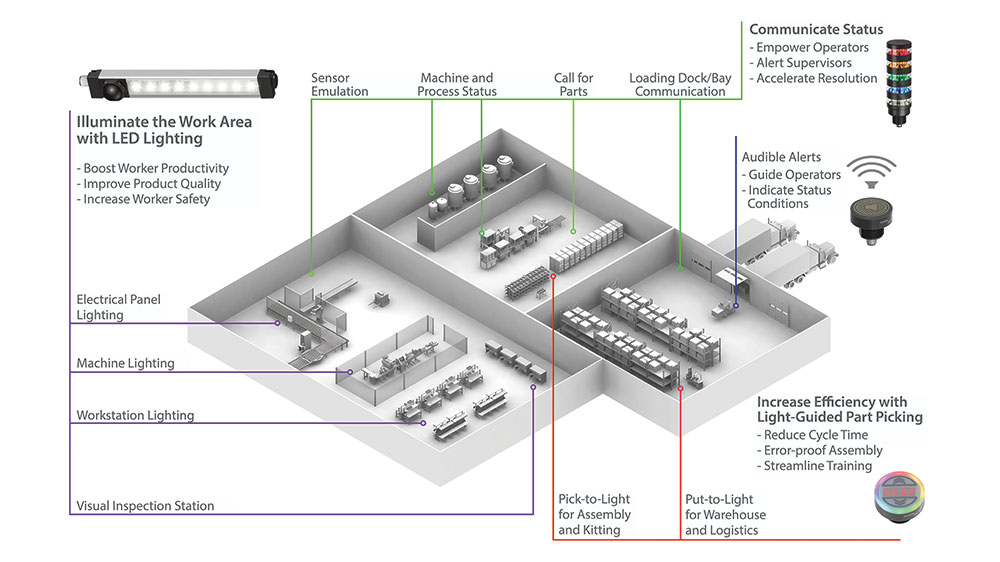
At Banner, the visual factory comprises three key applications for lighting and indication in industrial settings. These applications include the ability to help machines and workstations quickly communicate their status to people nearby, to use light to guide workers to perform certain tasks such as part picking, and to provide illumination for work areas and tasks. The lighting products used in the visual factory include tower lights, strip lights, touch buttons, and indicators. The capabilities of products in the visual factory range from simple single-colour lights and indicators to lights that offer advanced multicolour animations, and multi-tone audible alarms.
What are the benefits of the visual factory?
Communicate status: When machines and workstations are equipped with tower lights, Andon lights, and/or multicolour strip lights, they can quickly communicate their operating condition to people working nearby, providing at-a-glance knowledge of status and performance, and accelerating the identification of problems so they may be solved quickly.
Here are some application examples:
• Andon lights attached to workstations allow operators to notify managers if everything is okay, if they need raw materials, or if they cannot do their job, simply by pressing a button that selects a specific light. This keeps workers from spending unnecessary time walking around looking for help, and lets help come to them instead.
• Tower lights installed on lathes and milling equipment can tell people exactly which step of the process the equipment is in, which enables one person to operate more than one machine, and see where each one is in the process.
• Strip lights connected to analogue sensors conveniently display information about fill level, part size, piece positioning and guidance so operators can quickly identify problems and make adjustments.
Light guidance: By using pick-to-light buttons, guide spotlights and verification arrays, workers are easily shown where pallets need to be dropped, parts need to be picked, and boxes need to be placed, helping to reduce cycle times, error-proof processes, and to streamline training.
These are some applications:
• Applying pick-to-light buttons helps error-proof the assembly process by directing workers to specific bins to get parts so that all the correct parts are picked and used in the right order. These lights also help identify when the wrong part was picked, immediately notifying the worker via the light. Additionally, pick-to-light helps reduce training time by guiding people through the process automatically.
• A similar, but larger-scale, application for pick-to-light is when high-power guide spotlights are used to illuminate areas where pallets need to be both picked up and placed, without obstructing the work area.
• Tower light and strip light segments can be activated based on process step completion or time elapsed during an assembly step. This shows workers where they are in the process and provides Takt Time guidance to keep the line running smoothly.
Work area and task illumination: Providing adequate light for people in work areas, or supplemental light for performing specific tasks, helps boost worker productivity and improve product quality. Additionally, energy-efficient lights help reduce energy costs.
Application examples include:
• Inspection lights help provide workbenches, assembly stations and visual inspection stations and tunnels with bright, even light, increasing worker productivity and ergonomics, and providing illumination exactly where it is needed, allowing operators to monitor processes effectively while completing automated and manual tasks.
• Strip lights installed in control panels give maintenance technicians better visibility compared to typical alternatives such as handheld lights. Better control panel lighting helps technicians when installing or replacing components, troubleshooting wiring errors, and reprogramming PLCs.
• Incorporating coloured LEDs into standard illumination products gives a two-for-one combination of illumination and status indication, allowing operators and supervisors to focus on the work area, but still get status change updates.
Product innovation for the visual factory
Banner leads the advancement of the visual factory with its broad and ever-expanding portfolio of industrial LED task lights, tower lights, indicators and touch buttons, all engineered to provide bright, superior-quality illumination, clear status indication, and unmistakable operator guidance. These products offer the advantages of low power, long life, and maintenance-free operation inherent in LED technology built into rugged, industrial-grade packages.
Banner’s programmable lights can communicate more about the status of machines because they allow you to easily configure colour, flashing, dimming, and advanced animations such as rotation, strobing, two-colour display, two-colour rotation, two-colour flashing, and chase.
Controlling these colours and animations can be achieved in several ways. First, colours and animations may be configured using Banner’s free Pro Editor software, and then controlled through simple discrete I/O. Models with IO-Link require no special configuration, and are simply controlled by commands from the IO-Link master. For pick-to-light, put-to-light, or other operator guidance applications, PICK-IQ (based on Modbus) provides a method to create simple connections between devices to reduce wiring and installation time, along with simplifying the programming and setup of the system.
Programmable lights offer the additional benefit of helping companies reduce inventory SKUs by consolidating several lights into one programmable unit. For example, consider a machine builder who stocks a variety of three-segment tower lights, each with a different combination of colours and flash patterns. With Banner’s programmable tower lights, the machine builder could standardise on one tower light model, and simply load the lighting configuration needed for the application during the machine build. This inventory consolidation benefit also carries through to Banner’s touch buttons and programmable strip lights.
The visual factory in action
Improving productivity and quality in manual assembly processes: The Banner PTL110 pick-to-light solution was recently used at a hydraulic pump manufacturer that was trying to error-proof and reduce cycle times in an assembly process. The customer had a kitting cell for building hydraulic pumps. Each of the pumps are made to order; the bill of materials could include any combination of valves, fittings, orifices or seals. The manufacturer had been documenting rework problems due to the wrong components being used in the pump assembly. Knowing there had to be a way to improve their process, the manufacturer decided it was time to implement a picking system with advanced functionality to meet its needs.
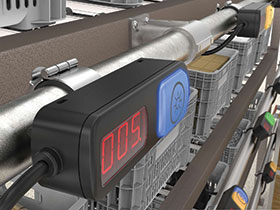
The first implementation of this system included 50 PTL110 pick-to-light buttons to help assemblers pick the right parts when building the pumps. Installing the system was simplified because the PTL110 can be connected in a series instead of using point-to-point wiring. Further assisting the installation was the PTL110’s serial communication protocol, eliminating the need for I/O to control the lights, and therefore reducing system complexity. Assemblers benefited from the bright, multicolour LED indicators guiding them to pick the right component every time; the PTL110’s multi-segment display provided easy-to-read pick quantities when more than one part could move quickly through the picking process, by either pressing the standard touch button to acknowledge the pick, or by using the optional optical sensor to detect that their hand was in the bin. The hydraulic pump manufacturer realised an immediate return on investment, with the initial system saving them hours, and reducing defects, helping them achieve their original goals.
Enabling robotic palletisers to notify operators of machine conditions: A manufacturer of industrial palletising systems was looking for ways to communicate machine status more easily to people working near their equipment ,so they would not have to rely only on the HMI display, which was only visible if you were directly in front of it. Because several palletising machines are usually tended by one person, unnecessary time was spent walking over and checking each machine to understand when pallets needed to be removed or faults needed to be cleared.
The customer chose to use several Banner lighting products to help give the machines a voice. WLS27 Pro strip lights were used, configured in level-mode, and mounted vertically on both sides of the operator station. This allowed operators to easily see from afar how full pallets were. As the machine was placing boxes on pallets, the lights were programmed to show a blue light that would gradually increase with the pallet height. K90 Pro indicator lights were configured in 50/50 rotate mode to reflect machine health conditions, and were mounted on top of the operator station. These lights helped notify operators if the machine needed attention, such as resetting a fault, and could be seen from a long distance away. Additionally, the customer chose to use Banner’s programmable K50 touch buttons, that were programmed to show a variety of machine states using more intuitive animations and colours, such as a rotating green/white animation to show that the machine was running. Adding these features not only helped operators, but also helped to differentiate the company’s palletising equipment in the market.
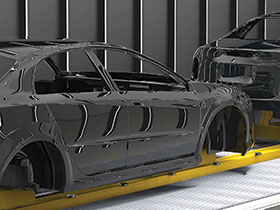
Paint tunnel inspection in motor vehicle manufacturing: In a recent automotive application, a manufacturer required new inspection lighting that would achieve specific light levels, while reducing eye strain and glare for the operators inspecting vehicles. The lights they had previously used had inconsistent light characteristics, and were difficult to install and maintain. Scratches and marks on the paint surface were missed during final inspection, which caused scrap and rework.
The customer installed a configuration of four-foot and eight-foot WLB72 inspection lights cascaded along the side and ceiling of the inspection tunnel. The lights came fully assembled and in one piece, including bracket and plug-in connections. They opted to use the LCS10 controller to make installation an even easier process. With its high output and black opaque eye shields built into the window, the WLB72 created light and dark sections in a zebra pattern on the car’s surface to aid in the surface inspection. Workers were able to see the surface defects in the paint, without issue. The enlarged black eye shields on the WLB72 protruded past the light source, and further shielded workers from direct visibility of the light when looking down the length of the tunnel, without sacrificing light output.
With the WLB72 inspection light providing high-quality illumination and simple controls, workers were able to focus on their required specifications easily when determining whether a vehicle needed additional work. This ensured the highest quality paint finish. The WLB72 inspection light became the preferred solution for installers because of its plug-and-play design, and the first choice for workers in the paint tunnel because of its ability to highlight defects reliably and lessen eye strain.
We want to help you step into the visual factory
Stepping into the visual factory with Banner’s innovative lighting and indication products helps move your equipment and overall operation towards greater productivity. By giving machines and workstations a voice through advanced lighting technologies, we empower operators with immediate understanding of machine status, enable precise guidance for tasks, and illuminate work areas with superior quality. Banner’s commitment to product innovation and practical application solutions like programmable lights and the versatile use of LEDs streamlines operations, reduces training times and optimises performance. We look forward to talking to you about how we can help take your first step into the visual factory.
For more information contact Turck Banner,
| Tel: | +27 11 453 2468 |
| Email: | [email protected] |
| www: | www.turckbanner.co.za |
| Articles: | More information and articles about Turck Banner Southern Africa |






© Technews Publishing (Pty) Ltd | All Rights Reserved
 printer friendly version