



Anyone who wants to efficiently monitor the climate in control cabinets will find a comprehensive range of control cabinet monitors for the DIN rail in Turck Banner’s cabinet condition monitoring (CCM) family. The devices automatically detect temperature, humidity, and door closure with integrated sensors and are available in several performance classes. These range from the easy to retrofit IM12-CCM to the IIoT-capable Linux solution for OEMs, which can be seamlessly integrated into users’ automation networks via Ethernet.
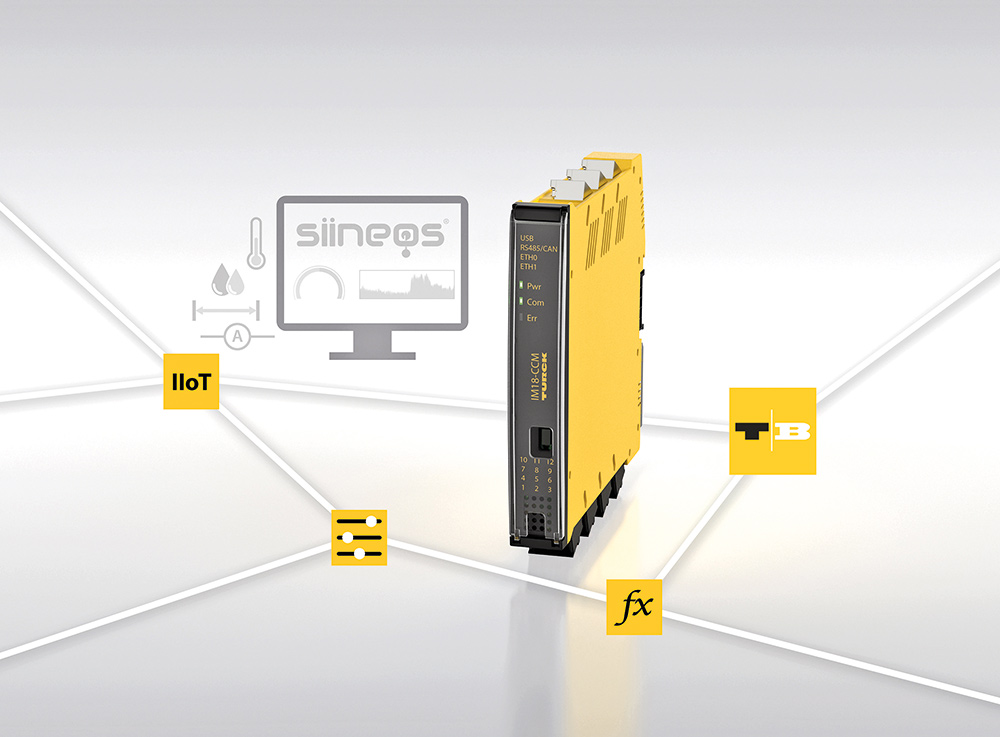
Turck Banner’s IM18-CCM60 is a new member of the family with an app-based operating philosophy that is just as capable as a standalone system, as it is in the cloud. The IM18-CCM60 is available with the siineos operating system, and combines hardware and software into an efficient plug-and-play solution for smart control cabinet monitoring. It is easy to use, intuitive to operate, and expandable at any time.
Temperature monitoring of control cabinets has always been a concern for designers and plant engineers. Temperature, air humidity and the security of control cabinets are variables that play an important role in virtually any plant concept. Raised or irregular temperature conditions in control cabinets can cause power loss, or even the failure of individual devices. Several risks also arise if the components of a control cabinet are arranged so that hotspots build up, or hardly any cool air can flow. Precision measuring devices may in some cases lose their accuracy, the lifespan of components may be reduced, and in the worst case, may fail permanently. Complex systems such as controllers are particularly susceptible to heat. Most PLCs have a maximum operating temperature of 55°C. This is just 15°C above the comfort temperature of many control cabinets. Besides temperature and humidity, reliable and traceable protection against unauthorised access plays an important role in many applications, especially in critical infrastructure such as energy and water supplies.
Control cabinet monitoring detects anomalies early
Even with an optimum topology, or ventilation with air conditioning systems, it makes sense to electronically monitor the climatic conditions in the control cabinet permanently. This allows anomalies to be detected at an early stage and failures to be avoided – especially when devices are located in more remotely installed control boxes. This applies, for example, to outdoor areas where the weather is an external factor.
Turck Banner has offered its CCM series as an easy-to-retrofit condition monitoring system for many years. Cabinet condition monitoring describes the central task of the compact DIN rail devices, which have three internal sensors for monitoring temperature, humidity, and door distance. Depending on the model, data from additional external sensors can also be processed. Turck Banner’s control cabinet monitors impress with their easy-to-use control functions. They automatically detect any door opening by measuring the distance to the door. These devices make every control cabinet fit for use in critical infrastructures, without any significant outlay. The monitoring of door closure by the DIN rail device is also more reliable and tamper-proof than door contact switches, and far less complex than roller switches.
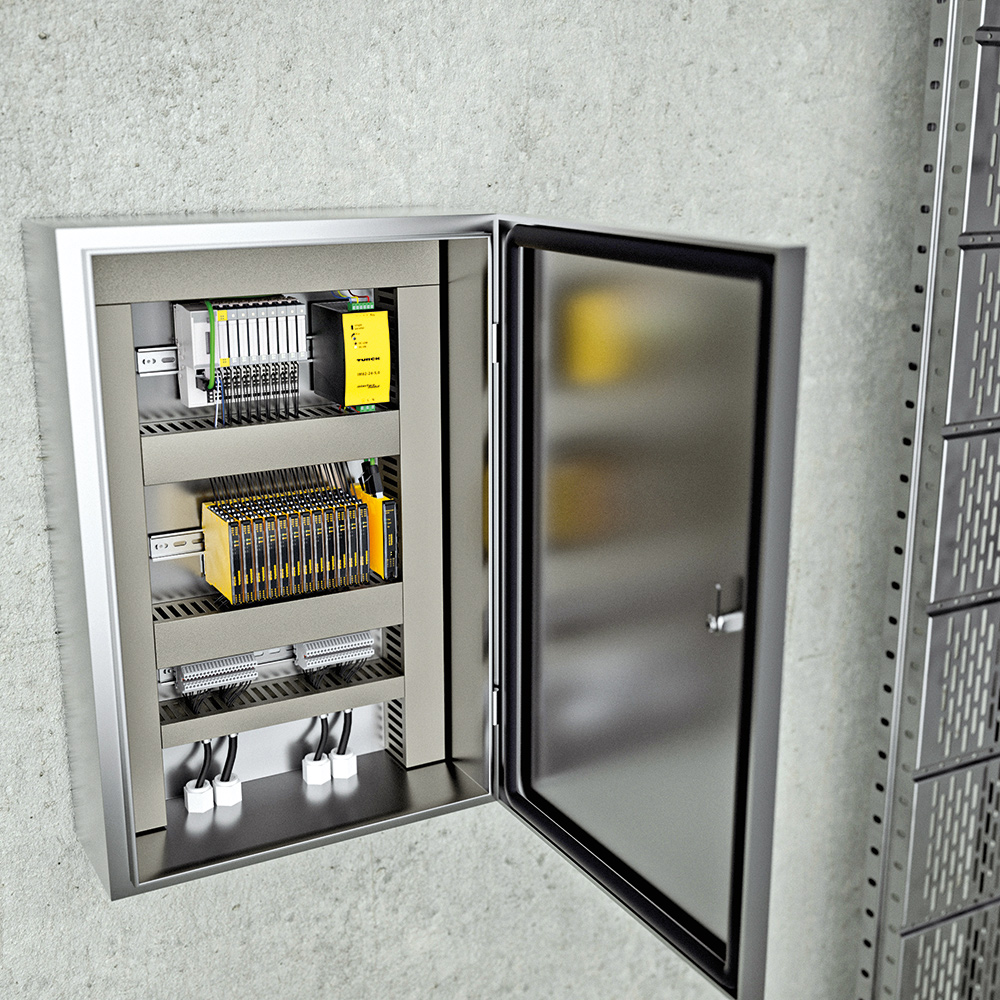
IM(x)12-CCM with switching contact and IO-Link
The first control cabinet monitors in the CCM series are the IM12-CCM and IMX12-CCM models with Ex approval. The compact devices are simply clipped onto the DIN rail and send a signal precisely when defined values are exceeded or undershot. Examples are when a device is overheated, dew forms in the control cabinet, or the door has been opened. The IM12-CCM features an internal data logger with a time stamp, and stores data for up to two years. This also enables users to detect creeping changes over long periods, and rectify the cause. Two cabinet guards can be operated in master-slave mode via an interface in order to simultaneously monitor correct door closing and the other limit values at two points in the control cabinet. The master processes the data of the slave and sends a signal to the controller. The standard IM12-CCM comes with two switch contacts and an IO-Link interface. Quick teach mode enables the user to set the limit values easily in the field. Alternatively, parameters can be set via IO-Link or an FDT framework such as PACTware.
IM18-CCM: connecting factory level and the IT world
Following the proven devices of the IM12 series, Turck Banner has built the bridge to the IIoT with the IM18-CCM. The devices can not only display the condition monitoring of control cabinets in the field, but also transmit the data to the IT world. The slim 18 mm device sends the measured values of the sensors to higher level systems via two independent Ethernet interfaces. This can go as far as the cloud, thus giving maintenance personnel access to actual climatic data at any time via mobile terminals. The boundary between the operative level and the IT infrastructure is thus gradually disappearing. As a result, users can analyse factory floor data from their office desk.
However, this not only offers plant builders and users additional possibilities for data output, but also for collecting measured values. The RS485 interface (Modbus RTU or CAN) enables external devices such as vibration sensors to be connected to the IM18-CCM if required, in addition to the three sensors installed. For an ideal temperature image of a control cabinet, several temperature sensors can be distributed to different positions. The data from three temperature sensors is often enough to obtain an accurate overall picture, even in large cabinets.
As a flexible, open, and attractively priced condition monitoring solution, the IM18-CCM40 is the first choice, especially for simple application scenarios. The IM18-CCM50, with additional digital and analogue inputs and larger working memory, covers all requirements beyond these.
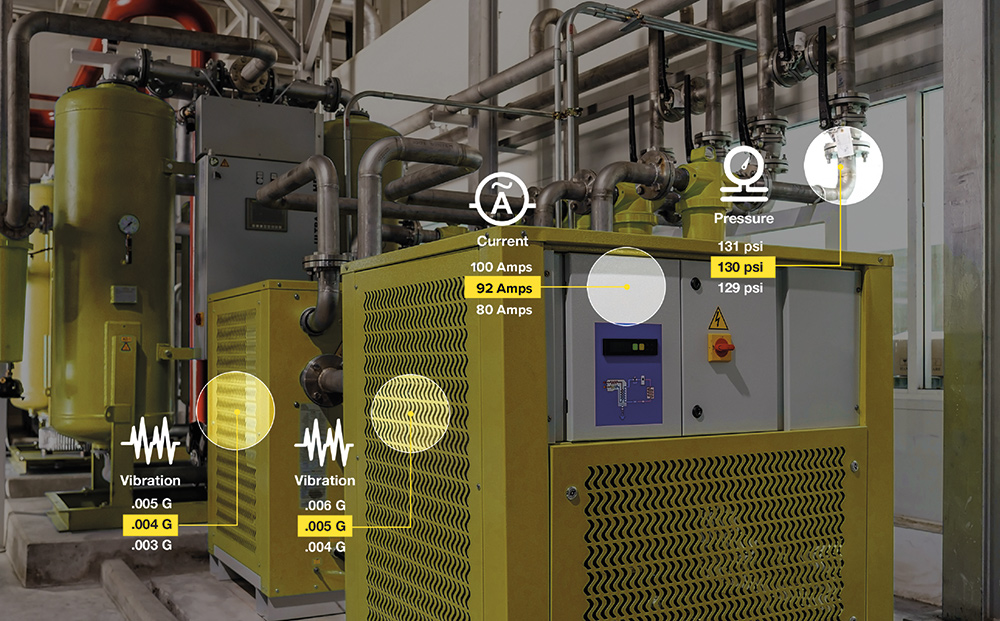
IM18-CCM60: plug-and-play solution for smart condition monitoring
The IM18-CCM60 is another model in its series of control cabinet monitors that now makes the capabilities of the CCM50 platform available to users without any programming knowledge. For this purpose, the new model is equipped with the siineos IIoT operating system. The IM18-CCM60 combines hardware and software into a smart plug-and-play solution that is easy to use anywhere. It is intuitive to operate and can be integrated into higher level systems at any time via MQTT or OPC UA. These range from an autonomous standalone system to an extensive condition monitoring solution with cloud integration.
The IM18-CCM60 enables users to solve condition monitoring tasks very efficiently by performing all configurations and parameterisation intuitively via the browser-based, graphical interface. You can also use a terminal user interface such as PuTTY to program your own applications. The InCore framework integrated in siineos offers a wide range of ready-to-use components for easy operation of the integrated interfaces and sensors, and also all standard network and industrial protocols.
Besides the existing apps, you can also create your own programs and apps, or load them on a smartphone. The web-based wizard accompanies the setup, so that even users without prior knowledge can handle the IM18-CCM60 without any problems. This also allows easy access to the internal sensors for temperature, humidity and door distance. The parameterisation of diverse interfaces and a knowledge of programming is not required.
Besides performance and user-friendliness, IT security is also a focus, and a sophisticated firewall allows full control of traffic into and out of the device. Furthermore, the IM18-CCM60 can also be set up as an OpenVPN client. This guarantees secure remote access to the device, and also to connected machines.
From the PoC to cloud integration
Since the IM18-CCM60 does not require any mandatory cloud or service accounts, users can also perform tests or proof of concepts offline without any effort. The recorded measurement data stays on the device, and the user still has access to all available functions, such as database systems or graphical dashboards (Grafana). The device is then accessed directly via Ethernet or USB. In this way, test installations can identify sources of error and potential savings at an early stage.
Summary
Interface devices are veritable multi-talents in the control cabinet. They combine the tasks of protecting, isolating, converting and supplying in the smallest possible space with fast and precise signal processing where space is at a premium. This is combined with lasting, zero-maintenance operation. The new IM18-CCM60 monitor adds a plug-and-play solution to Turck Banner’s control cabinet monitor family that is as easy to operate as a smartphone.
| Tel: | +27 11 453 2468 |
| Email: | [email protected] |
| www: | www.turckbanner.co.za |
| Articles: | More information and articles about Turck Banner Southern Africa |






© Technews Publishing (Pty) Ltd | All Rights Reserved
 printer friendly version